
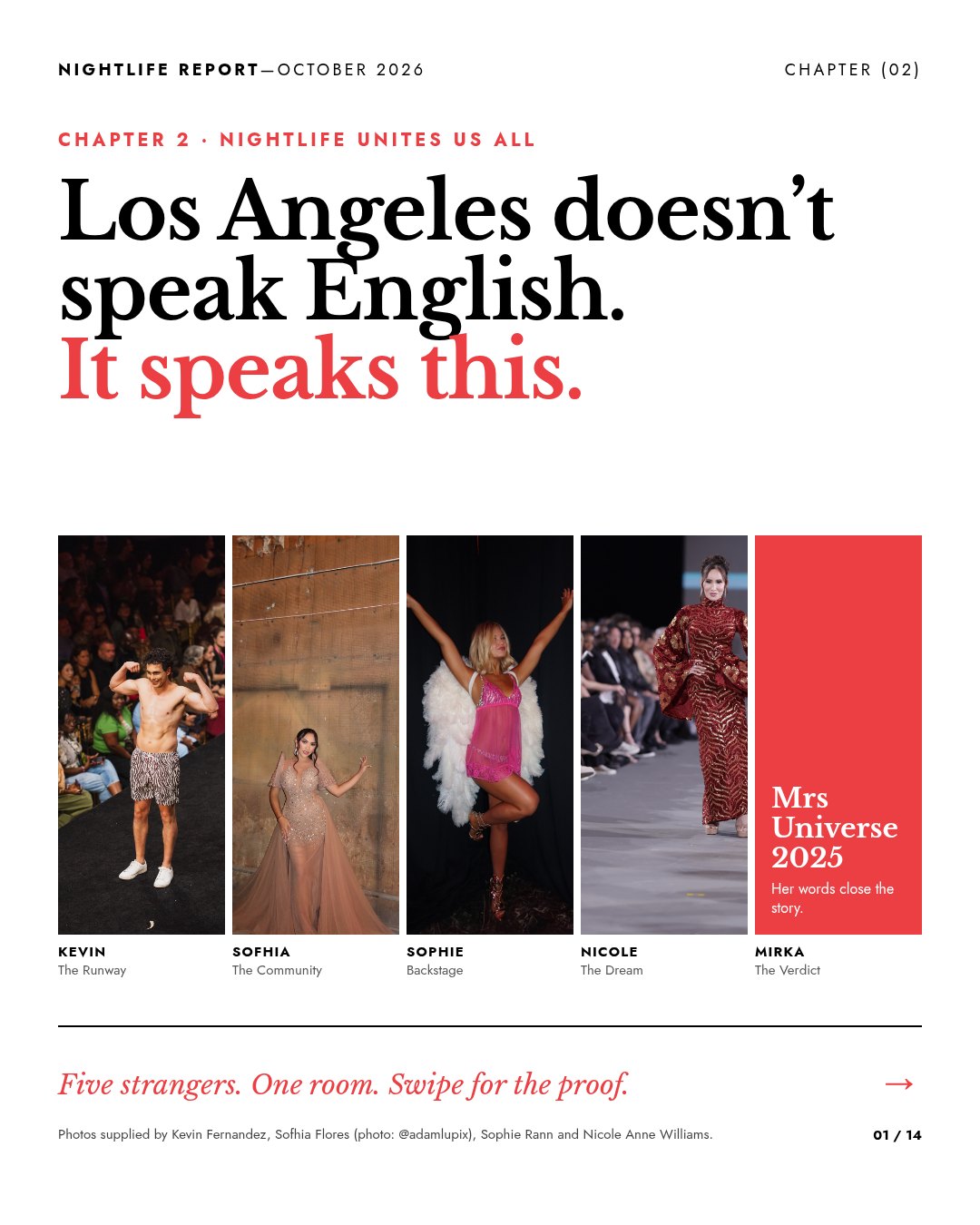
See the carousel on Instagram: Nightlife Unites Us All: L.A.’s Universal Language, Chapter 2
Nightlife Unites Us All · Chapter 2
Los Angeles County speaks in many tongues by day. After dark, it speaks one. The census, the science, and five voices from the runway explain why.
By Anthony Perlas · Nightlife Report. Fri Oct 23, 2026 · 8 min read. Chapter 2 of a story that builds to February 14. Chapter 1 is here.
LOS ANGELES — Stand at the edge of any good room in this city at a quarter to midnight and listen. You will hear Spanish at the bar, Tagalog near the photo wall, Korean in the corner booth, Armenian on the patio and English everywhere in between. Then the DJ drops the record everybody knows, and for three minutes the room stops translating. Hands go up. Strangers sing the same chorus. Nobody needs a subtitle.
That is not a metaphor. It is the most practical thing Los Angeles does, and it may be the most important. Chapter 1 of this series, What You Missed, was about who gets to wear the $50 million bra. Chapter 2 is about everyone else: the people who make a room work, and why science, history and a remarkable census say the room is where this city learns to be one city.
The census
Begin with the numbers, because they are staggering. In Los Angeles County, 55.1% of residents speak a language other than English at home. 49.3% are Hispanic or Latino. 33.4% were born outside the United States. 16.6% are Asian. Those figures come from the U.S. Census Bureau’s QuickFacts, drawn from the American Community Survey for 2020 to 2024.
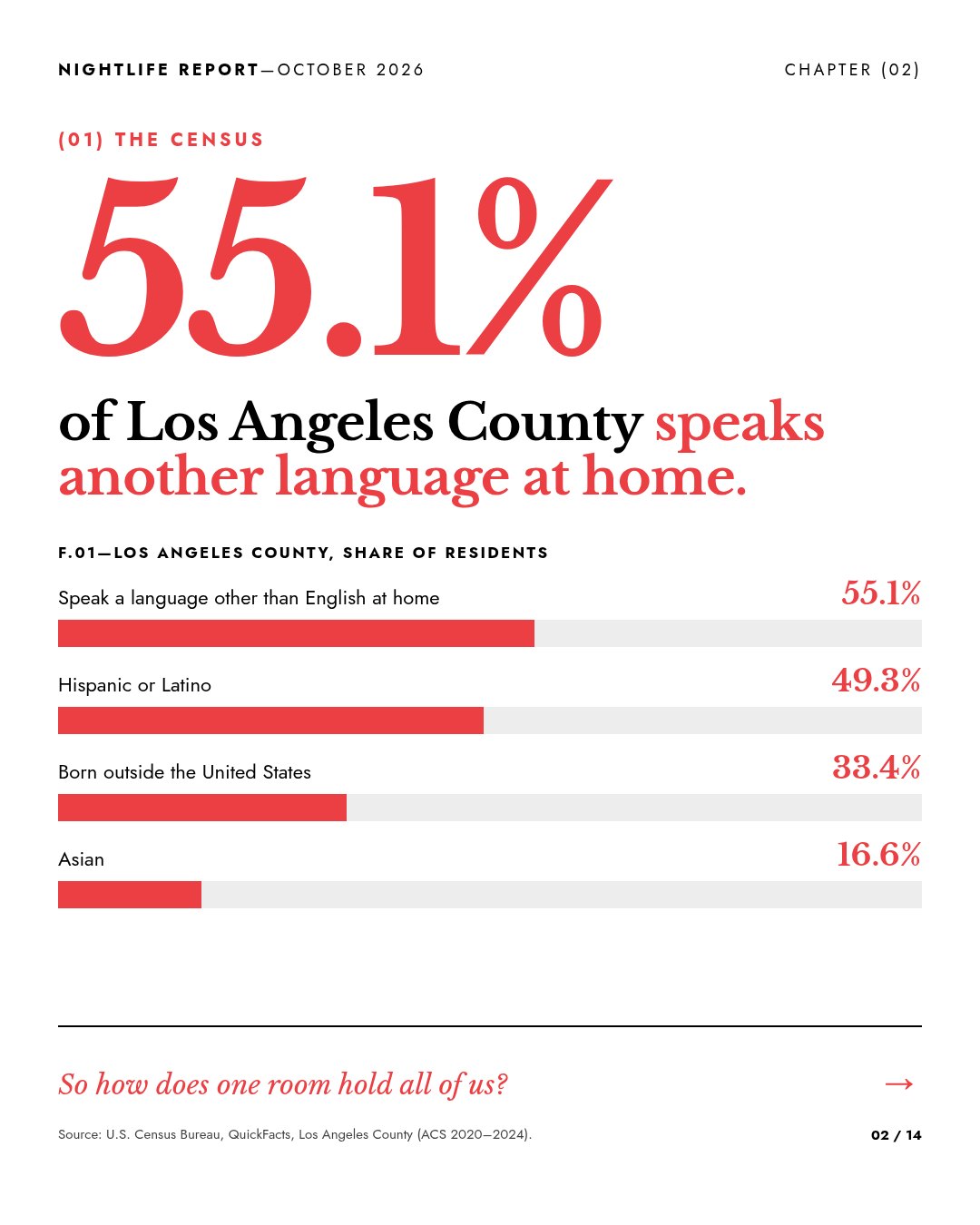
So here is the question this chapter asks: how does one room hold all of us? A majority of the county goes home to a language other than English. The workday splits people by neighbourhood, commute, industry and accent. The night is when the county’s many cities finally share a floor.
Voice one: the runway
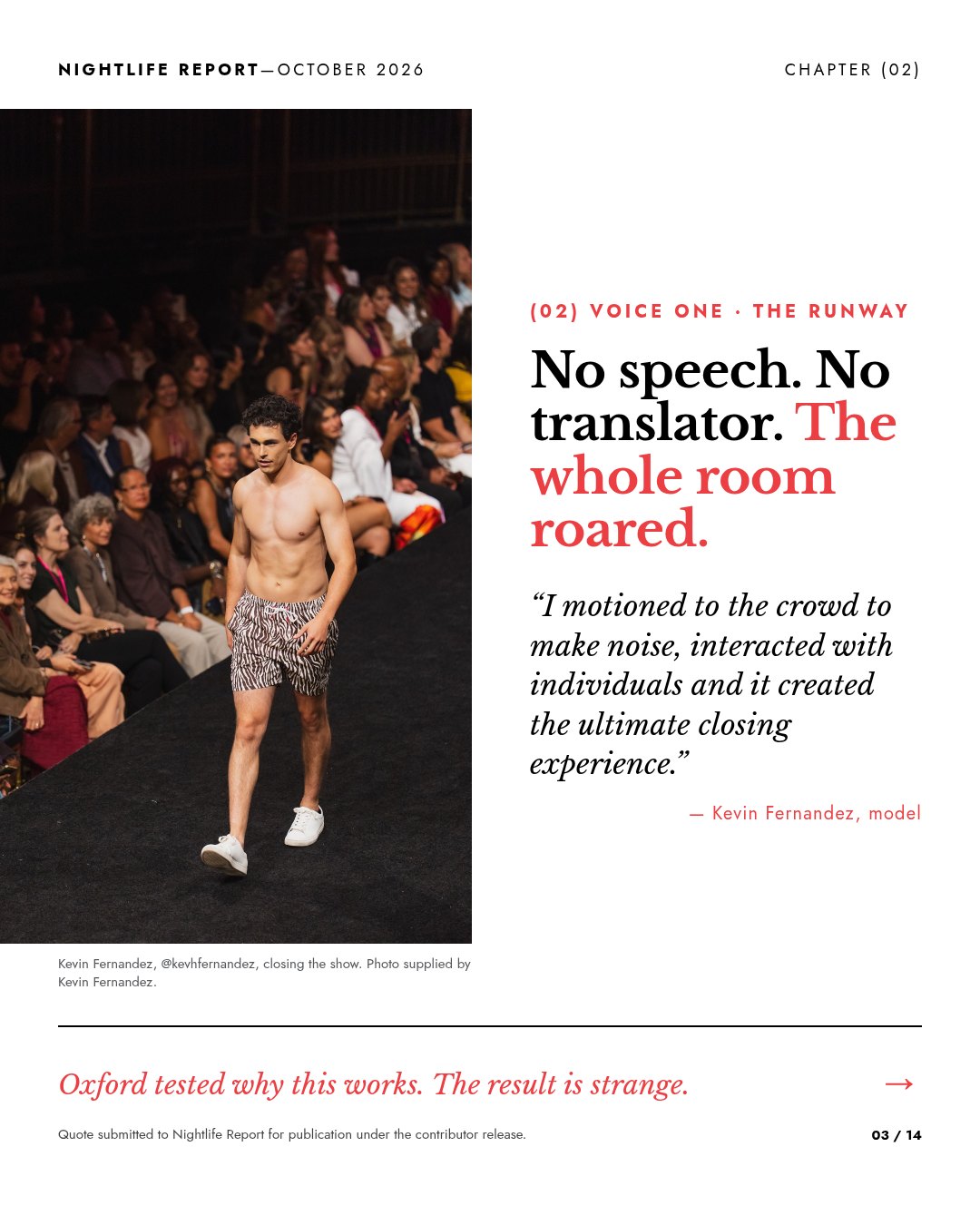
No speech. No translator. The whole room roared. Kevin Fernandez (@kevhfernandez), a reality TV personality and runway model, closed a show at The Bureau Fashion Week in Los Angeles this month, and he described the moment in a Nightlife Report questionnaire.
I motioned to the crowd to make noise, interacted with individuals and it created the ultimate closing experience.
— Kevin Fernandez, in a Nightlife Report questionnaire
Notice what he did not say. He did not say he gave a speech or explained the collection. He used a gesture, the oldest language there is, and the room answered in the same tongue. Off the runway, he wrote, the moment that mattered was “sharing this moment with my wonderful parents, I couldn’t do this without them.”
The science of the dance floor
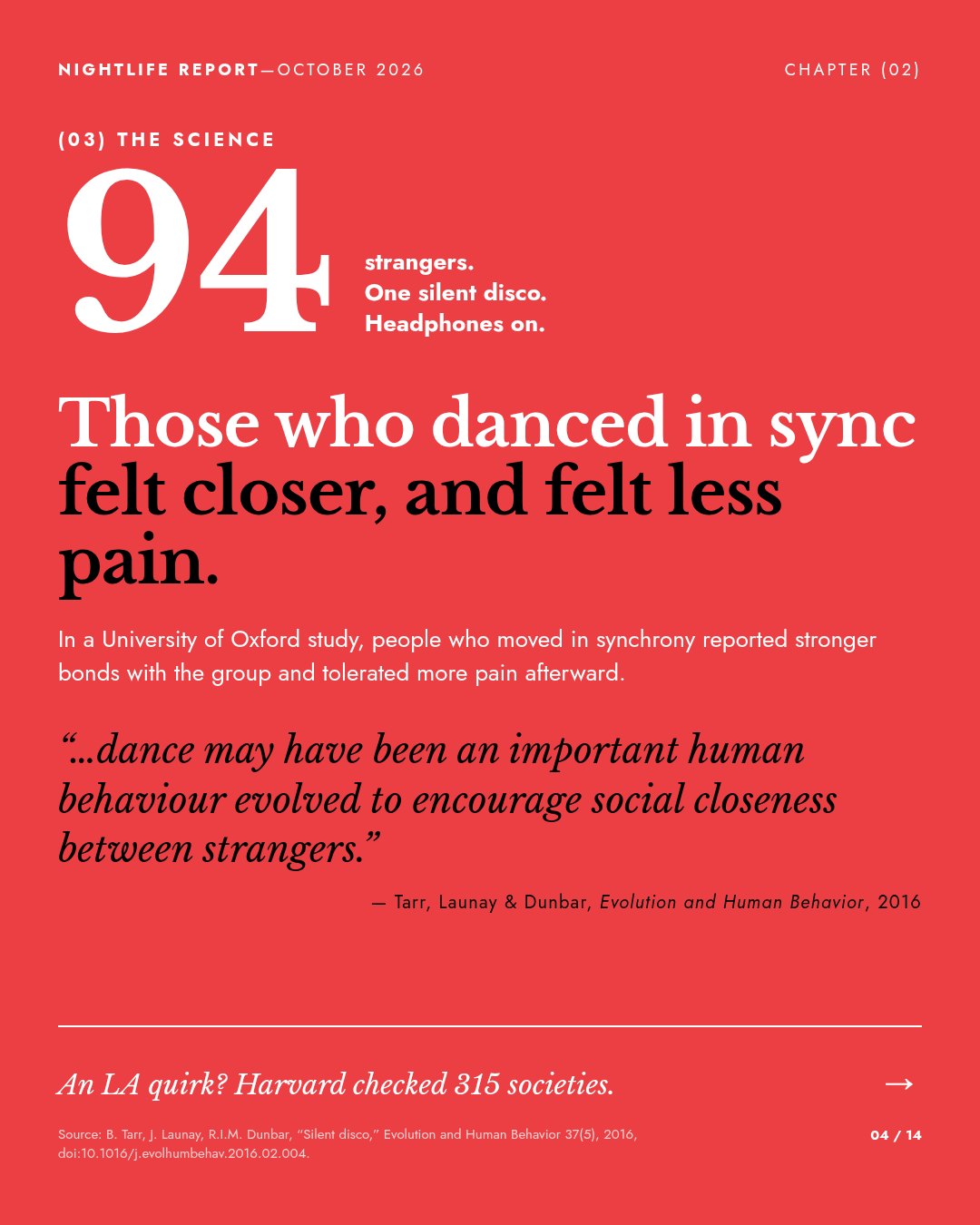
What Fernandez felt in the room, researchers have measured in the lab. At the University of Oxford, Bronwyn Tarr, Jacques Launay and Robin Dunbar put 94 people in a silent disco, each wearing headphones. The ones who danced in sync reported feeling closer to the group, and they tolerated more pain afterward, a marker the researchers link to the brain’s endorphin system. The authors concluded that “dance may have been an important human behaviour evolved to encourage social closeness between strangers,” in a 2016 paper in Evolution and Human Behavior.
Read the last two words again: between strangers. The authors are not describing families or old friends. They are describing exactly what happens on a Saturday night on Santa Monica Boulevard.
The proof: every society
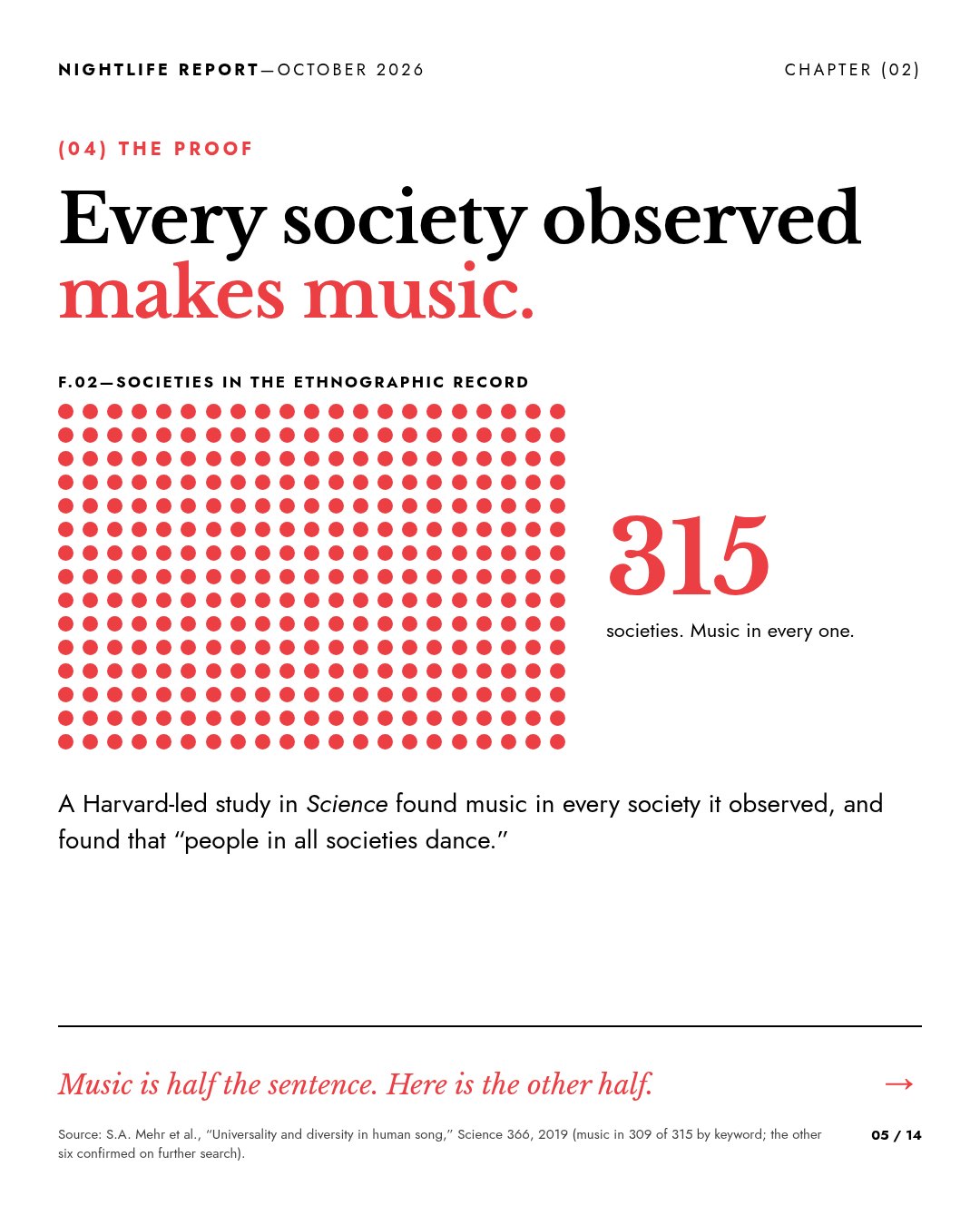
If one study is a data point, the next is a law of human behaviour. A Harvard-led team writing in Science examined the ethnographic record of 315 societies and found music in every one. Searching the same archive by keyword, they found music mentioned in 309 of them. And they found something else that the club kids of Los Angeles could have told them for free: “people in all societies dance,” according to Mehr and colleagues, 2019.
That is the scientific case for nightlife, and it is stronger than the case for most things a city spends money on. Every culture ever documented has done it. The only question is whether a city makes room for it.
Voice two: the community
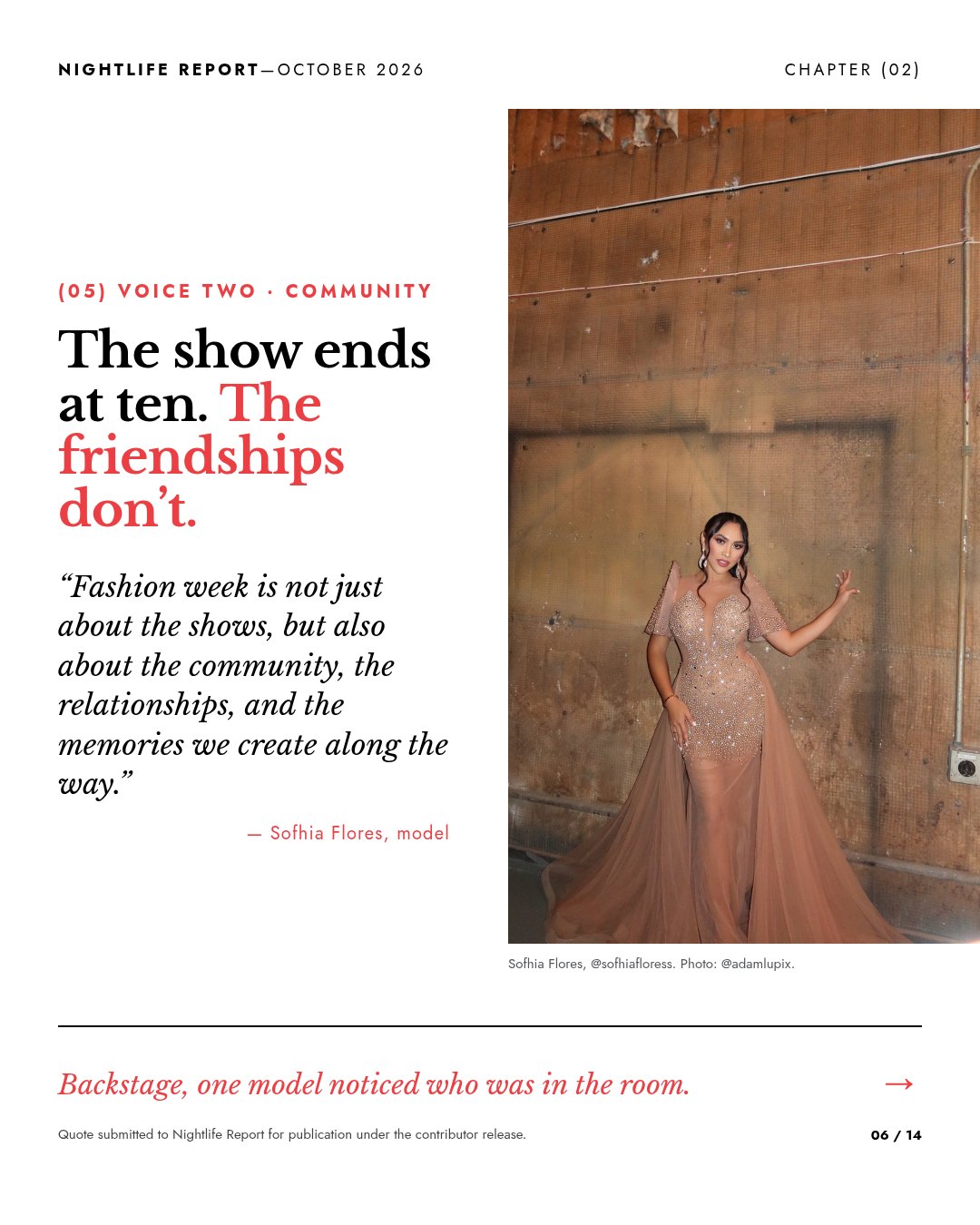
The show ends at ten. The friendships don’t. Sofhia Flores (@sofhiafloress) is a Filipino model and content creator from San Isidro, Nueva Ecija, who has walked in New York, Milan and Paris, and now Los Angeles. Her favourite part of the week was not on the runway.
Fashion week is not just about the shows, but also about the community, the relationships, and the memories we create along the way.
— Sofhia Flores, in a Nightlife Report questionnaire
She described what the week gave her off the runway as “reconnecting with my model friends, meeting new people, and building meaningful connections with other creatives in the industry.” Strip the fashion vocabulary away and that sentence describes every good night out in the history of this city.
Voice three: the dressing room
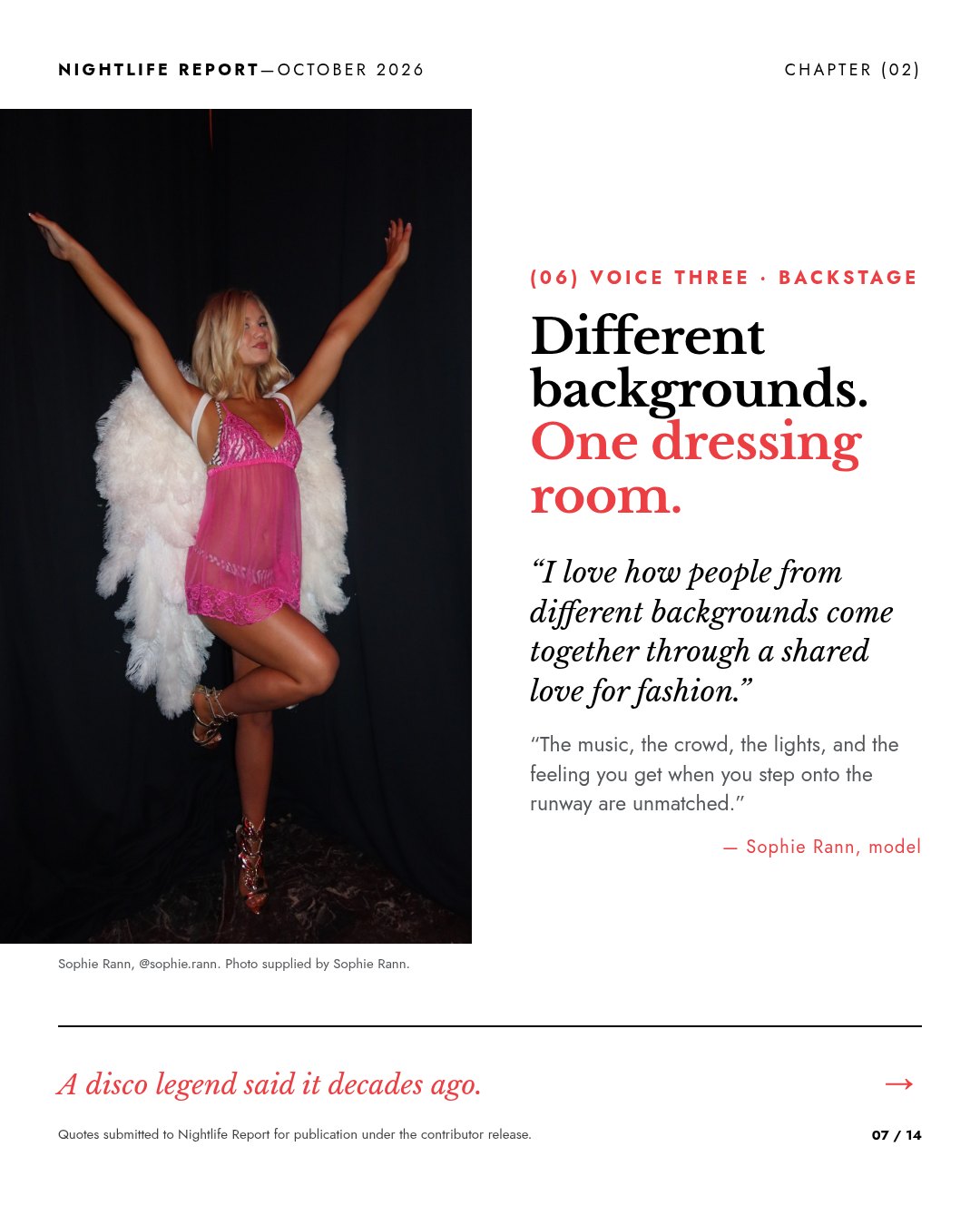
Sophie Rann (@sophie.rann) has walked from New York Fashion Week to Paris Fashion Week. Backstage, she wrote, is where the real exchange happens: “Beyond the runway, one of my favorite parts is the community backstage. I love how people from different backgrounds come together through a shared love for fashion.”
The music, the crowd, the lights, and the feeling you get when you step onto the runway are unmatched.
— Sophie Rann, in a Nightlife Report questionnaire
The music, the crowd and the lights. She lists them in the order a club promoter would. Fashion and nightlife are not neighbouring industries in Los Angeles. They are the same room with a different dress code.
The precedent
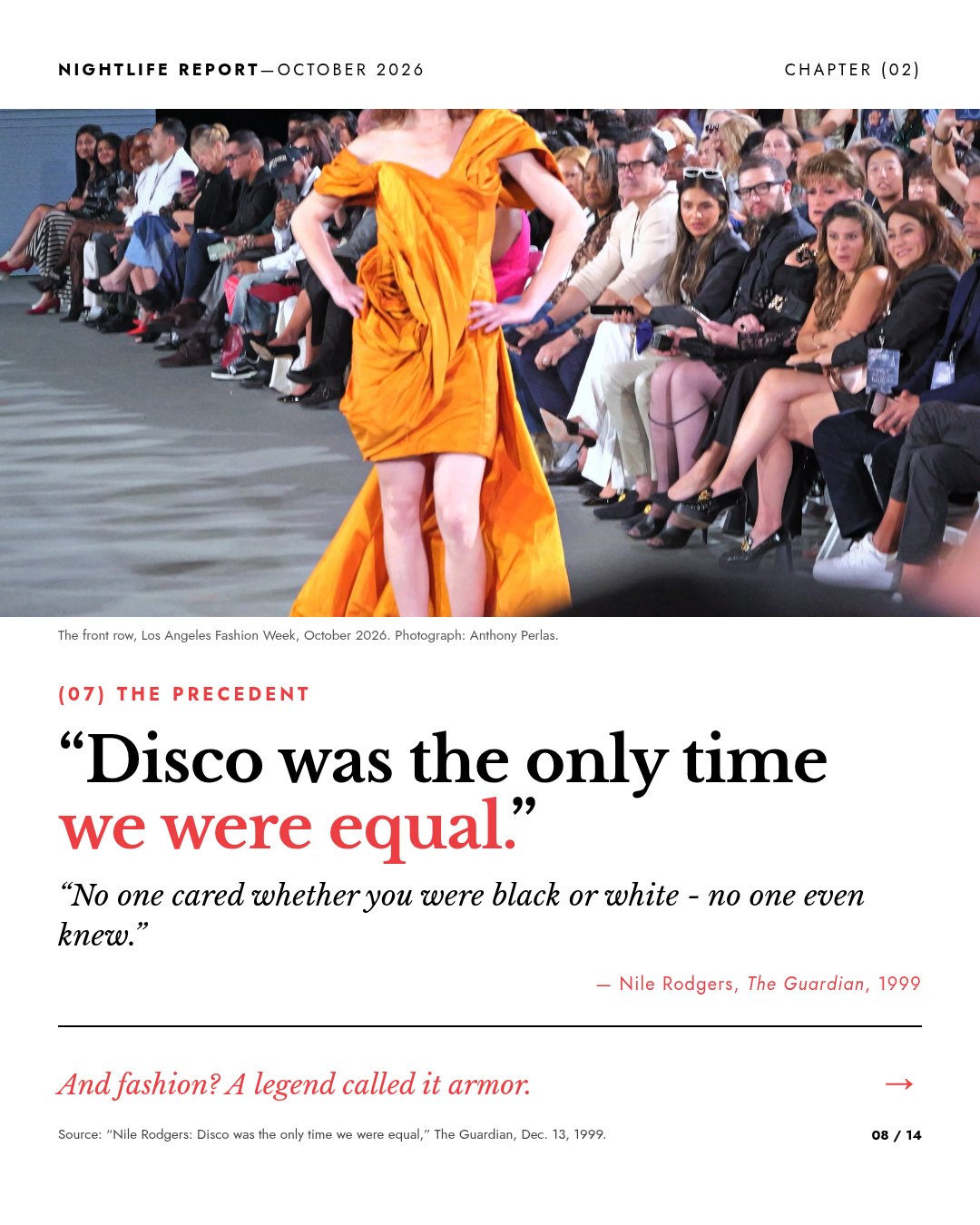
None of this is new. It only feels new every time it happens. In 1999, Nile Rodgers, the Chic co-founder who helped write the sound of the disco era, told The Guardian what the dance floor had meant in the 1970s.
That is the inheritance. Every room in Los Angeles that mixes the county’s 55.1% with everyone else is running Rodgers’ experiment again.
The armor
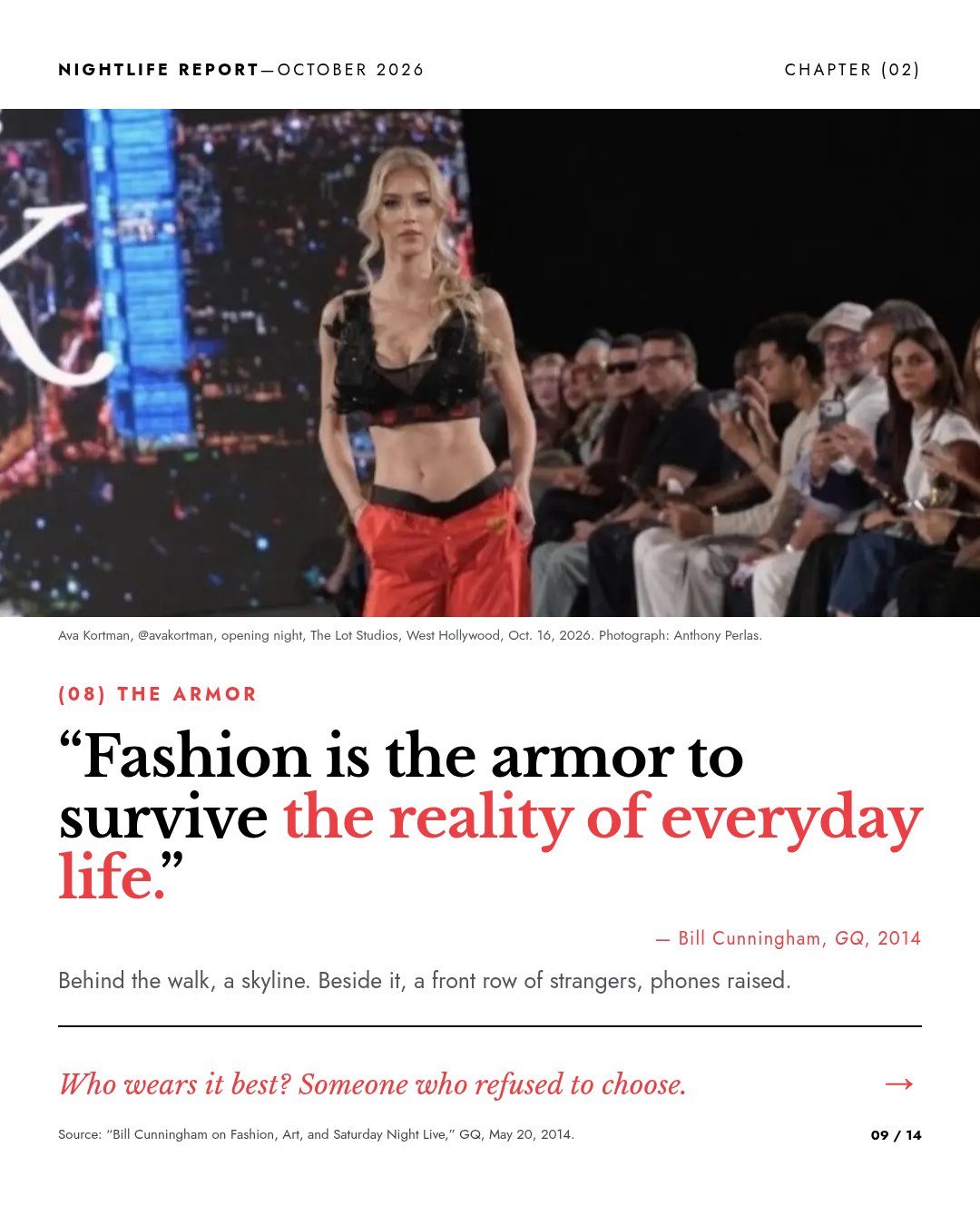
If music is the common language, clothes are the accent. Bill Cunningham, the street-style photographer who spent decades documenting New York for The New York Times, told GQ in 2014: “Fashion is the armor to survive the reality of everyday life.”
Armor is the right word. Nobody in this city dresses up on a Friday night to blend in. They dress to say who they are before they open their mouths, which in a county of a hundred languages is also the fastest way to be understood.
Voice four: the dream
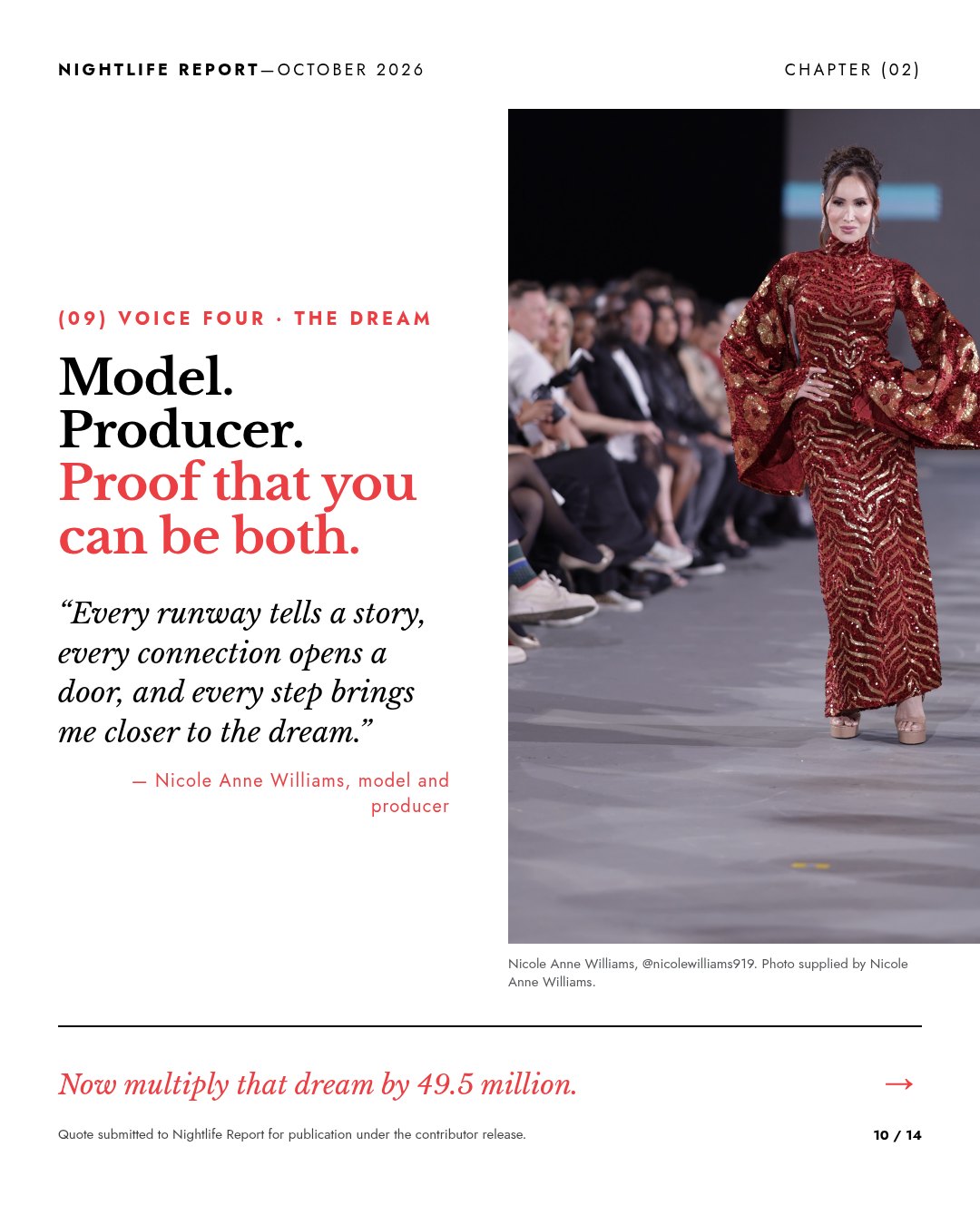
Nicole Anne Williams (@nicolewilliams919) walked The Bureau for the second time this season, and she is not content to stay in front of the lights. Her goal is to go “from walking the runway to producing the show.”
Every runway tells a story, every connection opens a door, and every step brings me closer to the dream.
— Nicole Anne Williams, in a Nightlife Report questionnaire
Every connection opens a door. That is the economic engine of Los Angeles nightlife in seven words. The introductions made in dark rooms become the jobs, collaborations and companies of daylight.
The economy of belonging
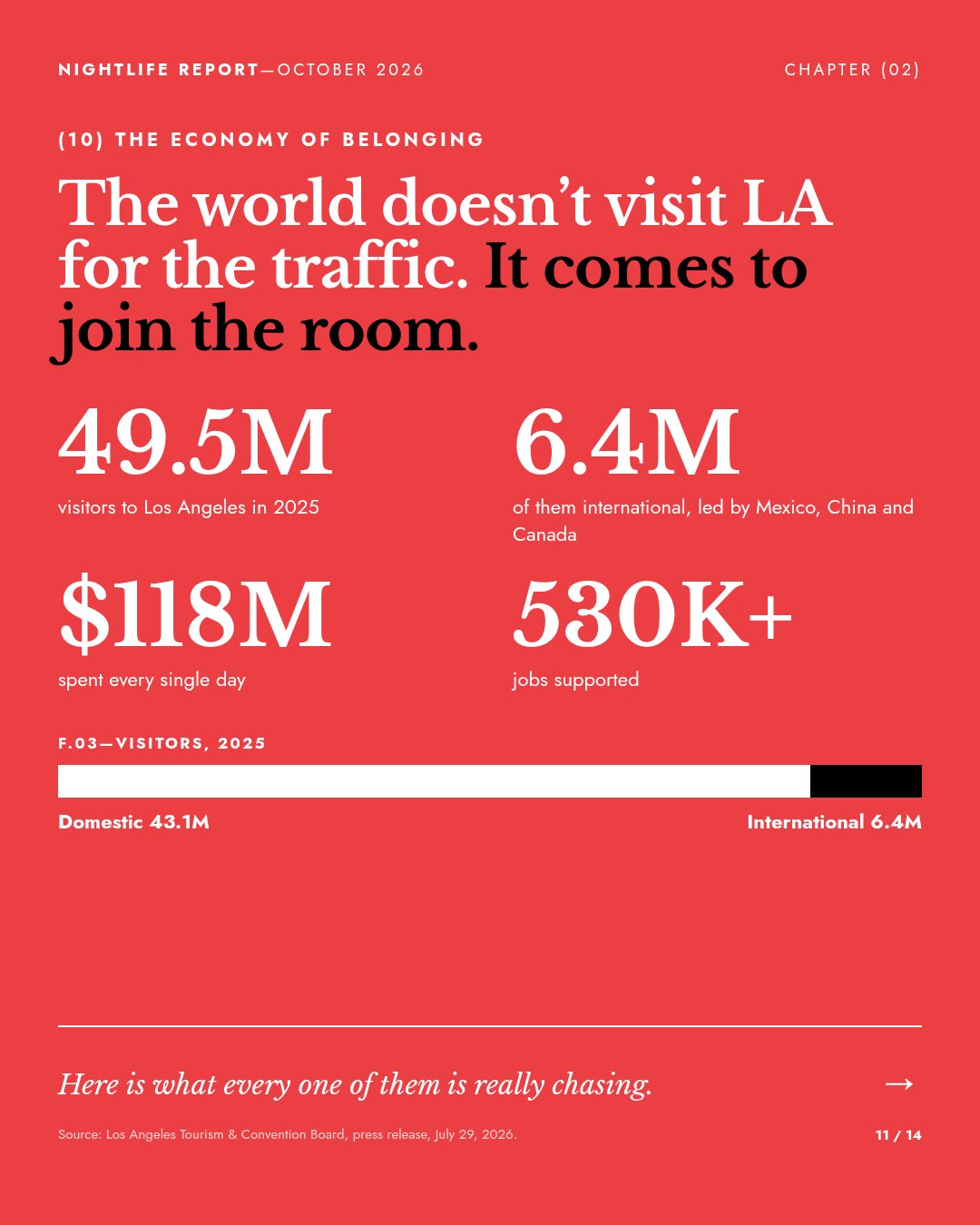
The world has noticed. In 2025, 49.5 million visitors came to Los Angeles: 43.1 million domestic and 6.4 million international, led by Mexico, China and Canada. They generated $42.6 billion in business sales, spent $118 million a day and supported more than 530,000 jobs, according to the Los Angeles Tourism & Convention Board, in figures released July 29, 2026.
Visitors do not fly across an ocean for the traffic. They come to join the room: the restaurant at nine, the show at ten, the dance floor at midnight. That is the product. When a city protects its night, it protects its export.
Voice five: the verdict
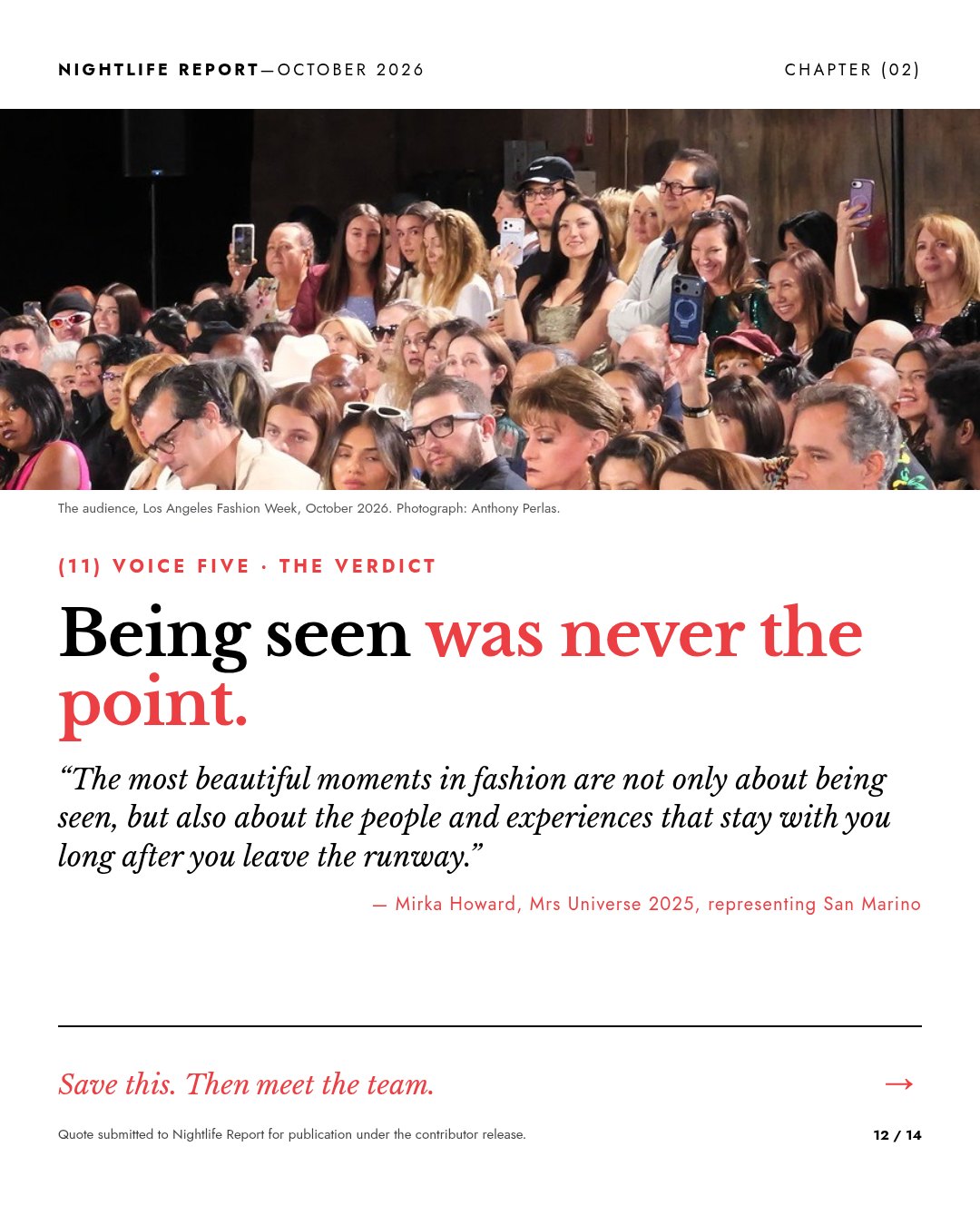
Mirka Howard, Mrs Universe 2025, representing San Marino, wrote that what stayed with her from the week was “the connection with the people behind the fashion — the designers, the creative teams, and everyone working tirelessly to bring their visions to life.” Then she gave this chapter its thesis.
The most beautiful moments in fashion are not only about being seen, but also about the people and experiences that stay with you long after you leave the runway.
— Mirka Howard, in a Nightlife Report questionnaire
The team
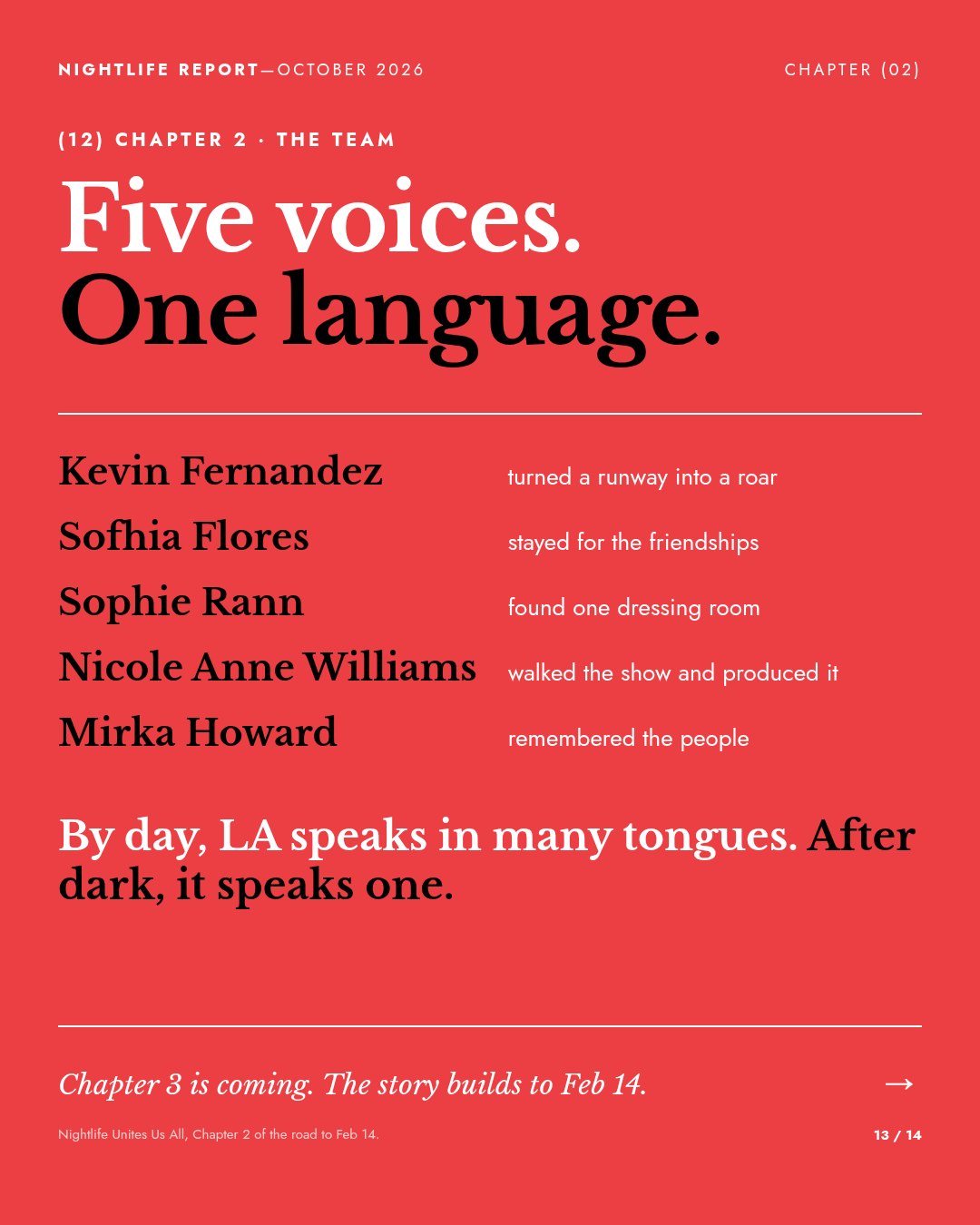
Five voices, and they sound like one team:
- Kevin Fernandez turned a runway into a roar.
- Sofhia Flores stayed for the friendships.
- Sophie Rann found one dressing room.
- Nicole Anne Williams walked the show and plans to produce it.
- Mirka Howard remembered the people.
Designer Eternalbeen (@eternalbeen), speaking in the Nightlife Report Hot Seat, put it plainly: “Talent shouldn’t need a famous name or industry connections to be seen.” And: “The future of fashion deserves new faces, new visions, and new voices.”
Why this matters now
Los Angeles is losing rooms. Long-running bars are closing, a Santa Monica party house is becoming a family club, and the economics of a late night are harder than they were a decade ago. We report on that in Last Call on Halloween. But the census, the science and the five people above all say the same thing. A city this varied cannot afford fewer places where strangers become a crowd and a crowd becomes a community.
By day, Los Angeles speaks in many tongues. After dark, it speaks one. Our job is to keep the room open long enough for everyone to learn the words.
Chapter 3 is already in motion, and the story builds to February 14.
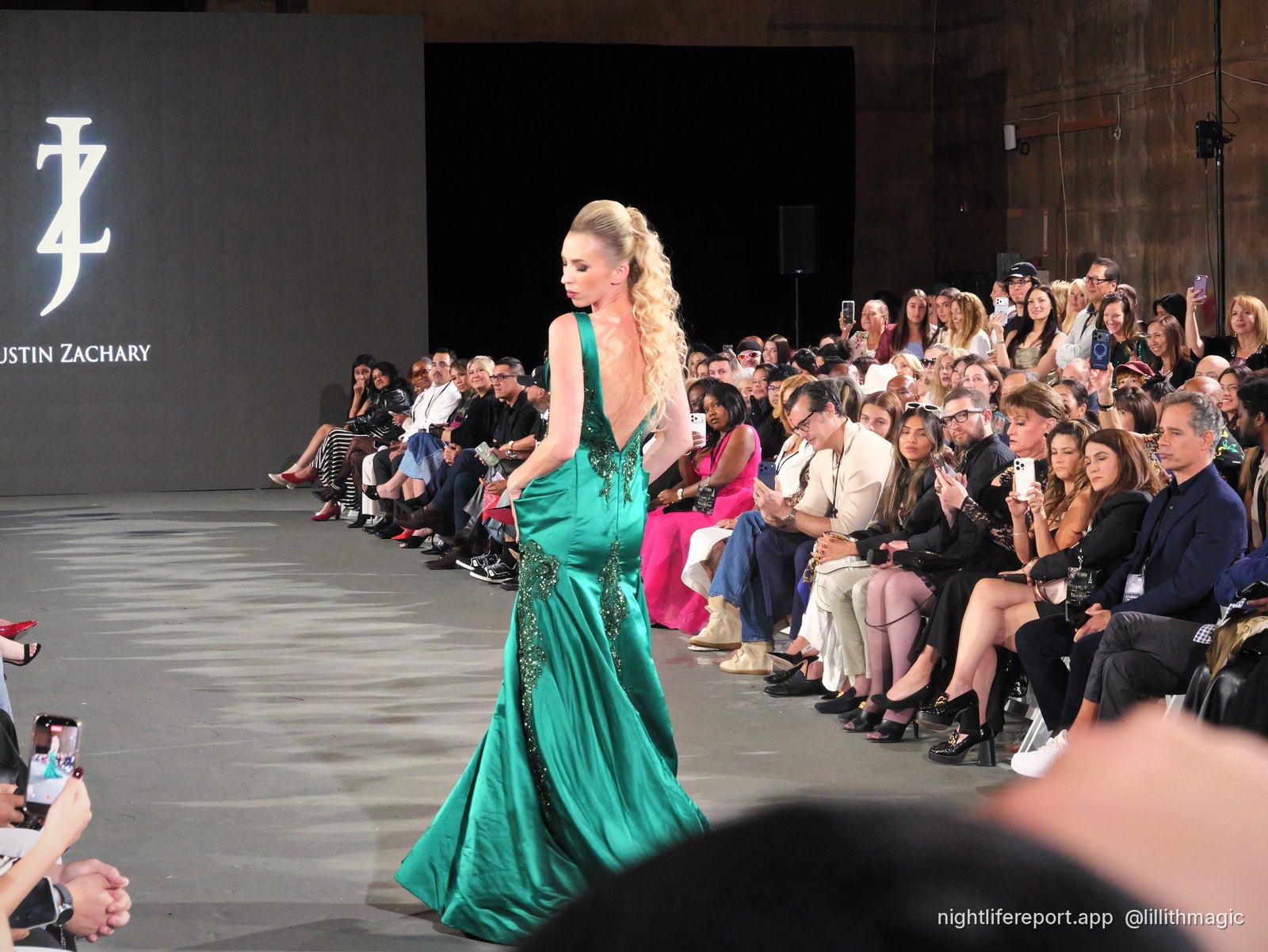
Photos: Kevin Fernandez, Sophie Rann and Nicole Anne Williams, supplied by the subjects; Sofhia Flores by @adamlupix; Ava Kortman (@avakortman), the front row and the audience by Anthony Perlas. Interviewee quotes were submitted to Nightlife Report for publication under signed release. Eternalbeen’s quotes come from the published Hot Seat (Oct. 22).
Sources
- U.S. Census Bureau, QuickFacts: Los Angeles County, California (ACS 2020–2024): census.gov
- Tarr, B., Launay, J. & Dunbar, R.I.M. (2016). “Silent disco: dancing in synchrony leads to elevated pain thresholds and social closeness.” Evolution and Human Behavior 37(5): 343–349: PMC4985033
- Mehr, S.A. et al. (2019). “Universality and diversity in human song.” Science 366(6468): PMC7001657
- The Guardian, “Disco was the only time we were equal,” interview by Imogen O’Rorke, Dec. 13, 1999: theguardian.com
- GQ, “Your Morning Shot: Bill Cunningham,” May 20, 2014: gq.com
- Los Angeles Tourism & Convention Board, July 29, 2026: discoverlosangeles.com
- Nightlife Report Hot Seat: Eternalbeen, Oct. 22, 2026: blog.nightlifereport.app
- Interviewee answers: Nightlife Report questionnaire, submitted Oct. 19–21, 2026, under signed release
Join the inner circle.
Nightlife Report is a nonprofit news desk funded by readers. Back the reporting at patreon.com/aperlas.
Seen something we should know? Tips: editor@nightlifereport.app
Request Coverage: editor@nightlifereport.app
nightlifereport.app | Tips: editor@nightlifereport.app | 1049 Havenhurst Dr, Unit 67, West Hollywood, CA 90046
Leave a Reply