
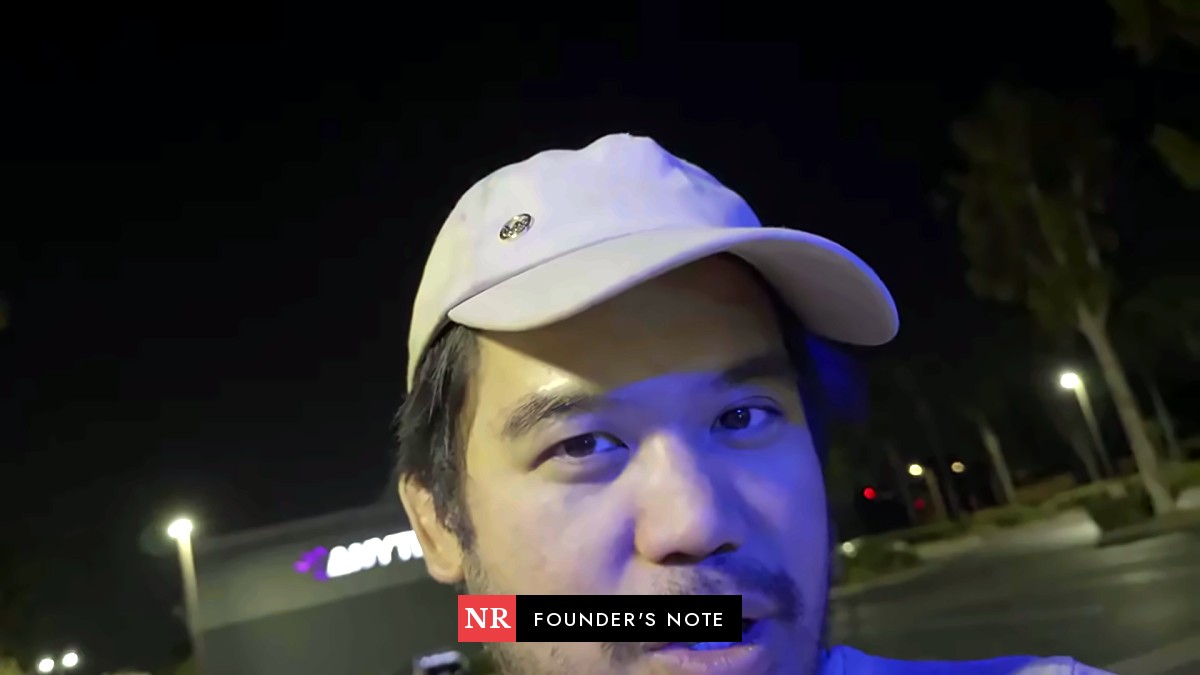
“Life is rare. Consciousness is a single candle, flickering in the wind, and one storm could put us all out. So we will carry that flame to other planets and other suns. And we will bring the one language that never needed words: the night. Where strangers rest, gather and dance as one under the same stars, until every star is home.”
— Anthony Perlas, Founder, Nightlife Report
I’ve been around computers since I was four. I don’t trust a system until I’ve taken it apart. That’s how I work: first principles first, then architecture. Break something down to what is actually true, then build it back up on purpose.
Where it started: 2008
I was a college student with a lot of free time, and I worked the information technology desk. July 23, 2008: my dorm, Clan TDA on Warcraft III, DotA Allstars in the channel.
Campus rules let you join a game. They didn’t let you create one. So I paid for a server, and our bots, TDABot and TDAHelper, held the room so the rest of us could walk in. I had the fast laptop and the second screen, with Appleseed on the monitor and Lost on the TV.
I was writing Battle.net chat bots, first on StealthBot and then on GHost++, a hosting bot written in C++. The use case was simple: a bot that tracked every player’s stats and welcomed each one by name. My goal wasn’t simple. I wanted to build a thinking bot, one that might someday become self-aware.
It didn’t. It was a host. But it taught me the lesson I still build on: a well-made system can hold a room. Spend once. Let other people play.
I won’t claim I was first at anything. I’ll say I started early, and I’ve never stopped asking the same question: how do you build a system that holds people together?
Nightlife Report is that question at a bigger scale
A good night is a system. There’s a door, a sound, a room and a reason to stay, and when it works, strangers become a crowd that moves together. I’ve spent my life watching how that happens, and Nightlife Report is how I write it down. Today the world talks about superintelligence. I care about something older: what makes people choose each other.
How I break down the big ideas (D.A.R.E.)
I run every big idea through four steps: Decompose it, Audit the assumptions (is each one fact, convention or unknown?), Recombine only the parts that are true, and Experiment as cheaply as possible.
1. A voice and a report that last a billion years. – Decompose: a voice, an archive, a way to spread it, and a way to renew itself. – Audit: Fact: radio signals leave Earth at the speed of light, and Voyager 1 left the heliosphere in 2012 carrying a record of Earth’s sounds and music. Convention: media brands die with their founders. Unknown: whether anything we make lasts a billion years. This is a vision, not a forecast. – Recombine: an open archive anyone can copy; a house style that teaches the next editor; readers who become contributors and then editors. – Experiment: can Nightlife Report publish for one full week without me? Pass: it ships on time and in voice. Fail: it stalls.
2. Consciousness spreading like pollen and fungi. – Decompose: the image is about things that spread without a center. – Audit: Fact: pollen travels by wind and insects, and fungi link plant roots underground. Even the science on how much forest fungal networks share is debated (Karst et al., Nature Ecology & Evolution, 2023). Fact: researchers have modeled computing on networks of neurons since 1943 (McCulloch and Pitts). Unknown: whether consciousness can “spread” at all. I use this as metaphor, not science. – Recombine: a report that spreads like pollen, city to city, through people instead of headquarters. – Experiment: one story, shared by contributors in three cities. Do new readers arrive from all three?
3. Research into human consciousness. – Audit: Fact: science has no settled account of how consciousness arises. Convention: we treat it as solved in everyday talk. Unknown: almost everything that matters. – Recombine: report the questions honestly, with real citations, and never claim answers we don’t have.
4. The left brain, the right brain, and the bicameral mind. – Audit: Julian Jaynes argued in The Origin of Consciousness in the Breakdown of the Bicameral Mind (1976) that people in Homer’s era heard one side of the brain as the voice of the gods, and that modern self-awareness emerged only about 3,000 years ago. It’s a famous and contested theory, not mainstream science. Fact: Roger Sperry won the 1981 Nobel Prize for split-brain research (Gazzaniga, Bogen and Sperry, PNAS, 1962). Michael Gazzaniga later described a left-hemisphere “interpreter” that builds a story out of what we do. Fact: newer work questions how divided split-brain consciousness really is (Pinto et al., Brain, 2017). Fact: the pop idea of “left-brained” and “right-brained” people doesn’t hold up in brain scans (Nielsen et al., PLOS ONE, 2013). The two hemispheres have been physically connected for as long as there have been mammals like us. Jaynes’s claim is about how the mind used them, not about anatomy. – Recombine: the useful idea is integration. The best minds, and the best nights, get both halves talking. – Experiment: put an engineer and a designer on one story. Is it better than either alone?
Why it matters
Greece and Rome fell. Our best future is a spacefaring civilization that reaches the ten nearest stars. We won’t get there divided. The way is unity, and the universal language is love. I see it spoken every night: whatever you do by day, the creative class and the night unite us, worldwide, for peace.
That’s the system I’m building. Spend once. Let everyone play.
— Anthony Perlas, founder, Nightlife Report
Sources: Instagram @lillithmagic, Oct 1, 2026 (instagram.com/lillithmagic/p/Dd9d951mjlp/); Jaynes 1976 (Houghton Mifflin); Gazzaniga, Bogen & Sperry, PNAS 48 (1962); Nobel Prize in Physiology or Medicine 1981; Pinto et al., Brain 140(5), 2017; Nielsen et al., PLOS ONE 8(8), 2013; Karst et al., Nature Ecology & Evolution 7, 2023; McCulloch & Pitts, Bulletin of Mathematical Biophysics, 1943; NASA/JPL Voyager.
nightlifereport.app | Tips: editor@nightlifereport.app | 1049 Havenhurst Dr, Unit 67, West Hollywood, CA 90046
Leave a Reply