
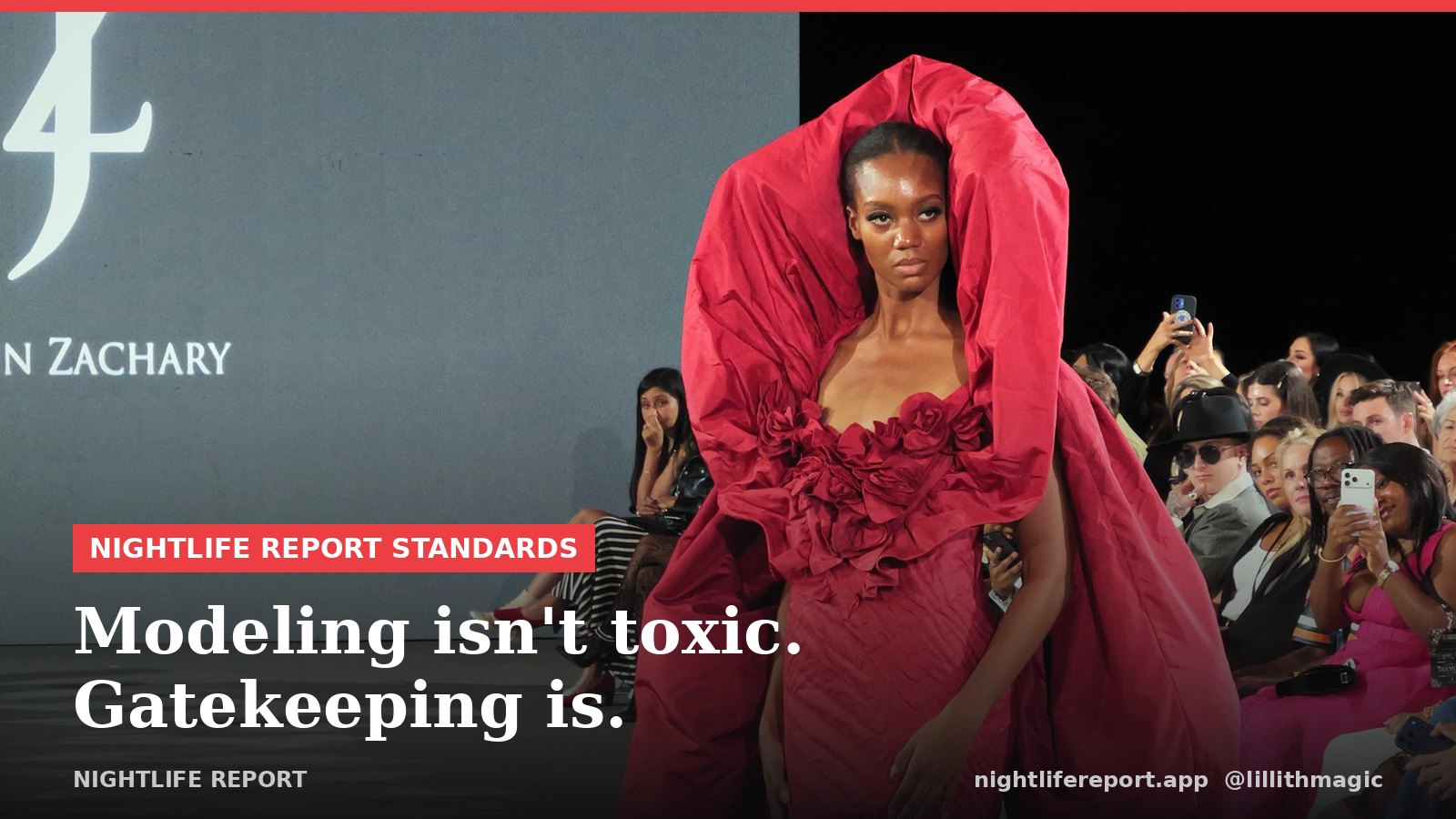
Nightlife Report Standards
Some people say modeling is toxic for girls. We respect the concern and we disagree with the conclusion. Here’s the standard we work by.
Nightlife Report Standards. Tue Oct 20, 2026. An editorial position from the Nightlife Report desk.
Every fashion season, the same argument comes back: modeling is bad for girls. It teaches them the wrong values, it exploits them, it should be discouraged. We hear it in comment sections, in think pieces, and sometimes from people we love.
We take the concern seriously. The industry has real history of bad actors, unpaid work and pressure that nobody should have to absorb. Pretending otherwise would be dishonest. But the conclusion, that the work itself is the problem, doesn’t hold up. Here’s where we stand.
The gods do not care what mortals do
That’s our first principle, and we mean it plainly. There’s no cosmic rulebook that says standing in front of a camera is shameful, or that being seen is a moral failure. The disapproval comes from people. Usually from people’s discomfort, sometimes from their prejudice, and often from habits nobody stopped to question.
If the heavens aren’t keeping score on your runway walk, neither should the neighbors.
Use what’s natural over prejudice
Presence, poise, timing, the ability to wear a designer’s idea and make a room believe it: those are gifts and skills, same as a singing voice or a fast first step. Nobody tells a gifted athlete to hide it out of modesty. Using what you were given, and building on it with work, is natural. Shaming people out of it is the prejudice.
If it looks good and you’re satisfied, do it
The test is simple. Is the work good? Are you proud of it? Are you treated and credited fairly? Then do it, and don’t apologize. The person whose opinion counts most here is the person doing the work.
Don’t gatekeep what’s great out of jealousy
A lot of “concern” about who gets to model is really about who gets to be admired. Gatekeeping something great because it makes you feel smaller isn’t protection. It’s envy wearing a cardigan. The fix for a culture with too few people celebrating beauty, craft and confidence is more celebration, not less. Evie Magazine’s Brittany Hugoboom has written about the backlash against beauty from her own angle; on that point we’re on the same page.
The benchmark we’re measured against: the Ford standard
The Ford standard, as Eileen Otte Ford laid it out: the “tall, thin, often blond” Ford woman with “wide-set eyes and a long neck” (AP), and the blue-eyed Nordic look Vogue credits her with popularizing in the early 1960s (“They work hard, and they look more American than American girls,” she said of Swedish models). Anyone under 5 feet 7 was told to forget it: “If you’re short you’re not going to model. That’s it” (The Telegraph). The high-fashion bracket, as Robert Lacey records it in Model Woman (Vanity Fair adaptation), started at 5 feet 8, with a 32- to 33-inch bust, a 20- to 21-inch waist and 33-inch hips, because, as she explained, “photographic models must fit manufacturers’ samples.” The 34-24-34 figure is often cited for Ford models (Los Angeles Times, 2014). That’s the historical benchmark, not Nightlife Report’s standard.
It’s the bar the industry measured itself against for half a century, and the one our stance is measured against. We don’t hold anyone to it. The gods do not care what mortals do, and we don’t gatekeep.
Sources: Robert Lacey, Model Woman: Eileen Ford and the Business of Beauty (2015); the New York Times and AP obituaries (2014); The Telegraph; Vogue; Los Angeles Times. Her own books: Eileen Ford’s Book of Model Beauty (1968), Secrets of the Model’s World (1970), Eileen Ford’s A More Beautiful You in 21 Days (1972) and Eileen Ford’s Beauty Now and Forever (1977).
What that looks like on our pages
- We credit everyone. Every look is credited to its designer, and every photo to its photographer.
- We describe the work, not the person’s body. Garments, styling, the walk, the show. That’s the story.
- Adults only in our runway coverage. If we can’t be sure, the frame stays out.
- No invented quotes, no invented facts. If someone said it, we link where they said it. If we couldn’t confirm it, we say so. Our corrections policy is public.
- You can ask. Models and designers can request their photos, ask for a credit fix, or ask us to take something down: editor@nightlifereport.app.
Modeling isn’t toxic. Bad behavior is, and we’ll call it out wherever we see it. The work itself, done well and credited fairly, is something to be proud of. We’ll keep showing up to the photo pit to prove it.
Nightlife Report is watching. Seen something? Send us a tip, especially if you’re drunk.
More Nightlife Report
nightlifereport.app · Blog · Forum · Wiki · patreon.com/aperlas · Join the VIP list (Mailchimp)
Leave a Reply