
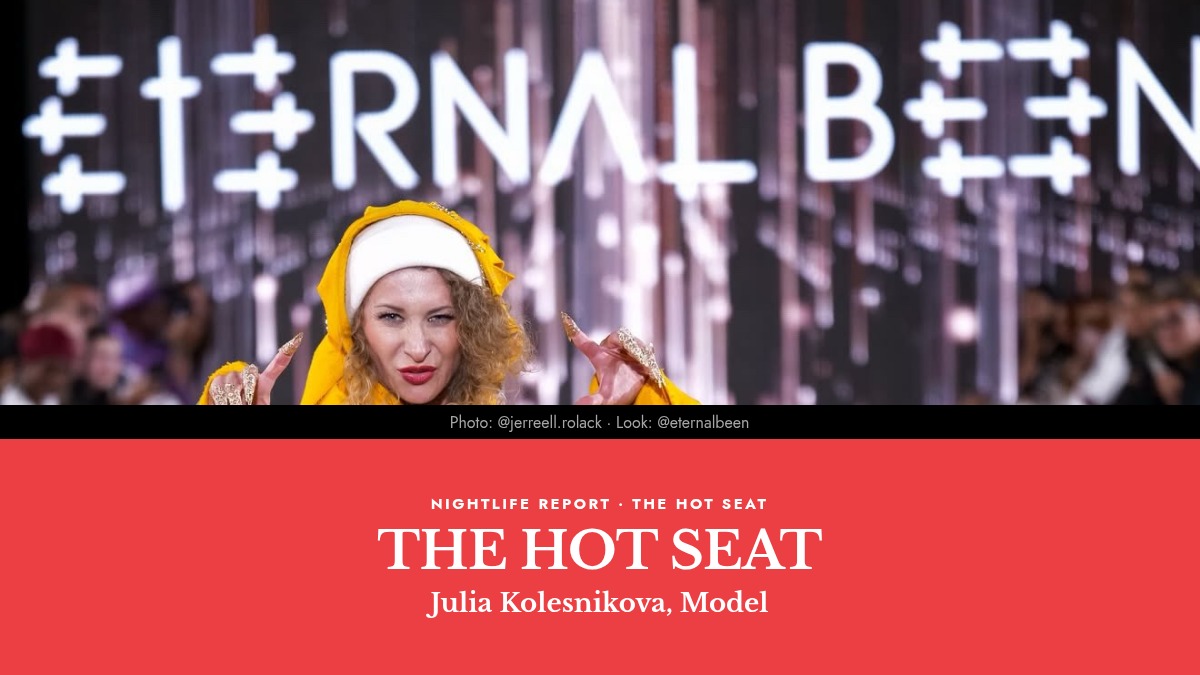
Five questions, printed exactly as she wrote them. A Los Angeles model on the color rules worth breaking, what the city’s sidewalks are missing, and the small change that would make Fashion Week better for every guest.
Most people asked to name the most overrated thing in fashion reach for a target. A trend. A brand. A silhouette they are tired of seeing.
Julia Kolesnikova reached for a paint box.
She is a model in Los Angeles, and she goes by @julia_kolesnikova_psy on Instagram. She was handed the Golden Apple, which means she was handed the Hot Seat: five questions from Nightlife Report, about three minutes, and a promise that her words would run exactly as written. No rewrites. No polishing. No quotes we made up to sound better.
What came back reads less like an interview and more like a manifesto for a brighter city. She wants more color, more nerve on the sidewalk and more kindness at the shows. And she wants it said with hearts.
Here are her five answers, each one checked against what the public record says about the city she is talking to.
How the Hot Seat works
The format is simple on purpose. One person answers five questions: what is overrated in fashion, which style rule everyone should break, what LA gets wrong about style, an unpopular opinion, and the first thing they would change if they ran Fashion Week. Then they pass a golden apple to people they think deserve the seat next.
We print the answers as submitted. Where we add context, it comes from published research or public data, and we cite it at the end. Anything we could not verify is marked [UNVERIFIED].
Answer one: “Overrated” is the wrong word for it
The first question was: what is the most overrated thing in fashion right now?
Julia did not name a trend. She named a habit, and then she broke it in the same breath:
“Let’s break the color rules and wear all the brightest colors at once! Wear what fills us with love and joy.”
Read that again and notice the move. Asked what to tear down, she answered with what to build. The overrated thing, by implication, is the rule book itself: the idea that colors must be rationed, matched, kept in their lanes.
It is a bigger idea than it looks. Color rules are mostly inherited, not tested. But the feelings attached to color appear to be widely shared. In a 2020 study in Psychological Science, researchers led by the University of Lausanne asked 4,598 people in 30 nations, speaking 22 languages, to link 20 emotions to 12 color words. The patterns were strikingly similar around the world, with an average similarity score of .88 between each nation and the global pattern.
In other words, people largely agree on what colors mean. That makes the rules about how to combine them look less like science and more like etiquette. And etiquette, as anyone who has worked a runway knows, is there to be bent.
Answer two: The rule she would break, now with hearts
The second question asked for one style rule everyone should break. Julia gave nearly the same answer as before, but this time she signed it:
“Let’s break the color rules and wear all the brightest colors at once! Wear what fills us with love and joy♥️🧡✨”
Saying it twice is its own kind of evidence. This is not a throwaway line. It is a position.
And the three symbols at the end line up neatly with the research. In the same 30-nation study, the most common color and emotion pairings included red with love, pink with love and joy, yellow with joy, and orange with joy. A red heart, an orange heart and a spark. Love and joy, written in the colors that people across 30 countries most link to those feelings.
One honest caveat. The University of Lausanne has since stressed that this work measures associations: how people connect color words to emotion words. It does not prove that wearing red will make you feel love, or that orange causes joy. So we will not promise that a brighter outfit will change your mood. [UNVERIFIED as a cause-and-effect claim.]
But Julia did not make that promise either. Her rule is simpler: wear what fills you with love and joy. That is not a lab claim. It is permission.
Answer three: What LA gets wrong is the sidewalk
Then came the question built to start arguments: what does LA get wrong about style? (Be honest. That’s the point.)
“There’s plenty of fashion in LA, but I’d love to see more bold, stylish people on the streets.”
Note what she does not say. She does not say LA lacks fashion. She says the opposite: there is plenty of it. Her complaint is about where it shows up.
The numbers suggest she has put her finger on something structural. In the U.S. Census Bureau’s American Community Survey for 2024, 62.2% of workers living in the City of Los Angeles drove to work alone. Just 3.6% walked. About 16% worked from home.
A city where most people travel inside a car is a city where most outfits are seen through a windshield. The fashion exists. It is simply parked.
That matters because street style has always depended on the street. The late New York Times photographer Bill Cunningham, who spent decades documenting what people actually wore, put it plainly in the 2010 documentary Bill Cunningham New York: “The best fashion show is definitely on the street. Always has been and always will be.”
Julia’s answer is a quiet challenge to that LA habit. If the best fashion show is on the street, Los Angeles needs more people willing to walk it.
Whether Angelenos actually dress less boldly than people in other big cities is a fair question, and we found no reliable data that measures it. [UNVERIFIED.] What the census does show is the stage problem: fewer sidewalks in use, fewer chances to be seen.
Answer four: The “unpopular” opinion that millions agree with
The fourth question gave her a blank page: your unpopular opinion, about anything, from fashion and nightlife to art and the city.
She used it to write a love letter:
“LA is beautiful in every way—and it has my heart forever.”
It is a gentle twist on the assignment. In a city that loves to complain about itself, saying you love it without conditions can feel like the bold position.
But by at least one measure, Julia is in very large company. The Los Angeles Tourism & Convention Board reported in July 2026 that Los Angeles welcomed 49.5 million visitors in 2025, including 6.4 million from abroad. Those visitors spent about $118 million a day and supported more than 530,000 jobs.
Nearly fifty million people a year do not travel to a city they find ugly. Julia’s “unpopular” opinion may be one of the most widely shared opinions in Southern California. It is just one that locals rarely say out loud.
Put her third and fourth answers side by side and a clear picture forms. She loves this city enough to want more from it. That is not a contradiction. It is how someone who works in front of the camera treats anything she cares about: she wants it to look its best.
Answer five: Champagne, coffee and the wait between shows
The last question asked what she would change first if she ran Fashion Week.
“I’d add a few champagne and coffee bars for guests to enjoy between shows.”
It may be the most practical answer anyone could give, and the reporting suggests why.
Fashion shows are famous for starting late and ending fast. Glossy, the fashion trade publication, put the typical runway delay at 30 minutes in its 2018 breakdown of fashion month, against a typical show length of 7 to 20 minutes. A first-hand account from New York’s fashion week in 2006 described shows starting about 45 minutes after the hour and lasting 10 to 12 minutes, concluding that guests spend longer standing in line than watching the show.
Los Angeles has its own version of the story. Writing in California Apparel News in 2015, a columnist said waits at some Los Angeles shows went up to two hours. That was one writer’s experience, not a measured average. [UNVERIFIED as a typical LA wait time.]
Put those figures together and the guest experience at many shows is mostly waiting. Julia’s fix turns that dead time into something people would actually look forward to: a coffee to stay sharp, a glass of champagne to celebrate, and a place to talk while they wait. She is not asking for a bigger runway. She is asking for better hospitality around it.
It is also, notably, the answer of someone who thinks about the audience, not just the clothes.
The Golden Apple: who Julia passes it to
Every Hot Seat ends with a hand-off. Julia received the apple from @lillithmagic. She passes it to three people:
@makeup_jenny_lv
@thaishalisdeclet
@soleabydarlyn
Asked why, she answered in one line:
“Because they each bring their own bold style and creative energy to LA.”
Notice the word that keeps coming back. Bold. It appears in her answer about the streets and again in her reason for these nominees. Julia is not just describing the city she wants. She is naming the people she thinks are already building it.
What her five answers add up to
Strip away the format and Julia’s Hot Seat says three things.
First, color is not a risk to manage. It is a feeling to share, and the research on color and emotion suggests those feelings are shared more widely than most rules allow.
Second, Los Angeles does not have a fashion problem. It has a visibility problem. The style is here; the sidewalks are just quiet.
Third, the best events are the ones that look after their guests. A coffee bar between shows will not make headlines. It will make people stay.
It is a hopeful set of answers from someone who clearly loves where she lives. And it ends, fittingly, with a heart.
Take the Hot Seat
Think you can answer five questions in three minutes, honestly, and let us print every word? Take the Hot Seat here: https://docs.google.com/forms/d/e/1FAIpQLScFfR0rTRfRTrqUgVU1EdzhrARfKnnWFlyPPAYG9foOeHUtyQ/viewform
Nightlife Report is independent and reader-supported. If you want more stories like this one, support the desk at patreon.com/aperlas.
Sources
1. Jonauskaite, D., et al. (2020). “Universal Patterns in Color-Emotion Associations Are Further Shaped by Linguistic and Geographic Proximity.” Psychological Science 31(10). doi:10.1177/0956797620948810. Author manuscript (University of Lausanne): https://api.unil.ch/iris/server/api/core/bitstreams/7d6867e0-d9bc-4341-885c-19643911db2d/content. Data used: 4,598 participants, 30 nations, 22 languages, 20 emotions, 12 color terms; average nation-to-global similarity r = .88; prominent pairs include red and love, pink and love/joy, yellow and joy, orange and joy. 2. University of Lausanne, “L’impact réel des couleurs sur nos émotions,” UNIL news: https://www.unil.ch/news/fr/1730964668072. Data used: the findings show associations and do not show that color causes an emotional response. 3. U.S. Census Bureau, American Community Survey 2024 1-year estimates, Table B08301, “Means of Transportation to Work,” Los Angeles city, California, via Census Reporter: https://censusreporter.org/tables/B08301/. Data used: drove alone 62.2%, walked 3.6%, worked from home 16.0% (calculated from the table’s estimates). 4. Bill Cunningham New York (documentary, 2010, dir. Richard Press). Quote also reproduced by PBS NewsHour, “Bill Cunningham, whose photographs epitomized street style, dies at 87”: https://www.pbs.org/newshour/arts/bill-cunningham-whose-photographs-epitomized-street-style-dies-at-87 5. Los Angeles Tourism & Convention Board, press release, July 29, 2026: https://www.discoverlosangeles.com/visitors-to-los-angeles-generated-426-billion-in-business-sales-and-supported-more-than-530000-jobs. Data used: 49.5M visitors in 2025, 6.4M international, $118M spent per day, more than 530,000 jobs. 6. Glossy, “Fashion month, by the numbers,” Feb. 6, 2018: https://www.glossy.co/fashion/fashion-month-by-the-numbers/. Data used: typical delay 30 minutes; typical show length 7 to 20 minutes. 7. Omiru, “Fashion Week Notebook: Time in the ‘Fashion Zone,’” Feb. 10, 2006: https://www.omiru.com/index.php/2006/02/10/fashion-week-notebook-time-in-the-fashion-zone/. First-hand account: shows started about 45 minutes late and lasted 10 to 12 minutes. 8. California Apparel News, “Fashion Week Humor,” Sept. 11, 2015: https://www.apparelnews.net/news/2015/sep/11/fashion-week-humor/. A columnist reported waits of up to two hours at some Los Angeles shows. This is anecdotal and marked [UNVERIFIED] in the text.
Julia Kolesnikova’s answers were submitted to Nightlife Report’s Hot Seat on Oct. 23, 2026, and are printed as written under the contributor release.
See the carousel on Instagram: https://www.instagram.com/p/De3T9cUkQiQ/
Photos: @jerreell.rolack · Look: @eternalbeen · Makeup: @makeup_jenny_lv
nightlifereport.app | Tips: editor@nightlifereport.app | 1049 Havenhurst Dr, Unit 67, West Hollywood, CA 90046
Leave a Reply