
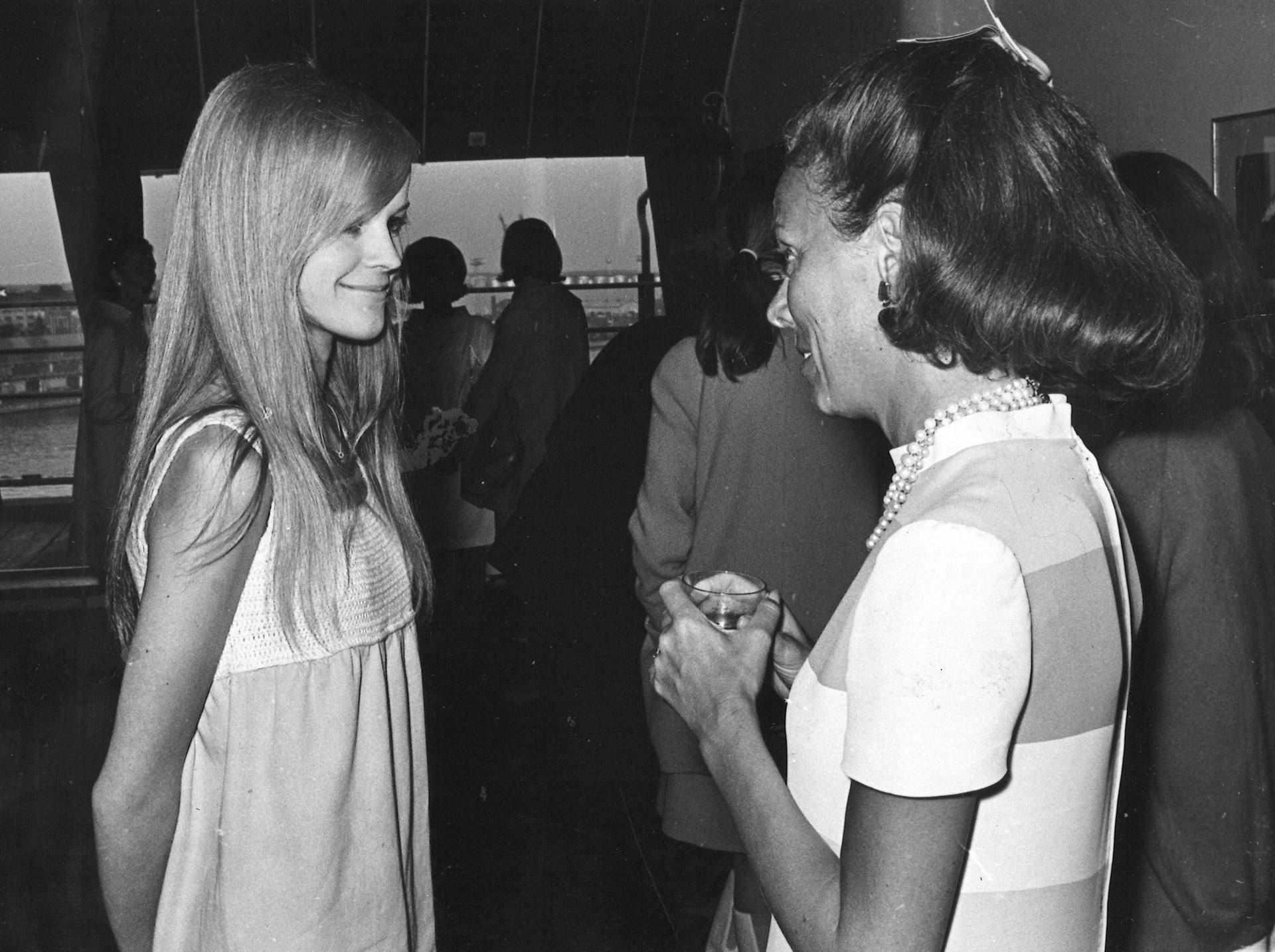
Top photo: Eileen Ford (right) with Finnish model Ritva Haikola, Finland, September 1967. Photo: Kari Santala / Lehtikuva, public domain, via Wikimedia Commons
By Anthony Perlas · Nightlife Report · History feature · Wed Oct 21, 2026, PT
For more than four decades, one woman did more than anyone to decide what an American fashion model looked like. Then a newcomer from Paris arrived in New York and set off what the industry called the “model wars.” This is the story of Eileen Ford and John Casablancas, told from published reporting, and why it still shapes the benchmark Nightlife Report uses today.
1. Eileen Ford: the agency as a household
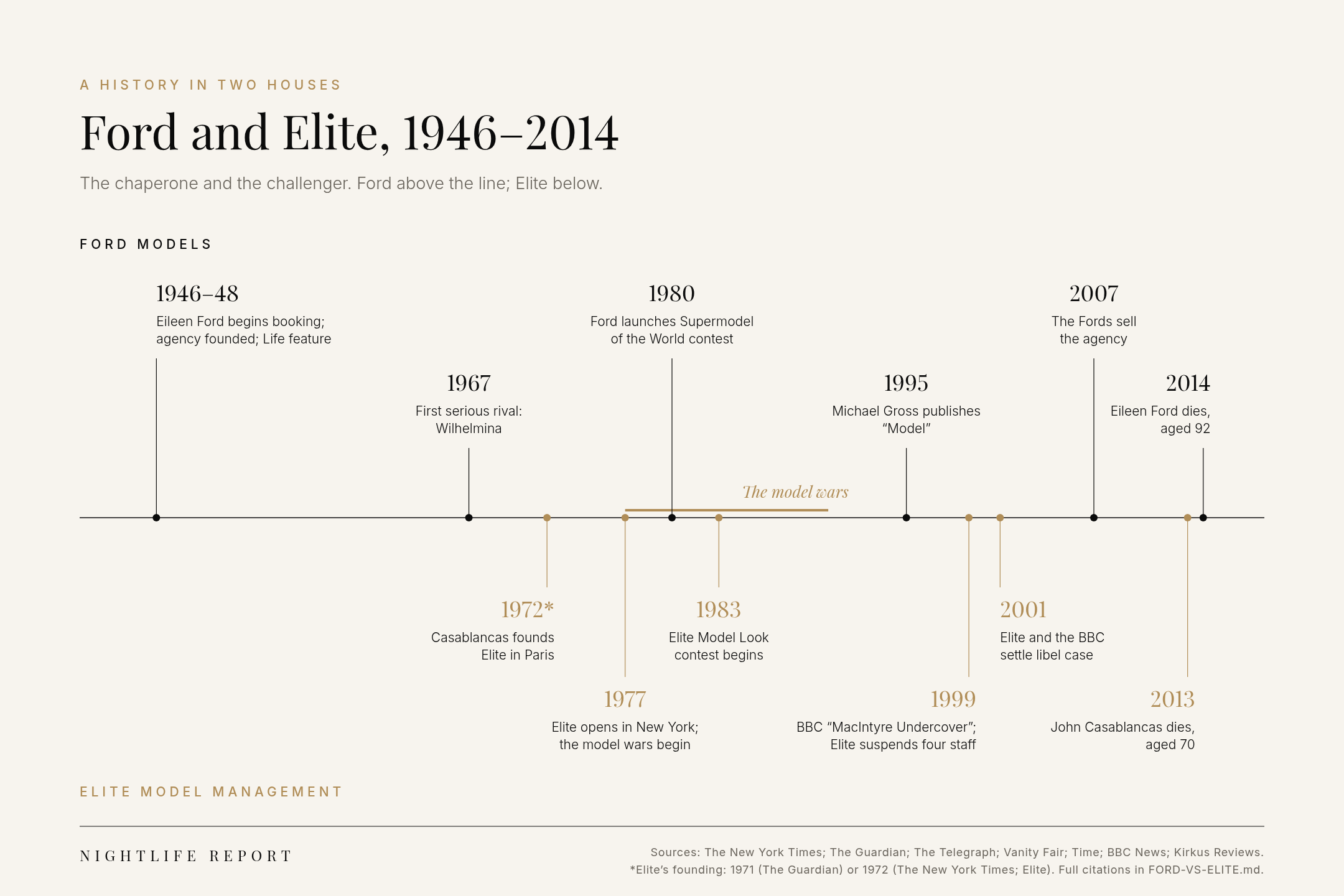
The founding. Eileen Ford was born Eileen Cecile Otte in Manhattan on March 25, 1922 (NYT obituary, via CNBC). She began booking jobs for model friends in 1946, working from a card table in a house owned by her parents (Vanity Fair, 2015). The New York Times dates the formal birth of Ford Models to 1947 (NYT obituary, via CNBC), and The Telegraph uses 1946 (The Telegraph). In 1948 the Fords sold their car to pay for an office on Second Avenue (NYT obituary, via CNBC). That October, a five-page Life magazine feature on the “family-style” agency put them on the map (Vanity Fair, 2015).
The partnership. Eileen was the scout and the face of the agency. Her husband, Jerry Ford, ran operations, introducing a voucher system that let models be paid in advance (NYT obituary, via CNBC). Jerry also introduced cancellation fees, fitting fees and weather-permitting fees, according to a banker friend quoted by Vanity Fair.
The influence. The New York Times wrote that Ford “influenced standards of beauty for more than four decades” (NYT, 2014).
Conservative, protective, and strict
Ford ran her agency, in the Times’s words, “like a convent.” She was widely known for protecting models from underhanded deals and sexual misconduct, and for insisting that clients and models follow a code of ethics and decorum (NYT obituary, via CNBC).
- She housed young models. Ford let some newcomers live in her Upper East Side townhouse so she could keep a watchful eye on them (NYT obituary, via CNBC). The Independent reported that many lived in her home, “sharing food, clothes, bedrooms and curfews with her daughters” (The Independent).
- She chaperoned. The Telegraph reported strict curfews for the youngest models, and that Ford acted as chaperone on trips to the cinema or theatre (The Telegraph).
- In her own words (to Forbes in 1984): “They eat dinner with me, at table, every night. I don’t ever want to tell a mother I don’t know where her daughter is at 2 a.m.” (NYT obituary, via CNBC; also The Guardian)
- She limited the work. Ford models would not pose for true-crime magazines or deodorant ads, among other limits, according to a list published in Life in 1948 (Vanity Fair, 2015).
Michael Gross’s 1995 history Model: The Ugly Business of Beautiful Women called the Ford agency “a fortress of propriety and moral rectitude that was to stand for 50 years” (quoted in the NYT obituary, via CNBC). Kirkus’s review of the same book described a “controlling” Ford whose “showy ‘mothering’” came second to “ruthless business acumen” (Kirkus Reviews).
She was also blunt. Ford told hopefuls under 5 ft 7 in to forget it: “If you’re short you’re not going to model. That’s it” (The Telegraph). She told one future star to get a nose job, and another that she was fat and had crooked teeth (NYT obituary, via CNBC).
The Ford look
According to The Telegraph, the typical Ford model “changed remarkably little over the decades. She was tall, willowy, usually blonde, and fresh-faced, with wide-set eyes and a long neck” (The Telegraph). Vanity Fair described “an expectation of blondeness, though not invariably so” and “a general impression of extra sparkle, height, and slenderness” (Vanity Fair, 2015).
In the 1950s, “high fashion” models started at 5 ft 8 in. Ford gave two reasons for the requirements: models “must fit manufacturers’ samples,” and “the camera really does add at least 10 pounds” (Vanity Fair, 2015).
The look was never the whole roster. The Guardian notes that Ford diversified “in shape and skin-colour,” signing Jerry Hall, Grace Jones and Naomi Campbell (The Guardian). Ford herself later admitted that “rejecting the shorter girls was often a bad mistake I made” (Vanity Fair, 2015).
2. John Casablancas: the jet-set challenger
Background. Casablancas was born in New York to Spanish parents. His mother was a former Balenciaga model. He was sent to boarding school in Switzerland (The Guardian), and The Wall Street Journal names the school as Institut Le Rosey (WSJ).
Elite, Paris. The New York Times says he founded Elite Model Management in Paris in 1972 (NYT, 2013), and Elite’s own history gives the same year (Elite Model Management). The Guardian’s obituary dates the move to Elite to 1971 (The Guardian). We use 1972.
The style. The Guardian wrote that he “mingled in the music business and pop arts culture,” did not care “how wild the talent was,” and did not share Ford’s “finishing-school rulebook,” thinking her a prude (The Guardian). A Hollywood Reporter review of a 2016 documentary about him contrasted Ford’s “conservative approach” with “the party-hearty, headlines-heavy atmosphere nurtured by Elite” (The Hollywood Reporter).
The business idea. Time reported that Casablancas stopped setting fixed fees and negotiated each booking separately, and that the rest of the industry had to follow (Time). The Guardian credits him with building the “superpaid supermodel era,” and also notes that it rested on deals Jerry Ford had negotiated earlier (The Guardian, Ford obituary). By the 1990s Elite was a $120-million-a-year business (WSJ).
3. The model wars (1977 into the 1980s)
Casablancas opened Elite in New York in 1977 (Elite Model Management; WSJ). The New York Times reported in 1978 that he “flung aside the conventions and began to woo top models away from the established agencies,” which sued him for more than $10 million. Within the industry it was called the “Model Wars” (NYT, 1978).
- Raids and defections. Time reported that some 20 Ford stars joined Casablancas, and that some later returned. It also reported that the Fords filed a $7.5 million suit and Wilhelmina a $4 million suit (Time).
- The outcome. According to The Guardian, Ford and Wilhelmina Cooper sued over broken territorial agreements “but lost as the arrangements were not in writing” (The Guardian).
- The long fight. The Times obituary places the rivalry in “the so-called model wars of the 1970s and ’80s.” Ford answered by expanding worldwide and launching its Supermodel of the World contest in 1980 (NYT obituary, via CNBC). Elite’s own model contest began in 1983 (The Guardian).
- The philosophical split. “Casablancas mocked Eileen’s controlling chaperonage,” The Guardian wrote. He “believed even very young models were old enough to manage their own lives.” The Fords “thought Casablancas let the sleaze they had cleaned up creep back in” (The Guardian).
4. The record on Elite’s conduct, as reported
This section repeats only published, attributed reporting. Nightlife Report makes no allegations of its own.
Casablancas’s personal life, in published accounts. The New York Times obituary reported that Casablancas “courted scandal in his own life as well, accused of having sexual relations with teenage models” (NYT, 2013). The Guardian reported that he was frank in interviews about his preference for very young women, that his second marriage ended after a public relationship in 1983 with the model Stephanie Seymour, then 16, and that he denied rumours of wider relationships with Elite clients (The Guardian). In the 2016 documentary Casablancas: The Man Who Loved Women, built around a long interview with him, he talks about his relationships himself. The Hollywood Reporter’s review called the film “more hagiographical than biographical” and noted that it never questions that Elite’s business was built largely on young women, many recruited through its contests (The Hollywood Reporter).
The 1999 BBC documentary. In November 1999, BBC One’s MacIntyre Undercover broadcast an episode on the modelling industry built on what the BBC described as a year of undercover research (NYT, 1999).
- Suspensions. Before broadcast, Elite suspended four employees pending an inquiry, including the president of its European division (NYT, 1999).
- Apology. Casablancas, as chairman, offered “an unreserved apology for the behaviour displayed by the agency’s staff” in the programme (The Guardian, 1999).
- Resignations. Two senior executives later resigned, and their resignations were accepted by Elite’s board (The Independent).
- Libel settlement (2001). Elite sued the BBC for libel and settled in June 2001 on confidential terms. In an agreed statement, the BBC acknowledged that Elite “warns and seeks to protect its young teenage models” and that “this was not reflected in the programme,” so “Elite was therefore unfairly portrayed.” The statement also said the investigation “revealed no sexual exploitation by Elite executives of its models or Elite Model Look contestants,” while Elite accepted that “sexual remarks made by some of its executives were clearly inappropriate.” The BBC agreed never to repeat the programme (BBC News, 2001; The Guardian, 2001).
- Casablancas’s exit. The Guardian’s obituary said he “was not implicated” by the documentary but “had had enough contention and resigned” (The Guardian). Elite’s own history says he sold his equity in April 2000 (Elite Model Management).
5. How it ended
The Fords sold their agency in 2007 to Stone Tower Equity Partners, later renamed Altpoint Capital Partners (NYT obituary, via CNBC). Casablancas died of cancer in Rio de Janeiro on July 20, 2013, aged 70 (NYT, 2013; Elite Model Management). Eileen Ford died in Morristown, N.J., on July 9, 2014, aged 92 (NYT, 2014; The Guardian).
6. Why it matters for today’s standard
The Nightlife Report Standard (about 5’10”, runway sample size 0–4, 34-24-34, tall and slender) is our own consolidated reading of the classic runway ideal. It is not a Ford agency specification, and Ford-era minimums were 5’7″–5’8″ (Nightlife Report). The history above explains three choices behind it.
- The look came from the clothes, not from taste alone. Ford’s own stated reason for her requirements was that models had to fit manufacturers’ samples (Vanity Fair, 2015). That is why our benchmark measures sample-size fit rather than appearance for its own sake. Hair and eye colour, central to the “usually blonde” Ford template (The Telegraph), are not scored (Nightlife Report).
- Casablancas showed that personality sells. The supermodel era he built turned models into recognizable stars (The Guardian). That is the reason 60% of our card is performance (walk, presence and charisma, styling and camera), and only 40% is the benchmark (Nightlife Report).
- Ford’s protectiveness is the part worth keeping. The industry’s own reckoning, from the 1999 documentary to the reforms that followed, points to care for young people as the lasting lesson. Our rules score benchmark lines only with a model’s consent, take any backstage measurement privately, and publish no individual measurements (Nightlife Report).
The benchmark is a historical reference, not a measure of anyone’s worth, and agencies today cast across a much wider range of heights, sizes and looks (Nightlife Report). For this season’s podium and the full Standard, see 16 Points Took the Crown: The Standard and the Rules of the Venus Games.
Where sources disagree
| Point | Version A | Version B |
|---|---|---|
| Ford agency founding | 1946 (The Telegraph) | 1947 (NYT, via CNBC; The Guardian) |
| Elite founding | 1971 (The Guardian) | 1972 (NYT; Elite) |
| Casablancas sells Elite | 1990 (The Guardian) | Sold his equity April 2000 (Elite) |
| Jerry Ford’s death | 2006 (The Telegraph) | 2008 (NYT, via CNBC; The Guardian) |
Further reading
- Michael Gross, Model: The Ugly Business of Beautiful Women (William Morrow, 1995). Kirkus review
- Robert Lacey, Model Woman: Eileen Ford and the Business of Beauty (Harper, 2015). Vanity Fair excerpt
nightlifereport.app | Tips: editor@nightlifereport.app | 1049 Havenhurst Dr, Unit 67, West Hollywood, CA 90046
Leave a Reply