
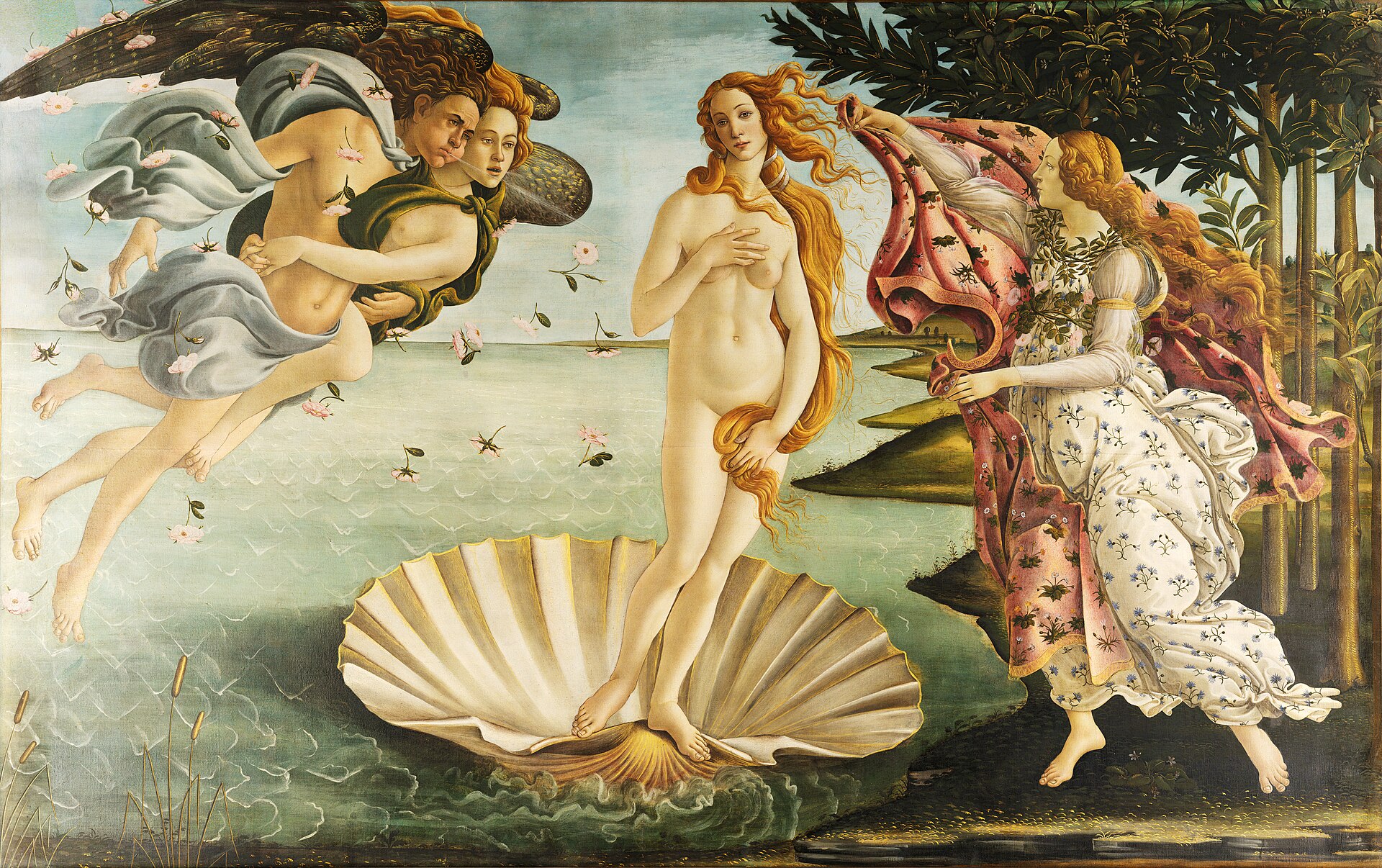
Top image: Sandro Botticelli, The Birth of Venus, c. 1485, Uffizi Galleries, Florence. Public domain, via Wikimedia Commons.
Battle of the Gods: The Business of Beauty, part 5 of 5. Series hub.
In the Venus Games, Ava Kortman fights for Venus. Most people treat Venus and Aphrodite as two names for one goddess, and the ancients did eventually merge them. But they began as different figures with different jobs, and the difference maps neatly onto modeling. Aphrodite is desire as a force of nature. Venus is desire turned into an institution, with a family tree, a temple and a brand. One is the moment a model steps into the light. The other is the house that keeps her there.
Aphrodite: born of the sea, worshipped from Cyprus to Corinth
Encyclopaedia Britannica describes Aphrodite as “the ancient Greek goddess of sexual love and beauty, identified with Venus by the Romans.” She was not only a love goddess. Britannica says she was “widely worshipped as a goddess of the sea and of seafaring” and “honored as a goddess of war, especially at Sparta, Thebes, Cyprus, and other places.” Some scholars believe her worship came to Greece from the East, since many of her attributes recall the Near Eastern goddesses Ishtar and Astarte.
Her most famous origin story is Hesiod’s. In the Theogony, a white foam spreads on the sea, “and in it there grew a maiden.” She drew near Cythera, then came to Cyprus. “Her gods and men call Aphrodite, and the foam-born goddess and rich-crowned Cytherea” (Hugh G. Evelyn-White’s translation). Britannica notes that the name was linked to the Greek aphros, foam. A Homeric Hymn instead makes her the daughter of Zeus and Dione.
Her symbols and stories, per Britannica: a magical girdle “which made its wearer irresistible”; the cockle shell; doves, swans and sparrows; pomegranates, apples, roses, myrrh and myrtle. Zeus married her to Hephaestus, and she had an affair with Ares. With the Trojan Anchises she became the mother of Aeneas. Her main cult centers were Paphos and Amathus on Cyprus, the island of Cythera, and Corinth on the mainland. Britannica adds that “her public cult was generally solemn and even austere.” The city of Aphrodisias in today’s Turkey was named for her. And of course she won the Judgment of Paris (part 4).
Venus: from garden goddess to the mother of Rome
Venus started somewhere much quieter. Britannica calls her an “ancient Italian goddess associated with cultivated fields and gardens and later identified by the Romans with the Greek goddess of love, Aphrodite.” Once identified with Aphrodite, she took on the Greek family tree: daughter of Jupiter and Dione, wife of Vulcan, mother of Cupid. Romans then gave her civic roles that the Greek goddess mostly didn’t have.
- Venus Verticordia, “changer of hearts.” Platner and Ashby’s Topographical Dictionary of Ancient Rome records her temple, built in 114 BC “to atone for a case of incest among the Vestals.” The epithet “referred to the power of the goddess to turn the mind from lust to purity.” The day of dedication was April 1. Britannica says that as Verticordia she was “charged with the protection of chastity in women and girls.”
- Venus Erycina. This cult was imported from Mount Eryx in Sicily. Digital Augustan Rome records a temple outside the Colline Gate that was vowed in 184 BC and dedicated in 181 BC.
- Venus Victrix and Venus Genetrix. Here Venus becomes politics. Macquarie University’s coinage exhibition notes that Pompey built a temple of Venus Victrix (“the Conqueror”) into his theater. Julius Caesar, who had publicly proclaimed his descent from Venus through Aeneas at his aunt’s funeral, vowed a temple before the Battle of Pharsalus. He built it to Venus Genetrix, “the Mother,” in his new forum, and the exhibition says “Venus only acquired the epithet Genetrix or ‘mother’ under Caesar.” The temple was dedicated on September 26, 46 BCE.
So the difference in one line: Aphrodite is a force; Venus is a franchise. The Greek goddess is desire, the sea and the irresistible girdle. The Roman goddess is a dynasty’s ancestor, a general’s patron, a guardian of marriage and a face on the coins. Caesar’s moneyers put Venus on their issues. That’s an early version of a brand putting its muse on the product.
Art history: from fully dressed to the most famous painting in the world
Britannica notes that early Greek art showed Aphrodite “fully dressed and without distinguishing features.” Britannica credits the great Greek sculptors of the 5th century BCE with first giving her an individual image. The most famous statue of all was the one Praxiteles carved for the Cnidians: “the first full-scale female nude,” which later became “the model for such Hellenistic masterpieces as the Venus de Milo.”
Pliny the Elder’s account of that statue is really a business story. Praxiteles made two versions of the goddess and offered both at the same price. The people of Cos chose the draped one “on the grounds of propriety and modesty.” The Cnidians bought the other, and Pliny says “many persons before now have purposely undertaken a voyage to Cnidos” just to see it. King Nicomedes later offered to pay off the city’s entire public debt for it. The Cnidians refused, “and with good reason, for by this statue Praxiteles has perpetuated the glory of Cnidos.” One image of the goddess turned a city into a destination. That’s the same thing a campaign image does for a fashion house now.
The Louvre’s Venus de Milo was found on the island of Melos in 1820, and King Louis XVIII gave it to the museum in March 1821. The Louvre still poses the question “Aphrodite or Amphitrite?” Amphitrite was a sea goddess “particularly worshipped on the island of Melos.” The museum says the case for Aphrodite rests partly on “the jewellery she once wore.” Even the most famous Venus in the world gets identified partly by her accessories.
Then there’s Botticelli. The Uffizi’s own description of the Birth of Venus (c. 1485, tempera on canvas) says the painting “actually shows the goddess of love and beauty arriving on land, on the island of Cyprus, born of the sea spray and blown there by the winds, Zephyr and, perhaps, Aura.” The subject “was perhaps suggested by the poet Agnolo Poliziano.” It was probably commissioned by a member of the Medici family, though, the Uffizi notes, “there is nothing written about the painting before 1550.” The orange trees in it are read as a Medici emblem. In other words it was patron-commissioned imagery, which is also how luxury advertising works.
From the Uffizi to the runway
Fashion has been quoting Botticelli for a long time. The V&A’s 2016 exhibition Botticelli Reimagined showed “a dress and trouser suit of fragmented details from The Birth of Venus from Dolce & Gabbana’s 1993 collection.” It displayed them alongside two Elsa Schiaparelli evening dresses from 1938 inspired by Botticelli’s Pallas and the Centaur. Pallas is Athena, so both of our goddesses were in the same gallery. Artsy’s record of the Dolce & Gabbana “Venus Dress: Look 15” lists the model as Karen Mulder at the Spring/Summer 1993 show in Milan. The Guardian noted that Lady Gaga wore the dress in 2013 while promoting her single “Venus.” The same V&A show traced Botticelli’s composition to Ursula Andress emerging from the sea “clasping a conch shell” in Dr. No (1962).
The archetypes in modeling
Here’s how we read the two goddesses as working archetypes on a runway. This is Nightlife Report’s interpretation, not ancient doctrine.
- The Aphrodite entrance. Botticelli’s Venus arrives. She doesn’t pose on land. She’s carried in on the wind. That’s the opening walk: the moment the room looks up. It’s the “Presence” score in the Venus Games, the thing Eileen Otte Ford called an “X factor” (part 1).
- The Venus Genetrix house face. Caesar made Venus the mother of his family line. Fashion houses do the same with a long-term face, someone whose image becomes the brand’s lineage over many seasons. Carmen Dell’Orefice, still on Ford’s books at 83, is the Guardian‘s “definitive Ford model.”
- The Venus Victrix campaign. Venus “the Conqueror” belonged to generals. In modeling, that’s the winning season, the show that turns into contracts.
- The Verticordia boundary. The Roman “changer of hearts” guarded propriety. The modern equivalent is consent and contract: New York’s rules on digital replicas, deal memos and image use.
Athena (Minerva to the Romans), Emily Sophie Christine’s champion, offered Paris victory in war. She’s the strategist’s archetype, and the Schiaparelli dresses show she has her own place in fashion history. Paris picked Aphrodite on Mount Ida. Readers decide who wins the Venus Games: vote in the Battle of the Gods crowning. As always, we score the performance, never the person’s looks.
The full series: Battle of the Gods: The Business of Beauty.
Sources
- “Aphrodite,” Encyclopaedia Britannica. britannica.com
- “Venus,” Encyclopaedia Britannica. britannica.com
- Hesiod, Theogony, in Hesiod, the Homeric Hymns, and Homerica, trans. Hugh G. Evelyn-White, Project Gutenberg. gutenberg.org
- Samuel Ball Platner and Thomas Ashby, A Topographical Dictionary of Ancient Rome, “Venus Verticordia, Aedes,” Perseus Digital Library. perseus.tufts.edu
- Digital Augustan Rome, “Venus Erycina, Aedes (Extra Porta Collinam).” digitalaugustanrome.org
- Macquarie University, Australian Centre for Ancient Numismatic Studies, “Caesar’s Divine Heritage and the Battle for Venus.” mq.edu.au
- “Temple of Venus Genetrix,” Wikipedia (dedication date). wikipedia.org
- Pliny the Elder, Natural History 36.4, trans. John Bostock and H. T. Riley, Perseus Digital Library. perseus.tufts.edu
- Musée du Louvre, “Ideal Greek Beauty: Venus de Milo and the Galerie des Antiques,” and “Vénus de Milo” collection record. collections.louvre.fr · louvre.fr
- Gallerie degli Uffizi, “Birth of Venus,” Sandro Botticelli (text by Daniela Parenti). uffizi.it
- “Botticelli Reimagined,” V&A exhibition, 2016, via UAL Exhibiting Fashion. arts.ac.uk · vam.ac.uk
- Artsy, “Venus Dress: Look 15,” Dolce & Gabbana. artsy.net
- “Destination Venus: how Botticelli became a brand,” The Guardian, March 5, 2016. theguardian.com
- Image: Sandro Botticelli, The Birth of Venus, c. 1485, Uffizi, Florence. Public domain, via Wikimedia Commons (Google Art Project).
Nightlife Report is watching. Seen something? Send us a tip, especially if you’re drunk. editor@nightlifereport.app
More Nightlife Report: nightlifereport.app · blog.nightlifereport.app · forum.nightlifereport.app · wiki.nightlifereport.app · patreon.com/aperlas · Join the newsletter (Mailchimp)
Leave a Reply