
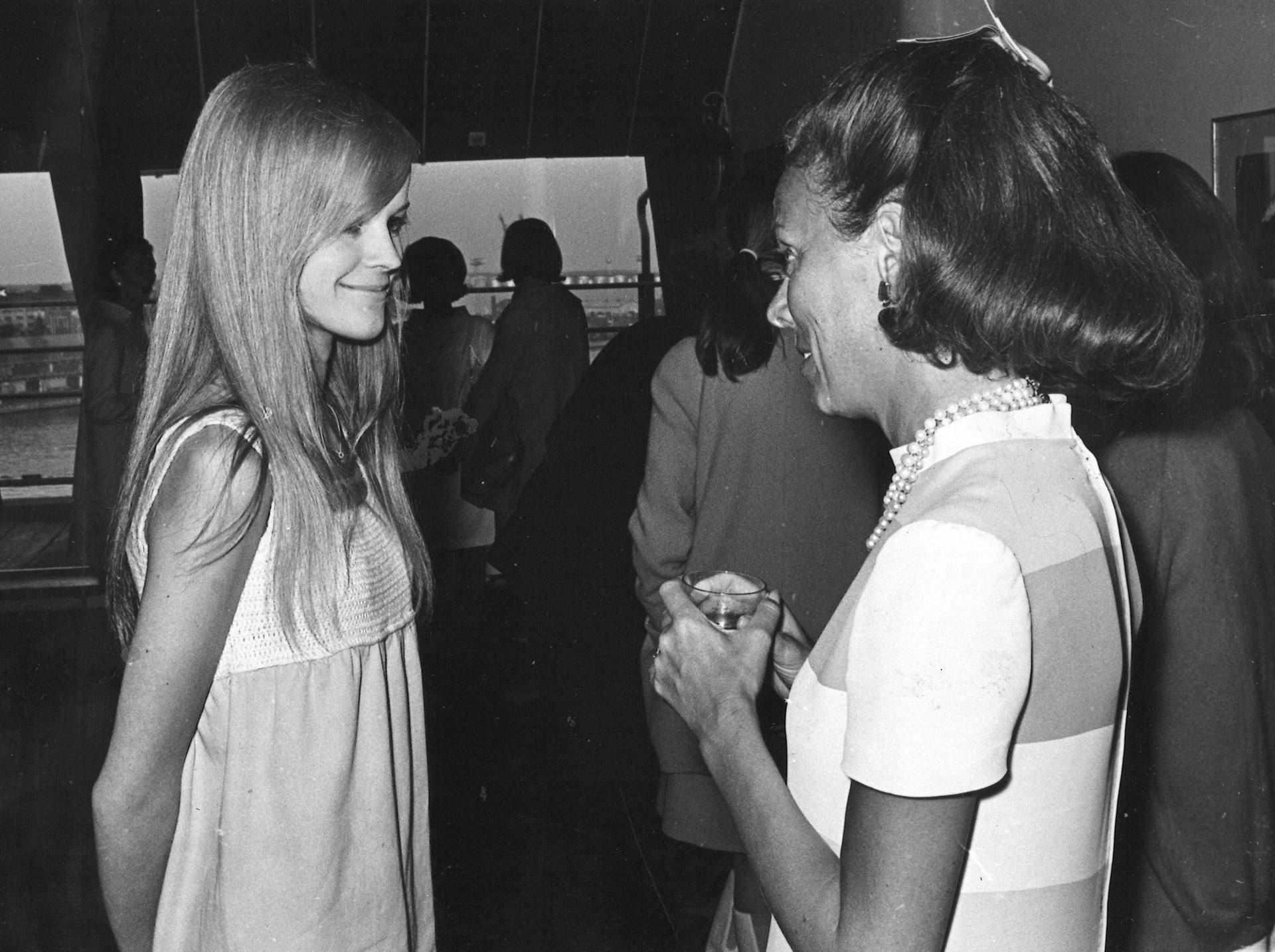
Top photo: Eileen Ford (right) with Finnish model Ritva Haikola, Finland, September 1967. Photo: Kari Santala / Lehtikuva, public domain, via Wikimedia Commons
Battle of the Gods: The Business of Beauty, part 1 of 5. Series hub.
Every round of the Venus Games has a myth on top: Venus, Ava Kortman’s champion, against Athena, Emily Sophie Christine’s champion. Underneath the myth is plumbing. Somebody books the model, somebody bills the client, somebody makes sure the check actually arrives. That plumbing has a founder. Before Eileen Otte Ford and her husband Jerry, modeling was a job. After them, it was an industry. Our argument in this series is simple: the modern business of beauty exists in the shape it does because of her.
A secretary for her friends, then a company
Ford was born Eileen Cecile Otte on March 25, 1922, in Manhattan. According to her New York Times obituary, her mother “had been the first model ever hired by the venerable clothing chain Best & Company,” and Eileen herself modeled for the Harry Conover agency during summer breaks from Barnard College, where she graduated in 1943 with a degree in psychology. She met Jerry Ford, then a Navy officer candidate at Columbia, in 1944. Three months later they eloped.
When Jerry came home from the Pacific in 1946, Eileen was already working as a secretary for several model friends and had become their informal agent. The Times says that when she became pregnant, Jerry stepped in to manage the business and “soon recognized the potential for a more organized agency” that could compete with the big houses run by Conover and John Robert Powers, who had opened what fashion historian Caroline Evans calls the first American model agency in 1923.
The founding year is usually given as 1946. That is the date in Evans’s entry in the Encyclopedia of Clothing and Fashion and in the Associated Press obituary. The Times and the Guardian date the formal opening to 1947, in the home of Eileen’s parents. Either way, the start-up story is very New York: in 1948 the Fords sold their car to pay the rent on an office on Second Avenue, which the Guardian notes was “next to a funeral parlour.” Encyclopedia.com reports that their client list grew “from 2 to 34” and that the agency took in $250,000 in 1948 alone.
Robert Lacey’s 2015 biography, Model Woman: Eileen Ford and the Business of Beauty, adds a detail the family’s own story had left out. As WWD summarized it, the model Natalie Nickerson “was originally a partner in Ford Models and clearly played an integral role in launching it.”
Vouchers, Fridays and a commission: the business model
The Fords’ biggest invention was not a face. It was a payment system. Before Ford, according to Encyclopedia.com, “Agencies found work for their models, but the models were expected to set their own rates and collect their own wages.” Jerry Ford changed that. The Times credits him with “introducing a five-day workweek for models, organizing their scheduling and establishing a voucher system, which allowed them to be paid in advance.” The paper adds that before then, models often had to wait a year or more to be paid. The agency then collected from the clients itself.
The Guardian describes it as wages “paid in cash every Friday.” Tim Teeman, interviewing Eileen for The Times of London in 2012, wrote that Ford paid fees “less the agency’s 10 per cent cut, every Friday.” Encyclopedia.com instead says the Fords “set the standard of a 20% commission, 10% from the models’ fee and the other 10% from the organization that hired the model.” The sources disagree on the exact split, and we’re reporting both. What they agree on is the structure. The agency fronts the money, takes a commission and carries the collection risk. Ford also helped set fees for “cancellations, fittings, bad weather, and the type of modeling done.” That rate card is the ancestor of today’s deal memo.
Eileen described the division of labor plainly to Teeman: “Jerry ran the agency. I was good at selling and picking the models.”
It scaled. The Times reports that within a decade, fees for top models like Dorian Leigh and Mary Jane Russell reached $3,500 a week. On the agency’s 20th anniversary, Jerry said it was billing $100,000 worth of bookings each week. By 1970, Encyclopedia.com says, Ford was taking in $5 million a year and representing 180 models. Teeman reports that the 1974 Lauren Hutton contract with Revlon was “the first contract for a model to represent a specific brand.” That deal set the template for the cosmetics contract, which is still the most valuable paper in modeling. The Guardian goes further: rival John Casablancas “built his financial success – and the basis of the superpaid supermodel era – on the deals Jerry had earlier negotiated.”
The eye: famous discoveries
Eileen was the scout. The Times says that sometimes “she would follow a young woman for a few blocks, appraising her.” She spotted Karen Graham on the stairs at the Bonwit Teller department store, and Graham became the first face of Estée Lauder. She found Vendela in a restaurant in Stockholm. In 1961 a Finnish magazine asked her to judge a contest and showed her its editors’ top 20. “None of these will do,” she said. “I want to look at all entrants.” She went through more than 700 photos and chose Hellevi Keko, who became a successful Ford model. The Guardian calls Carmen Dell’Orefice, Eileen’s 1947 pick who was still on the agency’s books at 83, “the definitive Ford model.”
The Ford roster, as listed by the Times, included Christie Brinkley, Cheryl Tiegs, Veruschka, Jerry Hall, Grace Jones, Naomi Campbell, Christy Turlington and Elle Macpherson. Many others, from Jane Fonda to Kim Basinger, went on to Hollywood. In 1980 Ford launched the international scouting contest that became Ford Supermodel of the World.
She never claimed a formula. She told Life in 1970 that it was “a way they have of moving, and it’s a way of talking to you.” In 2012 she told Teeman, “I always said it was an X factor. They just had it.” That’s why the Venus Games judges score Walk, Presence, Styling and Camera, never anyone’s looks. Presence is the part of Ford’s eye you can actually measure.
Protector, and the price of protection
Ford’s reputation for protecting models was real. The Times describes her as “widely known for protecting models from underhanded deals and sexual misconduct,” and says she insisted that “both clients and models observe a code of ethics and decorum.” Young models sometimes lived in the Fords’ Upper East Side townhouse. “They have to account for their time to me,” she told Forbes in 1984. “They eat dinner with me, at table, every night. I don’t ever want to tell a mother I don’t know where her daughter is at 2 a.m.” In his 1995 book Model: The Ugly Business of Beautiful Women, Michael Gross called the agency “a fortress of propriety and moral rectitude that was to stand for 50 years.”
The same control drew criticism. The Times says she was “criticized for an imperious approach” and known for “brusquely dismissing applicants of a sensitive age with stinging rejections.” Former models recalled being told to change their faces or their weight. Her public defenses of thinness came to stand for an industry accused of promoting an unhealthy ideal. The Guardian notes that Casablancas “mocked Eileen’s controlling chaperonage,” while the Fords thought he “let the sleaze they had cleaned up creep back in.” There’s a structural critique too. The New Republic reports that in the 1970s, big New York agencies “like Ford and Elite” reorganized as “management companies,” which escaped the 10 percent cap on employment agencies. It also notes that a models’ class action against agencies settled at $22 million in 2005.
The Ford standard, as Ford laid it out: the “tall, thin, often blond” Ford woman with “wide-set eyes and a long neck” (AP), and the blue-eyed Nordic look Vogue credits her with popularizing in the early 1960s (“They work hard, and they look more American than American girls,” she said of Swedish models). Anyone under 5 feet 7 was told to forget it: “If you’re short you’re not going to model. That’s it” (The Telegraph). The high-fashion bracket, as Robert Lacey records it in Model Woman (Vanity Fair adaptation), started at 5 feet 8, with a 32- to 33-inch bust, a 20- to 21-inch waist and 33-inch hips, because, as she explained, “photographic models must fit manufacturers’ samples.” The 34-24-34 figure is often cited for Ford models (Los Angeles Times, 2014). That’s the historical benchmark, not Nightlife Report’s standard.
Sources: Robert Lacey, Model Woman: Eileen Ford and the Business of Beauty (2015); the New York Times and AP obituaries (2014); The Telegraph; Vogue; Los Angeles Times. Her own books: Eileen Ford’s Book of Model Beauty (1968), Secrets of the Model’s World (1970), Eileen Ford’s A More Beautiful You in 21 Days (1972) and Eileen Ford’s Beauty Now and Forever (1977).
The legacy: her questions are now law
Katie Ford became CEO in 1995. The family sold the agency in 2007 to Stone Tower Equity Partners, later renamed Altpoint Capital Partners. Ford died on July 9, 2014, at 92.
The questions she and Jerry answered in 1946 were these: who pays the model, when, how much, and who protects her on set. Those questions are now written into statute. New York’s Fashion Workers Act, in force since June 19, 2025, caps management commissions at 20 percent and requires a deal memo listing total pay before work starts. It requires payment within the agreed term and forbids signing fees. The New York State Department of Labor’s guidance spells all of this out. Ford’s own summary of the business was blunter. “It’s all about money,” she told American Photo, as quoted by Encyclopedia.com. “Nobody gets in this business for the love of it.”
Gods need temples. Runway champions need agencies, vouchers and Fridays, and Ford built that temple.
Next in the series: The History of Modeling: From Worth’s House Mannequins to AI Twins. Earlier on Nightlife Report: The Business of Beauty: From Eileen Ford to the LA Runway.
Sources
- Eric Wilson, “Eileen Ford, Grande Dame of the Modeling Industry, Dies at 92,” The New York Times, July 2014 (NYT; syndicated full text at CNBC).
- Veronica Horwell, “Eileen Ford obituary,” The Guardian, July 11, 2014. theguardian.com
- “Eileen Ford,” Encyclopedia.com (biographical entry citing Life, People and American Photo). encyclopedia.com
- Caroline Evans, “Fashion Models,” Encyclopedia of Clothing and Fashion, via Encyclopedia.com. encyclopedia.com
- Associated Press obituary (Beth J. Harpaz), July 10, 2014, via Legacy.com.
- Tim Teeman, “Eileen Ford: The woman who created the supermodel,” The Times (London), March 17, 2012. timteeman.com
- Lorna Koski, “Robert Lacey’s Eileen Ford,” WWD, June 2015, on Robert Lacey, Model Woman: Eileen Ford and the Business of Beauty (Harper, 2015). wwd.com
- “Fashion Week’s Labor Problem Is Our Labor Problem,” The New Republic, Sept. 11, 2019. newrepublic.com
- New York State Department of Labor, “New York State Fashion Workers Act FAQs.” dol.ny.gov
Nightlife Report is watching. Seen something? Send us a tip, especially if you’re drunk. editor@nightlifereport.app
More Nightlife Report: nightlifereport.app · blog.nightlifereport.app · forum.nightlifereport.app · wiki.nightlifereport.app · patreon.com/aperlas · Join the newsletter (Mailchimp)
Leave a Reply