
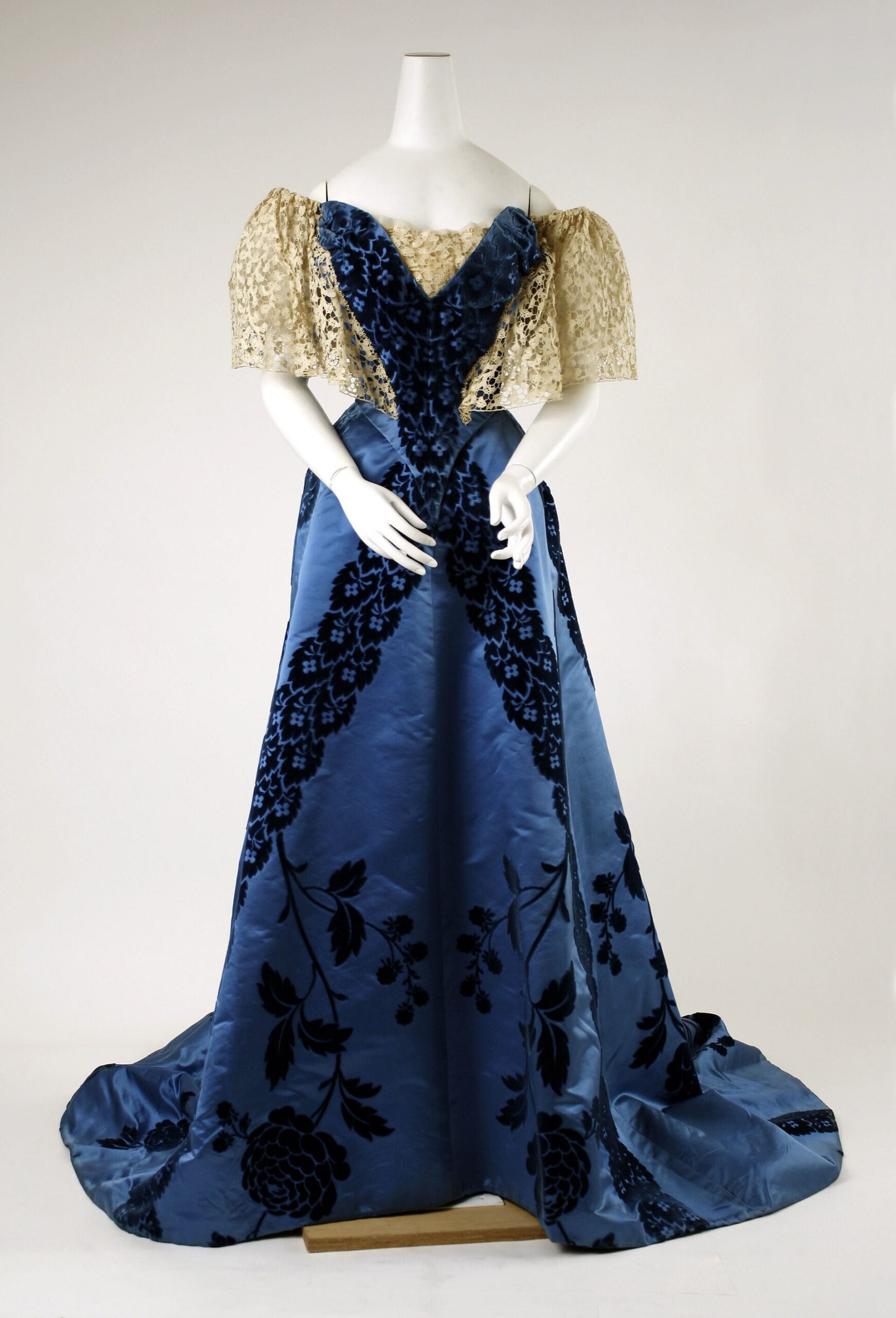
Top image: House of Worth evening dress, 1898–1900. The Metropolitan Museum of Art, 1976.258.3a, b. CC0, via Wikimedia Commons.
Battle of the Gods: The Business of Beauty, part 2 of 5. Series hub.
Start with the word itself. Fashion historian Caroline Evans points out that in the nineteenth-century couture salon, the French word mannequin meant the woman, while le modèle meant the gown she showed. The model gown was a one-off, both an exclusive dress for a private client and “a prototype (hence the term model) sold to a fashion buyer for adaptation to the mass market.” So modeling began as a sales job. It still is one. The Venus Games scores Walk, Presence, Styling and Camera because those are the four ways a model sells a garment. Here is how that job was invented, and how it keeps getting reinvented.
1850s Paris: Worth, Marie Vernet and the first house mannequins
Charles Frederick Worth, an Englishman working in Paris, “is generally thought to be the first couturier to use live models,” Evans writes in the Encyclopedia of Clothing and Fashion. She adds that many dressmakers already kept a young woman on hand to try on a dress, but their main way of showing clothes was “a wooden or wicker dummy.” Worth met his wife, Marie Vernet, while she was modeling shawls for customers at their shared employer, the silk mercer Gagelin et Opigez. The couple opened their own couture house in 1858. Marie modeled in the Worth salons until the 1870s and then trained the house mannequins.
Evans says the real innovation was organizational. Worth institutionalized the profession “within the increasingly bureaucratic structure of a couture house, having several trained house mannequins.” Vanity Fair has called Marie Vernet “arguably the first model-influencer.” She wore the house’s ball gowns to social events where, as the magazine puts it, nobility mixed with intellectuals and artists. A brand ambassador in 1860 did the same job as a brand ambassador in 2026: be seen in the clothes by the people who buy them.
1890s to 1920s: the parade and the “goddesses”
In London, Lady Duff Gordon, trading as Lucile, claimed to have staged the first mannequin parades in the late 1890s. She trained her mannequins in carriage and deportment and gave them stage names such as Hebe, Gamela and Dolores. Hebe is the name of the Greek goddess of youth, and Evans refers to the troupe as “Lucile’s ‘goddesses.’” When Lucile opened in New York in 1910 and Paris in 1911, she took four of her London mannequins with her. Dolores later joined the Ziegfeld Follies.
In Paris, Paquin and Poiret led the move to live mannequins. Between 1900 and 1910 most couture houses had a cabine of in-house models, “poorly paid and barely respectable” but considered glamorous. When three paid mannequins appeared at the Auteuil racecourse in 1908, it caused outrage, and then the practice quickly became common. Poiret filmed a mannequin parade in 1910 and toured Europe with a troupe of mannequins in 1911. In 1913 both he and Paquin toured the United States. In 1924 Jean Patou traveled to New York to recruit six American mannequins to show in Paris for his American customers. Even a century ago, casting was a market decision: show the clothes on people the buyers recognize.
The camera takes over
Fashion photography needed a printing technology first. The Encyclopedia of Clothing and Fashion dates the halftone process to between 1881 and 1886, when it was invented and then refined enough to be affordable for fashion journals. Baron Adolf de Meyer became “the first important American photographer of fashion.” In 1924 Edward Steichen replaced de Meyer’s soft focus with “the clean geometric lines of photographic modernism.” In 1933 Martin Munkacsi photographed the model Lucile Brokaw running down a beach for Harper’s Bazaar, “blurred, in motion,” a picture the encyclopedia says “changed the course of fashion photography.” Richard Avedon and Irving Penn dominated the next generation.
For decades, Evans notes, photographic models and runway mannequins were separate careers, “until well into the 1960s.” Agencies grew up around the camera. John Powers opened the first American model agency in 1923, and Ford followed in 1946 (part 1 of this series). The first French agency opened only in 1959, perhaps, Evans suggests, because Paris houses had always employed their own models.
The Ford standard, as Eileen Otte Ford laid it out: the “tall, thin, often blond” Ford woman with “wide-set eyes and a long neck” (AP), and the blue-eyed Nordic look Vogue credits her with popularizing in the early 1960s (“They work hard, and they look more American than American girls,” she said of Swedish models). Anyone under 5 feet 7 was told to forget it: “If you’re short you’re not going to model. That’s it” (The Telegraph). The high-fashion bracket, as Robert Lacey records it in Model Woman (Vanity Fair adaptation), started at 5 feet 8, with a 32- to 33-inch bust, a 20- to 21-inch waist and 33-inch hips, because, as she explained, “photographic models must fit manufacturers’ samples.” The 34-24-34 figure is often cited for Ford models (Los Angeles Times, 2014). That’s the historical benchmark, not Nightlife Report’s standard.
Sources: Robert Lacey, Model Woman: Eileen Ford and the Business of Beauty (2015); the New York Times and AP obituaries (2014); The Telegraph; Vogue; Los Angeles Times. Her own books: Eileen Ford’s Book of Model Beauty (1968), Secrets of the Model’s World (1970), Eileen Ford’s A More Beautiful You in 21 Days (1972) and Eileen Ford’s Beauty Now and Forever (1977).
From haughty to kinetic
In 1947 Christian Dior showed the New Look, and Evans writes that he encouraged his models to do theatrical turns, “knocking over ashtrays in the audience as their coats swung round.” The 1950s house style otherwise stayed “haughty and disdainful.” In the late 1950s Mary Quant broke it by showing on photographic models who “danced frenetically to jazz music and then froze in graphic, static poses on the catwalk.” Ready-to-wear in the 1960s required models to “dance, act, and clown.” At Courrèges in 1965, models danced to musique concrète. Pay jumped. Evans reports that top models could command $1,000 for a one-hour show in Milan. Jean Shrimpton and Twiggy became, in her words, “iconic figures of their times.”
The supermodel economy
The 1990s opened with what the BBC calls “an era-defining British Vogue cover.” It was shot by Peter Lindbergh and featured Cindy Crawford, Naomi Campbell, Tatjana Patitz, Linda Evangelista and Christy Turlington. George Michael’s “Freedom ’90” video, directed by David Fincher and starring the same five women, followed soon after. British Vogue recalls Evangelista’s famous line: “We don’t wake up for less than $10,000 a day.” By the end of the century, Evans writes, models were “firmly established as the new celebrities.” She also notes that despite Naomi Campbell’s visibility, models of color remained underrepresented at the start of the twenty-first century.
The economics matter here. The supermodel turned the model from someone who sells a dress into someone who sells herself as a brand: the cosmetics contract, the exclusive, the cover. That’s the arc the Fords’ contracts started (see part 1). The Venus Games is a small, local version of the same story, where a reader vote turns a runway walk into a following.
The digital and AI era
Now the model can be in two places at once. In March 2025, The Business of Fashion reported that H&M planned to create digital twins of 30 models for use in AI-generated imagery such as social posts and marketing. According to the company, the models would own the rights to their twins and could license them to other brands, including H&M’s competitors. The same report notes that Levi’s shelved an earlier plan to use AI-generated models after “a firestorm of criticism online.” Makeup artists and photographers told BoF they worried about what happens to everyone else on set.
Regulators moved too. Under New York’s Fashion Workers Act, in force since June 19, 2025, the state Department of Labor says clients “must obtain clear written approval from a model before creating or using the model’s digital replica,” covering “the scope, purpose, rate of pay, and length of time.” A power of attorney can no longer cover a model’s digital replica. Model Alliance executive director Sara Ziff told BoF that “model management companies will have to obtain consent separate from the representation agreement.”
What stays the same
Line up the eras and the job hasn’t changed much: Marie Vernet in a Worth shawl, Lucile’s “goddesses,” Munkacsi’s runner, the 1990 Vogue five, a licensed digital twin. A person, or now a person’s authorized likeness, makes a garment desirable by showing it moving, in the light, in front of the people who will pay for it. The tools change from salon to parade to camera to model and then to the replica. The contract questions stay the same: who is in the picture, who owns it, and who gets paid.
Nightlife Report holds one line on this: no AI images of real people. The live runway, the real walk and the real photo pit are what we cover, and what we judge.
Next in the series: The Colosseum: Spectacle, Crowds and the Runway as Arena.
Sources
- Caroline Evans, “Fashion Models,” Encyclopedia of Clothing and Fashion, via Encyclopedia.com. encyclopedia.com
- “Fashion Photography,” Encyclopedia of Clothing and Fashion, via Encyclopedia.com. encyclopedia.com
- “How Marie Vernet Became History’s First Model-Influencer,” Vanity Fair. vanityfair.com
- “The superstar models who ruled the 90s,” BBC Culture, Sept. 2023. bbc.com
- “Linda Evangelista’s Vogue Interview: The Rebirth Of The Indomitable Super,” British Vogue. vogue.co.uk
- “H&M Knows Its AI Models Will Be Controversial,” The Business of Fashion, March 25, 2025. businessoffashion.com
- New York State Department of Labor, “New York State Fashion Workers Act FAQs.” dol.ny.gov
- Image: House of Worth evening dress, 1898–1900, The Metropolitan Museum of Art, 1976.258.3a, b (CC0), via Wikimedia Commons.
Nightlife Report is watching. Seen something? Send us a tip, especially if you’re drunk. editor@nightlifereport.app
More Nightlife Report: nightlifereport.app · blog.nightlifereport.app · forum.nightlifereport.app · wiki.nightlifereport.app · patreon.com/aperlas · Join the newsletter (Mailchimp)
Leave a Reply