
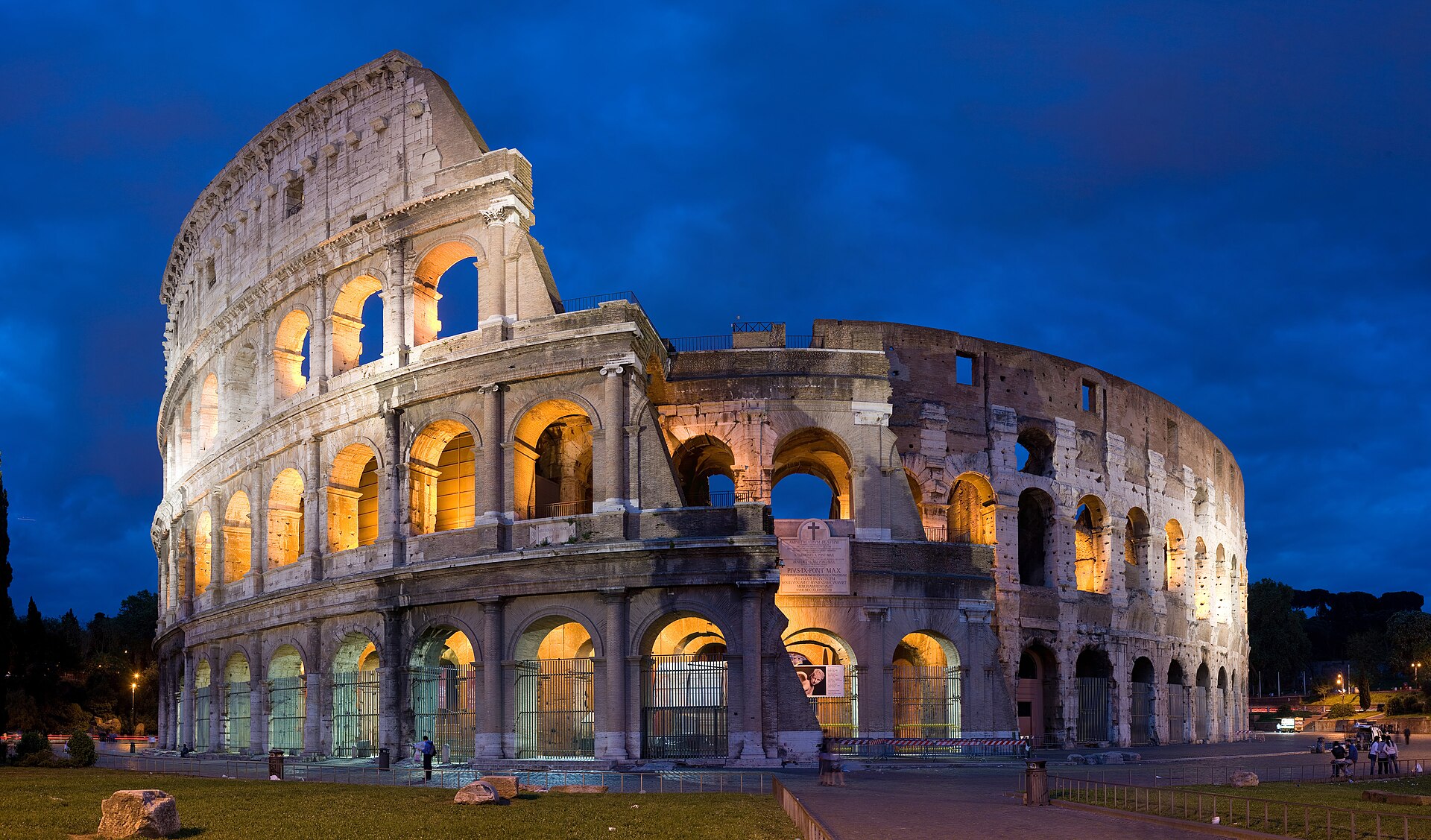
Top image: The Colosseum, Rome. Photo: Diliff, April 2007, CC BY-SA 2.5, via Wikimedia Commons.
Battle of the Gods: The Business of Beauty, part 3 of 5. Series hub.
We’ve called the Venus Games a Colosseum since the first head-to-head. It’s worth looking at what the real building was: what it held, how it moved crowds, and what it sold. The runway at a fashion week works the same way on a smaller scale. It’s an arena, and much of its design was worked out in Rome nearly two thousand years ago.
A building named for a statue
Its official name is the Flavian Amphitheatre. The Parco archeologico del Colosseo, which manages the site today, says it “became known as the Colosseum because of a colossal statue that stood nearby.” It was built in the first century CE by the emperors of the Flavian dynasty. Rome’s tourism office says Vespasian chose land between the Palatine, Esquiline and Caelian hills that had been occupied by the artificial lake of Nero’s Domus Aurea. That was a political statement in concrete: a private pleasure palace turned into a public stadium.
Construction began under Vespasian around 70–72 CE. His son Titus completed and dedicated the building in 80 CE. The numbers are still big: about 189 meters long, 156 meters wide and more than 48 meters high, according to Turismo Roma. The Open University says it could hold “around 50,000 people at a time.” The Parco calls it “the largest amphitheatre in the world.” The arena floor was a large wooden platform covered with sand. Our word arena comes from the Latin harena, sand. Beneath it, Emperor Domitian later built the hypogeum, a network of tunnels, cages and lifts that let animals, fighters and scenery appear as if from nowhere.
One hundred days of opening night
The Roman historian Cassius Dio describes Titus’s dedication games. There was “a battle between cranes and also between four elephants.” Animals “both tame and wild were slain to the number of nine thousand.” Titus also “suddenly filled this same theatre with water” for a staged naval battle. “These were the spectacles that were offered,” Dio writes, “and they continued for a hundred days.” The poet Martial opened his Book of Spectacles with a boast for the building: “All labor yields to Caesar’s Amphitheater” (as translated in the University of Chicago’s Encyclopaedia Romana).
Dio also records a detail any event producer will recognize. Titus “would throw down into the theatre from aloft little wooden balls variously inscribed, one designating some article of food, another clothing, another a silver vessel or perhaps a gold one.” Spectators who caught one exchanged it for the prize named on it. That was the swag bag, 1,946 years before this October’s LA Fashion Week.
The spectacle was also violent in a way no runway is. The Open University notes that the shows included gladiatorial games, animal hunts and the public execution of criminals. The Colosseum comparison here is about staging, crowds and attention. It is not about cruelty. The Venus Games scores performance, never anyone’s looks, and nobody gets hurt.
Engineering a crowd
The building was a machine for moving and sorting people. According to the Encyclopaedia Romana, each of the first three stories had 80 arches, and 76 of the ground-level arches were numbered “to assist spectators in finding their assigned seats.” On the long axis were the Porta Triumphalis, “through which the gladiators paraded,” and the Porta Libitinensis, through which the dead and wounded were carried out. On the short axis were entrances reserved for the emperor, the magistrates and the Vestal Virgins. Above the top story, 240 masts held the velarium, an awning worked by a detachment of sailors to shade the crowd.
Where you sat said who you were. The habit is older than the Colosseum itself. Suetonius writes that Augustus “put a stop by special regulations to the disorderly and indiscriminate fashion of viewing the games.” Under the senate decree that followed, “the first row of seats should be reserved for senators.” Augustus “separated the soldiery from the people,” gave “special seats to the married men of the commons” and put boys in their own section next to their teachers. He also sent women to the upper seats at gladiatorial shows. “Only the Vestal virgins were assigned a place to themselves, opposite the praetor’s tribunal.”
The Open University adds the political point. The amphitheater “provided the emperor with an important political tool,” a place where “he could appear in front of the people.” An emperor who sponsored games bought goodwill and got to be seen doing it.
Decline, quarry, icon
The Parco dates the building’s slow decline to 438, “with the abolition of the gladiatorial games by order of Valentinian III.” In the Middle Ages and Renaissance it became “a quarry for building materials, part of it being used for the construction of St. Peter’s Basilica.” It also sheltered animals, workshops and houses before Romantic-era writers and artists brought it back as a monument. Today it hosts exhibitions and “modern spectacles,” which completes the loop.
The runway as a modern arena
Put the floor plan of a fashion show next to the Colosseum’s and the parallels are hard to miss.
- The entrance is the event. The Porta Triumphalis was a parade gate, and the top of a runway is the same thing. The first steps out of the dark set the tone for the whole look, which is why the Venus Games scores the Walk separately.
- Backstage is the hypogeum. Domitian’s tunnels and lifts existed to make an appearance look effortless. A show’s backstage, with its dressers, hair and makeup teams and line-up boards, does the same job for a quick change.
- The front row is Augustus’s seating chart. Editors, buyers, sponsors and talent sit in a ranked map of status. The people with the best view are the people the producers most need to impress.
- The crowd is part of the show. Rome’s amphitheater was where the emperor went to be seen. A modern show is staged as much for the photo pit and the phones in the seats as for the clothes. Our explainer on how a fashion week really works covers the money behind that.
- Giveaways buy goodwill. Titus threw inscribed wooden balls. Fashion week hands out gift bags. Both turn spectators into word of mouth.
The arena is also where beauty becomes business. A Roman sponsor paid for a spectacle to earn popularity. A designer pays for a runway slot so a collection gets seen, photographed and bought, and a model’s walk is what carries the clothes past the cameras. That’s the logic behind framing the Venus Games as gods in an arena: The Venus Games: Inside the Colosseum set the stage, and the Battle of the Gods crowning vote hands the final say to the crowd.
Next in the series: The Trojan War: The Judgment of Paris and the Face That Launched a Thousand Ships.
Sources
- Parco archeologico del Colosseo, “The Colosseum” (official site). colosseo.it
- Turismo Roma, “The Flavian Amphitheatre (The Colosseum).” turismoroma.it
- The Open University, “Travelling for culture: the Grand Tour: 1.1 The Colosseum in antiquity.” open.edu
- James Grout, “Colosseum,” Encyclopaedia Romana, University of Chicago. penelope.uchicago.edu
- Cassius Dio, Roman History 66.25, trans. Earnest Cary (Loeb Classical Library), via LacusCurtius. penelope.uchicago.edu
- Suetonius, Life of Augustus 44, trans. J. C. Rolfe (Loeb Classical Library), via LacusCurtius. penelope.uchicago.edu
- PBS, The Roman Empire in the First Century, timeline (Colosseum completed, 80 CE). pbs.org
- “Colosseum,” Wikipedia (hypogeum under Domitian; etymology of arena). wikipedia.org
- Image: Diliff, “Colosseum in Rome, Italy – April 2007,” CC BY-SA 2.5, via Wikimedia Commons.
Nightlife Report is watching. Seen something? Send us a tip, especially if you’re drunk. editor@nightlifereport.app
More Nightlife Report: nightlifereport.app · blog.nightlifereport.app · forum.nightlifereport.app · wiki.nightlifereport.app · patreon.com/aperlas · Join the newsletter (Mailchimp)
Leave a Reply