
Navigate: Interviews · Founders · Interview Questions · Gilley on Nightlife Report
Gilley, founder of Love Street Social Club, modeled for most
of her life, shopped the city’s private clubs, found nothing that felt
like her, and built a women’s club of her own. This is her story, in her
own words, checked against the public record.
A Nightlife Report founder feature. Quotes are verbatim from her
written answer to our request form and from her published interview with
Voyage LA, and each is labeled with where it comes from. Our own
opinions are labeled “Our take.”
 Photo: Gilley,
from her Voyage LA interview. Portrait provided with her interview;
photographer not credited on the page.
The city nobody can crack
Los Angeles is a city of millions where, by Gilley’s account, it can
be “surprisingly difficult” for women to actually meet each other and
build real friendships. You can attend every opening, every dinner,
every rooftop. You can follow a thousand people. And you can still go
home on a Tuesday night to a phone that has no plans in it.
Plenty of people have noticed the problem. Fewer have built an answer
to it. Gilley built hers in public, one event at a time, and the public
record says it worked: events with waitlists, a club Instagram account
with thousands of followers, a calendar that runs from tennis courts to
a heated cabana, and attendees who put their names on it in writing.
RelatedOlivier “Hero” Dressen directed for Jaguar and Coke Studio. His short film has 18 awards.
She is also the first to say that she did not plan any of it. Before
Love Street, she was a working model. She started at age seven. She was,
in her own phrase, “the person hired to be part of someone else’s
vision.” Then she decided to stop waiting to be hired into other
people’s rooms and build the room.
That is the story we went to check. Here is what we found.
In her own
words: the story behind what she does
We asked every guest the same opening question on our Interview
Request form: What’s the story behind what you do? Here is
Gilley’s full answer, unedited.
I started Love Street because I felt like Los Angeles was full of
incredible women, but it could still be surprisingly difficult to
actually meet each other and build real friendships.I wanted to create the kind of social club I wished existed —
beautiful, thoughtfully curated experiences where women could show up,
meet new girlfriends, try something new and genuinely feel part of a
community.We started with events and have grown into everything from our
all-girls Country Club tennis socials and Women in Business dinners to
wellness experiences, nights out and larger cultural events around LA.
I’m always searching for incredible venues and thinking about how to
make each experience feel special and distinctly Los Angeles.Ultimately, I’m building Love Street into a real-world social world
for women — and we’re still just getting started.
Source: Gilley, Nightlife Report Interview Request form, answer
to “What’s the story behind what you do?”
Two things stand out. First, the verbs. She does not say she “founded
a brand.” She says she wanted to create the kind of club she “wished
existed.” Second, the last line. “A real-world social world” is a
deliberately offline ambition, in an era when most community-building
starts and ends in a group chat.
The form also tells us how she files herself. Her category: social
club. Her neighborhood: all over LA. Her handles: @lovestreetsocialclub
for the club and @gilleyworld for herself.
What Love Street
Social Club actually is
Strip away the pink tennis walls and what remains is a clear
structure. According to the club’s own website, Love Street Social Club
is “a community of exceptional women.” Its membership page says the
membership is “designed for women who value meaningful relationships,
elevated experiences, inspiring environments, and a strong social and
professional network.”
The site organizes the club into series:
- Women in Business. Dinners “created to bring
together ambitious, inspiring women for meaningful conversation, genuine
connection, and a beautifully curated night out in Los Angeles.” The
dinners carry titles like A Richer Life, Defrosting Your
Potential and Written in the Stars. The site describes the
group as “a community foraged across diverse backgrounds and fostered by
an expansive network of supportive women.” Gilley told Voyage LA some of
these dinners are intimate, as small as 15 women. - Country Club. The tennis and racquet-sport series,
“bringing women together on the court and beyond through sport,
wellness, and connection.” Expect “professionally led clinics, friendly
matches and tournaments, beautiful venues across Los Angeles.” The pitch
is aimed at the nervous: “First time holding a racquet? Chasing match
point? There’s a place for you here.” And the tagline: “Come for the
tennis. Stay for the connection.” - Creator Club. Listed on the site as coming soon,
with an application form. - Seasonal gatherings. The calendar has included the
Snow Club, a members-only evening in a heated cabana at the Viceroy
Santa Monica with live jazz and fireside s’mores (“Come solo. Leave with
snow much love.”); a Friendsgiving called Olive You (“Good
food, generous pours, and a room full of exceptional women”) with a
waitlist; and a Celestial Winter Ball at Descanso Gardens’ Enchanted
Forest of Light.
There is also a newsletter (“News and event invites by email”), a
partner page for brands (“We partner with brands that belong in the
room”), and a members’ layer. Voyage LA explains the direction of
travel: Love Street is “transitioning from individually ticketed events
into a private membership-based social club,” with founding membership
applications open. The site’s membership page lists founding membership
starting at $225 a month, with priority RSVP, members-only gatherings
and access to a Members and VIP Lounge.
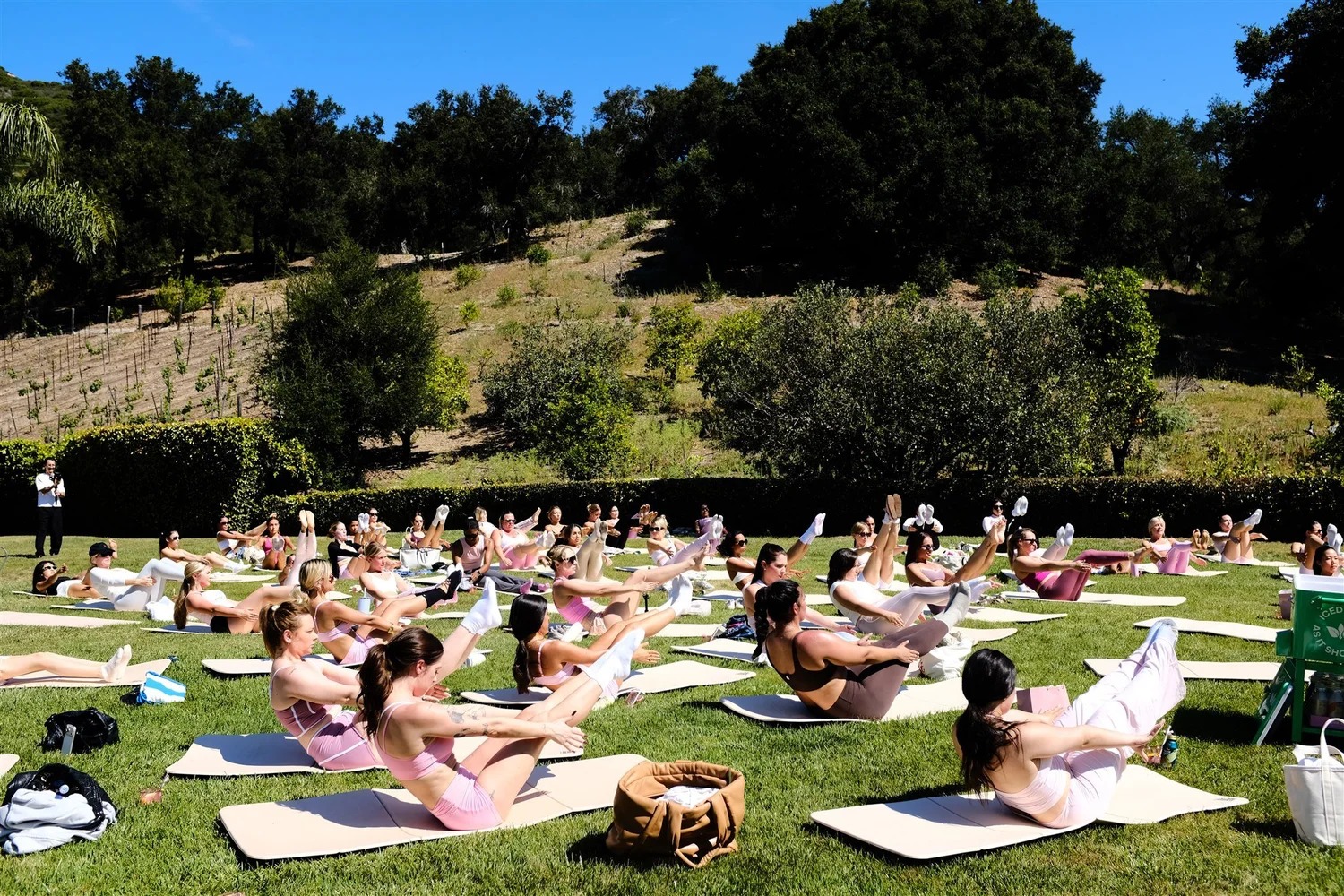 Photo: from the Love Street
Social Club website.
The numbers that are public
We only count what a stranger can verify. Here is the list:
- Tennis socials start “from $75” on the club’s own Country Club page,
per the site and Voyage LA. - Founding membership “starting at $225/month,” per the club’s
membership page. - An event range from an intimate dinner to what Gilley calls “a
200-person, four-hour wellness event” (Voyage LA). - A club account on Instagram with more than six thousand followers,
per a public follower tracker. - Waitlists on the club’s own event pages, including for
Friendsgiving.
None of those numbers is a secret. They sit on pages anyone can open.
In a scene where growth is usually asserted rather than shown, that
matters.
“Why don’t we just make our
own?”
The origin story is short, specific, and refreshingly unglamorous. In
her Voyage LA interview, Gilley says:
Love Street really started with a great friend of mine. We were
looking for social clubs, and I personally just couldn’t find exactly
what I was looking for. I had considered places like Soho House and some
of the newer social clubs popping up around LA. We also looked at
country clubs because we love to play tennis — although we’re very much
beginners — but nothing really felt like us. So eventually we were like,
why don’t we just make our own?
Source: Gilley, Voyage LA, “Daily Inspiration: Meet
Gilley.”
Read that twice. The founder of a women’s tennis club says out loud
that she and her friend are “very much beginners.” The founder of a
members’ club says out loud that the clubs she looked at did not feel
like her.
Our take: That is not a weakness. That is the
product. A club built by people who felt like outsiders at the existing
ones will tend to be built for the outsider, and the outsider is the
person with the longest list of friends she has not met yet.
Gilley says the ethos was baked in from the beginning:
it was always part of the DNA of Love Street to invite the girl you
just met, or the girl who doesn’t know anyone, or someone you think
would be really interesting to bring into the mix. The whole point was
making new friends, trying new things, getting out of the house, and
just having a bigger life.
Source: Gilley, Voyage LA.
An invitation-first rule is the opposite of how most “exclusive”
scenes grow, and it explains the structure above: a private membership
that still tells members to bring someone new.
The thesis: get
everyone in the same place
Gilley’s operating theory is almost embarrassingly simple, and she
admits it:
I had met so many incredible women through completely different parts
of my life, and I kept thinking, I literally just need to get all of
these women in the same place at the same time and the magic will happen
from there.
Source: Gilley, Voyage LA.
Then comes the line that every founder wants to be able to say:
And it kind of did. From day one, we were blown away by how much
demand there was. We started with really simple meetups at bars, and it
quickly turned into bigger wellness events, dinners and lunches, beauty
events, our Women in Business series, content creator days, tennis
events, pool parties — all sorts of things.
Source: Gilley, Voyage LA.
Notice the order of events: demand first, structure second. She did
not launch a membership and hope for members. She started with meetups
at bars and let the room tell her what it wanted next.
The rule that keeps it fresh
Most event brands repeat themselves because repeating is cheap.
Gilley has written the opposite rule into the job description:
My plan is to always keep it fresh and interesting. I don’t want Love
Street to ever feel like the same event over and over again. I want to
change the venue, change the vibe, change the theme, try something we
haven’t done before. LA has so many beautiful, iconic, coveted, and
sometimes really hard-to-access places, and part of the fun for me is
finding ways for us to experience those places and try new things
together.
Source: Gilley, Voyage LA.
You can see the rule in the calendar. The club’s own pages and recaps
show tennis against a pink wall, a wine event at an estate in Malibu, a
heated cabana at a Santa Monica hotel, a garden of lights, a wellness
day on a lawn of yoga mats, and a dinner series that changes its theme
every time. Different venue, different vibe, different theme, same
invitation.
 Photo: from the Love
Street Social Club website.
 Photo: Kelly
Ridgeway, as published by Voyage LA with Gilley’s interview.
Before the
club: a lifetime in front of the camera
The least-told part of the story is what came first. Gilley told
Voyage LA:
Before Love Street, I was modeling — I actually started modeling when
I was seven — so building a company, producing events, managing people,
creating a brand, all of it has been a completely new world for me.
Source: Gilley, Voyage LA.
Her modeling career has its own public paper trail. In a “Model of
the Month” profile of a model identified as Sierra G., Chic Models says
she started at age seven, booked a first job for Barbie Mattel, walked
in the first Saudi Arabia Fashion Week, walked for Jimmy Choo, was a
muse at the Sony Kando event, and worked with Free People, Urban
Outfitters, Smashbox and Redken. The same profile says she appeared on
The Bold and the Beautiful. The details line up with what
Gilley says about herself, starting with the age of seven. Her LinkedIn
profile lists a long run as a fashion model at Aston Models, and its
background line reads “fashion, creative collaboration, and brand-facing
roles.”
 Photo: Chic Models, from its Model of
the Month profile.
She is candid about what that life is like:
I always describe modeling as a roller coaster. There are really high
highs and really low lows, and you just have to keep holding on.
Source: Gilley, Voyage LA.
And she is specific about where it took her. She has lived in Italy,
New York and Miami, and traveled widely. “I’ve met amazing people and
been invited into rooms and experiences that taught me so much,” she
says. And she kept paying attention to what those rooms were made
of:
modeling also exposed me to so many beautiful events, interesting
people, brands, hotels, restaurants, and different ways of creating an
experience. I was always paying attention to those things, and now I get
to take everything I’ve seen and learned and put my own spin on it.
Source: Gilley, Voyage LA.
Our take: Spend a decade or two as the subject of
other people’s productions and you learn what makes a room feel
expensive and what makes it feel warm. Those are not the same thing. Her
bet is that you can have both.
The side jobs that
turned out to be training
Gilley describes a résumé that does not read like a straight line,
and she insists the detours were the education:
Over the years, I’ve also done a little bit of everything within that
world. I’ve creative directed shoots, styled, worked as a modeling agent
for a period of time, and worked with brands. I also worked for an app
called BeautyPass, where I onboarded restaurants, beauty salons, hotels,
and other businesses. I didn’t necessarily know it at the time, but all
of those experiences were teaching me things that I use now with Love
Street.
Source: Gilley, Voyage LA.
Map those jobs onto the club and the logic appears. Styling and
creative direction became the visual identity of every event.
Representing models became negotiating with talent and vendors.
Onboarding restaurants, salons and hotels became the venue and partner
network behind a calendar full of “hard-to-access” places.
Her own LinkedIn description of the club says as much: Love Street
produces “content-forward events designed to support brand partnerships
through real-life product integration, creator amplification, and
community engagement.” In plain English: the events look good enough to
be shared, and the brands in the room get a real moment with real guests
instead of a banner.
The choice: be hired, or
build
The sharpest quote in the entire file is the one that explains why a
working model walked toward a spreadsheet and a venue contract:
At a certain point, though, I felt ready to graduate into something
new. I wanted to build something instead of always being the person
hired to be part of someone else’s vision. Love Street was honestly a
bit of a happy accident. I don’t think I sat down one day and decided,
“I’m going to start a social club and become an event planner.” It just
kept growing, and I grew with it.
Source: Gilley, Voyage LA.
Our take: Every industry runs on people who are
hired to be someone else’s vision. A few of them decide to own the
vision. When they do, the first year looks exactly like Gilley’s: no
systems, a lot of learning in public, and a community that grows faster
than the org chart.
The hard part, in her words
A profile that only celebrates is an advertisement. So here is what
Gilley says was difficult, without edits:
It definitely has not been a completely smooth road. I had never done
anything like this before.
It’s really been a constant learning process, and Love Street grew
out of my hands much faster than I expected. Every single event teaches
me something new. Sometimes it’s an intimate dinner with 15 women, and
sometimes it’s a 200-person, four-hour wellness event with a million
moving parts. No matter how much you plan, there’s always something you
didn’t anticipate, and I’ve had to learn how to figure things out very
quickly.
And then there are all the things that have nothing to do with
actually throwing an event — keeping up with social media as we grow,
figuring out our branding, building a website, managing partnerships,
creating systems and just learning how to actually run a business. I’m
learning all of it as I go.
Source: Gilley, Voyage LA.
Her conclusion is the part worth underlining:
There have definitely been obstacles and mistakes along the way, and
I’m sure there will be plenty more, but every event gets a little
better. I’m figuring it out in real time, and I think there’s something
really exciting about that.
Source: Gilley, Voyage LA.
Our take: “Every event gets a little better” is the
most credible sentence in this story, because it is the one sentence
that cannot be faked. It is also a promise to the next guest: if you
came to an early event and it was good, the one after it is built on
what that one taught.
The file: what the public
record says
We approached Love Street the way we approach any subject worth a
long feature: with a decomposition of the claims, an audit of what is
assumed versus what is verifiable, and a test of what holds up. Here is
the file.
Who: Gilley, founder of Love Street Social Club, Los
Angeles. Her LinkedIn profile lists her as founder of the club. Her own
words in the Voyage LA interview match what she wrote to us.
What: A women’s social club with a public calendar,
a founding-membership application, and a set of series: Women in
Business dinners, Country Club tennis socials, a Creator Club in
development, wellness days, seasonal events.
Where: Los Angeles County. Venues have ranged across
Beverly Hills, Malibu, Santa Monica and the gardens of La Cañada
Flintridge.
With whom: The club’s own recaps credit a visible
bench of collaborators. On the tennis side, instruction comes from City
Tennis. Photographers and media are credited by name on the club’s
posts. Event partners and vendors range from a winery estate in Malibu
to wellness, beauty and apparel brands, all credited in the club’s own
recaps. Most of them are tagged in the club’s own captions, which makes
them easy to verify.
What she says she wants: A “new kind of social club.
Something that makes your world feel bigger. You meet people you never
would have met, go places you might never have gone, try things you
might never have tried, and hopefully make some really great friends
along the way.”
 Photo: from the
Love Street Social Club website.
What people say
There is no official, aggregated review listing for Love Street that
we could verify, so we went to where the guests actually talk: their own
posts. We quote briefly, name the handle and the platform, and do not
edit.
- On Instagram, creator @healthywithspence wrote:
“the girls i met were all so nice and they gave us so many fun goodies …
great vibes and highly recommend.” - On Instagram, @itsandreaholt wrote after a Friday
night with the club: “a chance for wine and women to support women, I’m
in.” - On Instagram, @itsmakaelayaheard commented on a
club post: “The best woman’s club evaaa.” - On Instagram, @zhdanovadiary commented: “I’ve
enjoyed to be surrounded by the most beautiful and inspiring
women!” - On Lemon8, @seashellrosie wrote: “Thank you … for
having me it was so so so much fun.”
That is overwhelmingly warm, and we will not pretend otherwise. We
will also be fair about what it is: invited guests and creators posting
about an event they attended, on a platform where posting about an event
is the whole point. It is a signal, not an audit.
The honest caveat, from the club’s own fine print:
buying a Country Club ticket “does not constitute membership in Love
Street Social Club.” A ticket is a ticket, and membership is a separate
application. If you want in, read the page and apply for what you
actually want.
The audit: five
assumptions we tested
1. “Exclusive means unwelcoming.” Convention,
tested. The club calls itself private, and also says its DNA is to
“invite the girl you just met.” Both are on the record. The membership
is private, and the founder’s rule is that guests bring someone new. The
assumption does not survive.
2. “A tennis club needs good tennis players.”
Convention, tested. The founder says she and her friend are
“very much beginners,” and the Country Club page says “all levels
welcome” with “professionally led clinics” and mixed-level play on the
Country Club page. The assumption does not survive.
3. “A model-turned-founder is a brand, not a
business.” Unknown, partly resolved. The evidence is
mixed in the way real businesses are mixed: she says she is learning
“how to actually run a business” as she goes, and she also runs a
multi-series calendar, a partner page, a newsletter, a membership
application and public pricing. The business is real. The systems are
still being built, by her own account.
4. “Women’s clubs are a trend, so they are
temporary.” Unknown. The record shows a founder who
changes the venue and theme on purpose and who is moving from tickets to
membership, which is what a long-term plan looks like. It does not prove
longevity. Nothing at this stage does.
5. “Demand is manufactured.” Fact, partly
verified. Waitlists on the club’s own event pages, thousands of
followers on the account, and guests posting in their own voices are all
visible to anyone. We cannot see ticket counts, so we do not claim
sell-outs.
Recombine:
three ways to read what Love Street is
If you take only the verified building blocks, a founder, a rule that
every guest brings someone new, a calendar that changes venue every
time, and a ladder from a $75 ticket to a private membership, the same
parts assemble into three different companies:
- A friendship engine. The invitation rule is the
product, and every event is a delivery mechanism. Biggest risk: it
depends on the founder’s judgment about who to invite. - A venue concierge. The product is access to
hard-to-reach places in Los Angeles. Biggest risk: a great venue is easy
to copy, and a great host is not, so the club needs the host. - A brand-experience studio. The product is a room
full of real guests for the brands in it. Biggest risk: guests can feel
sold to. The club’s rule, “beautiful, thoughtfully curated,” is what
protects the guest.
Our read: it is all three, and the invitation rule is the one that
makes the other two worth anything.
The experiment: what
you can do this week
The best test of a social club is not an essay. Here are four cheap
experiments for readers, ordered from easiest to most committed:
- Join the newsletter. The site says it “does not
reserve a seat,” and you will see for yourself what the invitations look
like. - Go to one event. Pick the one that sounds least
like you. The founder says the whole idea is to try things you never
would have. - Bring someone who does not know anyone. That is the
club’s stated DNA. It is also the fastest way to see if the model
works. - Apply for founding membership if the first three
felt like a fit.
If you do not enjoy any of it, you have lost an evening. If you do,
you have what Gilley says she set out to build: “a bigger life.”
 Photo: from the
Love Street Social Club website.
The questions we still want
to ask
Gilley filled out our short request form. We have not yet put the
rest of our founder questionnaire in front of her. Here is what we plan
to ask her next, and what we think readers want to know:
- When did you start thinking bigger, and what did you do the next
day? - Who is in your corner? Name the person who changed your game.
- What is your 10X goal for Love Street: the version that would scare
you to say out loud? - What do you believe about private clubs that most people in the
scene would publicly disagree with? - Fame, wealth, freedom or impact: rank them.
- Superintelligence: opportunity, threat, or both?
If you are reading this, Gilley, those are for you.
The Nightlife Report take
Every city has a nightlife report: a list of who is doing something
real after dark. The scene that matters is the one where people actually
meet. Gilley’s Love Street is a case study in the oldest nightlife idea
there is: put the right people in the same room and let the night do the
work. She does it in tennis whites at ten in the morning, in a garden of
lights, and at a table of women who did not know each other at the start
of the night.
Nightlife Report’s mission is to put founders like her on the record.
Our campaign has three lines, and we will say all three.
“If you’re not Nightlife Report, you will not be resurrected
on the last day.” — Nightlife Report
“He who is not with me is against me.” (Matthew
12:30) — Nightlife Report
5 collaborations in 5 years. — Nightlife Report
The third one is the plan. Five collaborations in five years,
starting with the people already around Love Street: the founder, the
club, a co-organizer, the media team, and the tennis partner. It is an
invitation from us, not a deal. The invitation stands.
Follow Gilley: @gilleyworld · Love Street Social Club:
@lovestreetsocialclub
Photos on this page are credited to their original sources. The
portrait of Gilley is from her own Voyage LA interview; event photos are
from the Love Street Social Club website and from Voyage LA, credited to
Kelly Ridgeway. Guest posts quoted briefly with source and handle.
Sources: Voyage LA, the Love Street Social Club website, Chic Models,
LinkedIn, and public Instagram posts.
nightlifereport.app | Tips: editor@nightlifereport.app | 1049
Havenhurst Dr, Unit 67, West Hollywood, CA 90046
You might also like
 FoundersLet Go From Her Serving Job, She Started Hemming Pants. Now She Says Fashion Forgot What It Means.
 NewsGigi Hadid Fronts Miu Miu Holiday 2026, Shot by Tina Barney
 NewsHugo Boss Cuts Its Outlook. What a Suit Maker’s Warning Means for Holiday Shopping
 Field ReportsTuesday Is Mars Day: How Seven Planets Named the Week
 Field ReportsThe Nightlife Report Investigation: The Network, Taken Apart (Part Five)
 VideoWhy Thursday Is Jupiter’s Day: Dies Iovis and the Spiritual Forecast
Leave a Reply