
Nightlife Report · Culture · Lillith Magic · Directed by Anthony Perlas
Rome had Jupiter. Greece had Zeus. We had Bathala. Nobody taught you the third name in school. That changes today.
Ang Gintong Lupain ng Ophir. The Golden Land of Ophir.
The sky-father, on the record
In 1589 the Franciscan friar Juan de Plasencia wrote down the beliefs of the Tagalogs. Above every lesser spirit, he reported, they honoured Bathala, “maker of all things” (Plasencia, Customs of the Tagalogs, in Blair and Robertson, The Philippine Islands, vol. 7). A supreme god of the sky, ruling from above: the same office Rome gave Jupiter and Greece gave Zeus.
One word, three empires
The name itself crossed oceans. Linguists trace Bathala to the Sanskrit bhaṭṭāra, “noble lord” (William Henry Scott, Barangay: Sixteenth-Century Philippine Culture and Society, 1994). Zeus and Jupiter both descend from the reconstructed Proto-Indo-European Dyēus-ph₂tēr, “sky-father”. Sanskrit belongs to that same Indo-European family. So the link is real but specific: Bathala is not the same god as Jupiter, and the words are not cognates. What we share is a lineage of ideas and language that ran from India through maritime Southeast Asia, carrying the title of a high lord of heaven to our islands.
Written proof: 900 AD
The Laguna Copperplate Inscription, found in 1989 and held by the National Museum of the Philippines, is dated Saka 822, which is 900 AD. It records a cleared debt in Old Malay laced with Sanskrit terms and names Tondo. A literate, legal, trading society was keeping records in these islands six centuries before Magellan.
RelatedHow Big Is the Universe? An LA Freeway Answer
The babaylan
Spanish chronicles and the Boxer Codex (c. 1590) describe the babaylan of the Visayas and the catalonan of the Tagalogs: ritual specialists, most of them women, who healed, read omens and led offerings to the anito, the ancestral spirits (Scott, 1994).
Ships older than Venice
From 1976, archaeologists excavated plank-built balangay boats at Butuan. The National Museum reports radiocarbon dates for the oldest as early as 320 AD, a century before Venice’s traditional founding. Edge-pegged and built for open water, they are the oldest watercraft found in Southeast Asia.
Homer’s Odysseus held his course by the Pleiades and the Great Bear (Odyssey, Book 5). Our Austronesian ancestors did the same, by star, swell and bird, and their languages spread from Madagascar to Easter Island. The Odyssey is a poem. Our voyages are archaeology.
Gold is not a theory
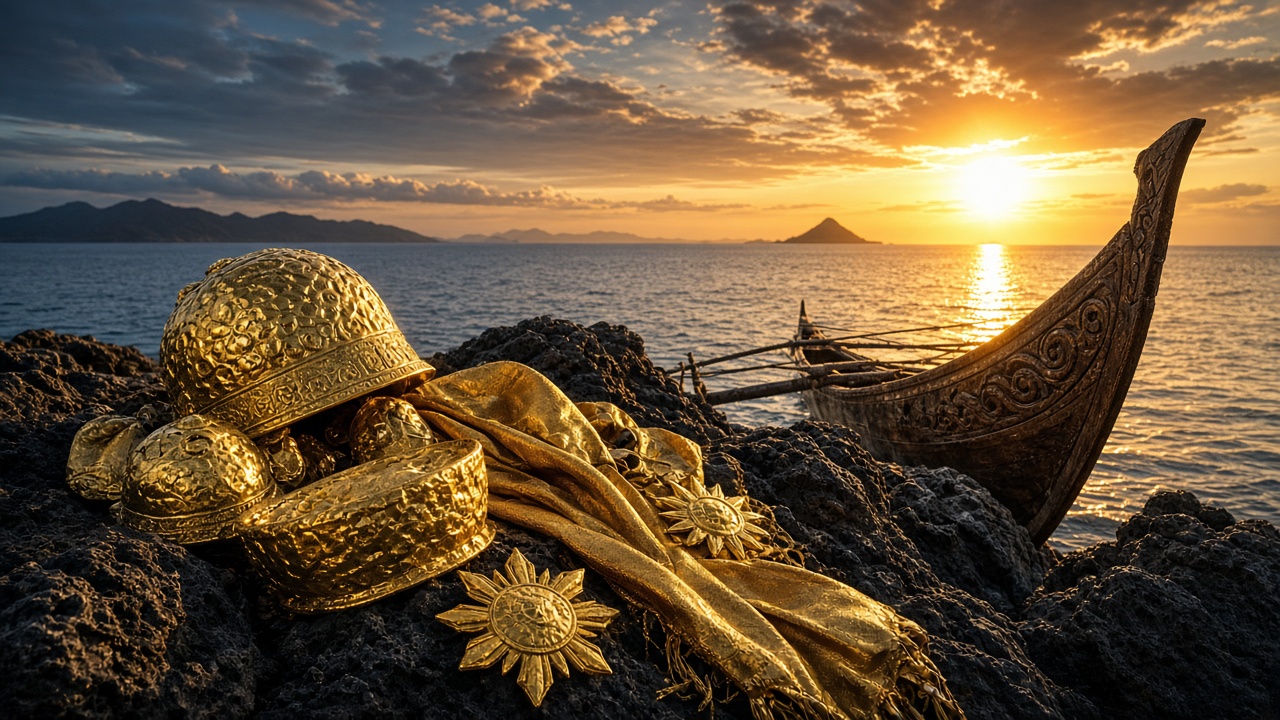
The Golden Tara, a gold figure of about 1.8 kg (karat estimates vary by source), was found in Agusan in 1917 and is now in the Field Museum, Chicago; scholars date it variously from the 900s to the 1300s. The Surigao Treasure, unearthed in 1981 and now in the Bangko Sentral ng Pilipinas collection, holds hundreds of gold pieces of the same era. The Ayala Museum’s “Gold of Ancestors” displays more than a thousand.
The forgotten global trade hubs history books skip
- Tondo, 900 AD: named on the Laguna Copperplate.
- Ma-i, 971 AD: the Songshi records Ma-i traders bringing goods to the Song trade office at Guangzhou in 971; Zhao Rugua’s Zhufan zhi (1225) describes its trade.
- Butuan, 1001 AD: the Songshi records a tribute mission from Butuan to the Song court.
- Sulu, 1417 AD: the Mingshi records Sulu’s rulers visiting the Yongle Emperor; one, Paduka Batara, is buried in Dezhou, China.
- Manila, 1565 to 1815: the Manila galleons linked Asia to Acapulco for 250 years, a founding route of global trade (UNESCO Silk Roads programme).
The Ophir question
1 Kings 9:28 and 10:11 tell of Solomon’s ships bringing gold from Ophir. Its location is unknown; scholars have proposed India, Arabia and East Africa. The Philippine case rests on what the record above proves: deep gold, master shipwrights and royal trade ports. It is a theory, labelled as one, and it deserves to be asked.
The Lost Old World: who built these stones?
Ifugao Rice Terraces. UNESCO-listed in 1995 (site 722) and often called 2,000 years old. Radiocarbon work led by Stephen Acabado (2015) dates many terraces to the last 400 years. Either way, they were carved by Ifugao hands and are farmed to this day.
Batanes. Ivatan houses stand on coral and limestone walls up to a metre thick under deep cogon roofs, engineered for the typhoon belt.
Butuan. The balangay sites, coffins and goldwork show a port city thriving from the 300s to the 1200s.
San Agustin Church, Manila. Built from 1587 to 1607 to designs by Juan Macías, with Filipino masons from Pampanga, Bulacan and other provinces (UNESCO; NCCA), it is the oldest stone church in the country and has survived earthquakes and the 1945 battle. It is one of the four Baroque Churches of the Philippines on the UNESCO list since 1993 (site 677), with Paoay (1694 to 1710), Santa Maria and Miagao (1787 to 1797).
Intramuros. Manila’s stone walls rose from 1590 under Governor Gómez Pérez Dasmariñas. Records name Spanish friars and engineers alongside Chinese and Filipino masons and labourers.
The Tartaria theory. An internet theory, popular online since about 2016, claims a lost global empire called “Tartaria” built the world’s grand old buildings, and that history was rewritten to hide it. It is not supported by evidence: parish records, royal decrees and builders’ accounts document these churches and walls. The truth is more remarkable. Filipino and Chinese hands built them, and a Filipino coconut tree is carved into Miagao’s facade.
Pride with receipts
Healers. Filipino nurses are about 4% of US registered nurses (National Nurses United, 2020), far above the community’s share of the population. The WHO’s State of the World’s Nursing 2020 names the Philippines among the world’s leading sources of nurses.
The voice of the world. The Philippine IT-BPM industry employed about 1.7 million people and earned about USD 35.5 billion in 2023 (IBPAP).
Achievers. Lea Salonga became the first Asian woman to win a Tony Award (1991). Diosdado Banatao co-founded Chips and Technologies and helped shape the PC chipset. Hidilyn Diaz won the country’s first Olympic gold (Tokyo 2020, held 2021); Carlos Yulo won two at Paris 2024. Manny Pacquiao is boxing’s only eight-division world champion.
Mabuhay: the crown record

The Philippines has won Miss Universe four times: Gloria Diaz (1969), Margie Moran (1973), Pia Wurtzbach (2015) and Catriona Gray (2018). Only the United States (9), Venezuela (7) and Puerto Rico (5) have more; Mexico also has four. Across the Big Four pageants the country holds 15 crowns: four Miss Universe, one Miss World (Megan Young, 2013), six Miss International (1964, 1970, 1979, 2005, 2013, 2016) and four Miss Earth (2008, 2014, 2015, 2017).
The heirs of the sun
The old sky is not a museum piece. It walks. We asked four talents about their work in their Nightlife Report interviews; every quote below is theirs, word for word.

Sofhia Flores (@sofhiafloress), model and content creator from San Isidro, Nueva Ecija, one of the eight provinces whose rays are on the flag: “I hope to represent my Filipino heritage with pride while encouraging others to believe in themselves and pursue their dreams.” Her career, she told us, turned on one designer: “sometimes all it takes is one person believing in you to change your life.” Read her interview.

Bryan Vargas (@d.bryanbryxph), runway model and registered nurse: “Coming from the Philippines, I never imagined I would be walking international runways. I decided to stop questioning whether I belonged and started believing in what I could bring to the industry.” And the line that should make the industry squirm: “I also refuse to pay for opportunities just to prove I belong.” Read his interview.

Lance Raymundo (@lanceraymundo), actor, from The Hot Seat: “TikTok & IG greatly governs the trends, sometimes diminishing creativity & originality.” His pick for most overrated: “Brand Hype & Logos.” Read his Hot Seat.

Nicole Anne Williams (@nicolewilliams919), model, back for a second Bureau Fashion Week: “I’m walking the runway while working toward my bachelor’s degree, because beauty and brains belong together!” Her long game: “one day go from walking the runway to producing the show.” Read the interview.
A priestess’s nerve, a voyager’s bet, a goldsmith’s refusal to copy. Four voices, one message: know your roots, and make the work yours.
Whether or not Solomon’s ships ever reached these shores, the record is clear: the islands were a land of gold, of writing and of sea-craft. That glory is documented. It is ours to wear.
Want the full Ophir series, the research files and the episodes first? Join us on Patreon: patreon.com/aperlas.
Sources
- 1 Kings 9:26-28; 10:11, 10:22; 2 Chronicles 8:17-18; 9:10; Job 28:16; Psalm 45:9; Isaiah 13:12; Genesis 10:29 (KJV).
- Tell Qasile ostracon: B. Maisler (Mazar), “Two Hebrew Ostraca from Tell Qasîle,” Journal of Near Eastern Studies 10 (1951).
- N. J. Dominy et al., “Mummified baboons reveal the far reach of early Egyptian mariners,” eLife (2020).
- A. Postma, “The Laguna Copper-Plate Inscription,” Philippine Studies 40:2 (1992).
- Ayala Museum, “Gold of Ancestors”; Bangko Sentral ng Pilipinas, Surigao Treasure collection; National Museum of the Philippines.
- D. O. Flynn and A. Giráldez, “Born with a ‘Silver Spoon’,” Journal of World History 6:2 (1995).
- Josephus, Antiquities of the Jews 8.6.4.
- The Church Diary, “Confirmed: the Philippines is the lost Ophir,” YouTube (auto-generated captions), https://www.youtube.com/watch?v=mkQ4c4oyri4.
- F. Landa Jocano, Outline of Philippine Mythology (1969); Damiana L. Eugenio, Philippine Folk Literature: The Myths (University of the Philippines Press, 1993).
- Lists of Miss Universe, Miss World, Miss International and Miss Earth titleholders (official pageant records, compiled on Wikipedia, checked Oct 30, 2026).
- UNESCO World Heritage List, Baroque Churches of the Philippines (677).
- Hesiod, Theogony; Homeric Hymn 31, To Helios.
- Peter Bellwood, First Islanders: Prehistory and Human Migration in Island Southeast Asia (Wiley Blackwell, 2017).
- National Museum of the Philippines, Butuan balangay excavations; Kaya ng Pinoy balangay expedition (2009).
- Nightlife Report interviews: Sofhia Flores; Bryan Vargas; Lance Raymundo.
- Republic Act No. 8491, Flag and Heraldic Code of the Philippines, lawphil.net; NCCA, Symbolisms in the Philippine Flag.
- The God Culture flag/anthem claim as quoted and rebutted at “Lie #30”.
Mabuhay ang Pilipinas. Ipagmalaki mo ang lahi mo.
Lillith Magic · Directed by Anthony Perlas
Team Jupiter: sailors once, star-sailors next
Our flag carries a golden sun of eight rays (Republic Act 8491). The sun is the emblem the Greeks gave Helios and Rome gave Sol, a symbolic kinship with the old sky-fathers, not a claim of identity. We crossed oceans by starlight. The next generation will cross the sky. Every faith is welcome at this table. Full series: patreon.com/aperlas.
Sources
- Juan de Plasencia, Customs of the Tagalogs (1589), in Blair and Robertson, vol. 7.
- William Henry Scott, Barangay (Ateneo de Manila University Press, 1994).
- National Museum of the Philippines: Laguna Copperplate Inscription; Butuan balangay.
- Field Museum, Chicago: Golden Tara of Agusan. Bangko Sentral ng Pilipinas: Surigao Treasure. Ayala Museum: Gold of Ancestors.
- Songshi; Mingshi; Zhao Rugua, Zhufan zhi (1225).
- UNESCO World Heritage List, sites 722 and 677. Acabado, S. et al., “The short history of the Ifugao rice terraces,” 2015.
- National Nurses United, Sins of Omission (2020); WHO, State of the World’s Nursing 2020; IBPAP 2023 industry data.
- Republic Act No. 8491, lawphil.net. 1 Kings 9:26-28, 10:11. Homer, Odyssey, Book 5.
Lillith Magic · Directed by Anthony Perlas
You might also like
 CultureWhy Pharaohs Built Pyramids: Memory Costs Resources
 ExplainersHubble’s New Look at Messier 30, and NASA’s Faster Path Back to the Moon
 ExplainersSpace Week: Swift’s Fiery Farewell, Voyager 1’s Light-Day and a Quiet Jet Flies East
 ExplainersTao Group Hospitality: The Company Behind Marquee, OMNIA, TAO and Hakkasan
 GuidesLuxury for Less: 10 Real Deals Worth a Look This Week (Nov 4, 2026)
 VideoWhy Thursday Is Jupiter’s Day: Dies Iovis and the Spiritual Forecast
Leave a Reply