

Space Week · Nov. 2
One observatory comes home, one probe makes history, and the sky gets a new kind of listener.
Darlings, the sky has a fuller November calendar than most of West Hollywood. This week a beloved observatory comes home in a blaze, a quiet jet flies east for a weekend airshow, telescopes learn to take instructions in plain English, and in sixteen days the most distant thing humanity ever built crosses a line no one has crossed before. Here is your Space Week, with times in Pacific.
Swift says goodbye, around Friday
A farewell with a fiery exit. NASA’s Neil Gehrels Swift Observatory, a 2,500-pound telescope launched in 2004 on what was meant to be a two-year mission, is expected to reenter the atmosphere “on or around Friday, November 6,” according to a Space Force estimate reported by Popular Science. The telescope is expected to largely burn up on the way down. A reprieve nearly came in July, when NASA and the company Katalyst tried to boost Swift into a higher orbit with a robotic satellite, but the device malfunctioned en route. “We’ve known this day would come since before Swift was launched,” said John Nousek, a Penn State astronomer and Swift control lead, in remarks to AP News. “At least in low-Earth orbit, what goes up must come down. And that end is catastrophic,”
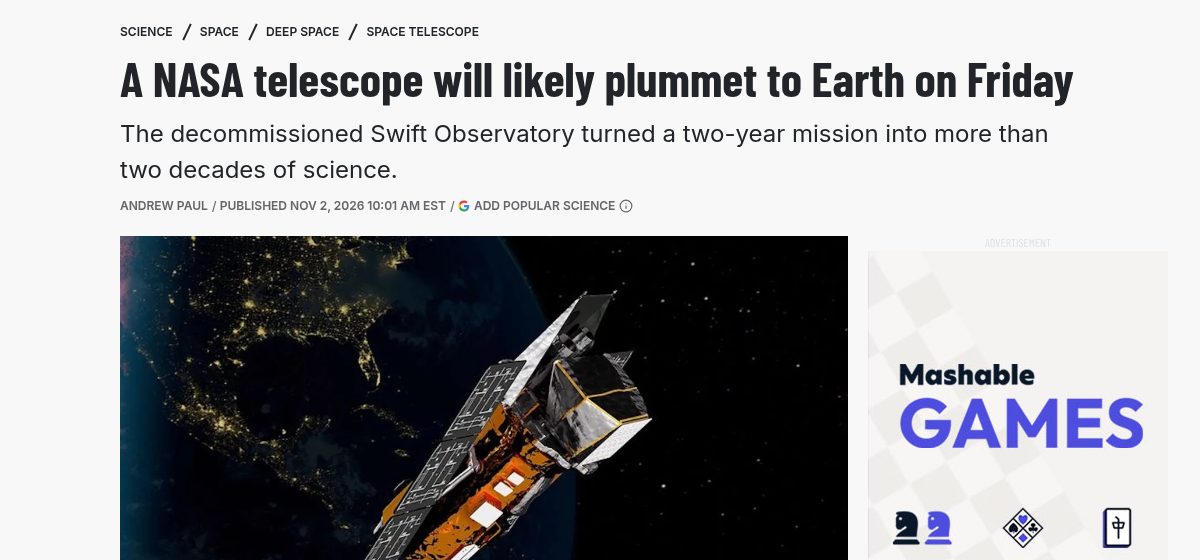
The résumé. In nearly 22 years, Popular Science notes, Swift catalogued more than 2,000 gamma-ray bursts and over 1,400 supernovae, contributed to about 7,000 scientific papers, and most recently observed the interstellar comet 3I/ATLAS. “Swift leaves us with an extraordinary archive of multiwavelength observations that will fuel new discoveries for decades more,” Shawn Domagal-Goldman, director of NASA’s Astrophysics Division, said in October. Reentry estimates keep narrowing as the day approaches, so check official Space Force and NASA updates rather than any rumor on X.
Voyager 1 reaches one light-day
A once-in-history timestamp. NASA says Voyager 1 will be one light-day from Earth on Wednesday, Nov. 18, at 5:16:07 a.m. EST, which is 2:16:07 a.m. PST. That is 16,094,799,096 miles, the distance light travels in 24 hours, reached after 49 years, 2 months and 11 days of flight. A radio command sent that morning will take a full day to arrive and another full day for the reply. Voyager 2, the slower twin, is due to hit the same mark in November 2035.
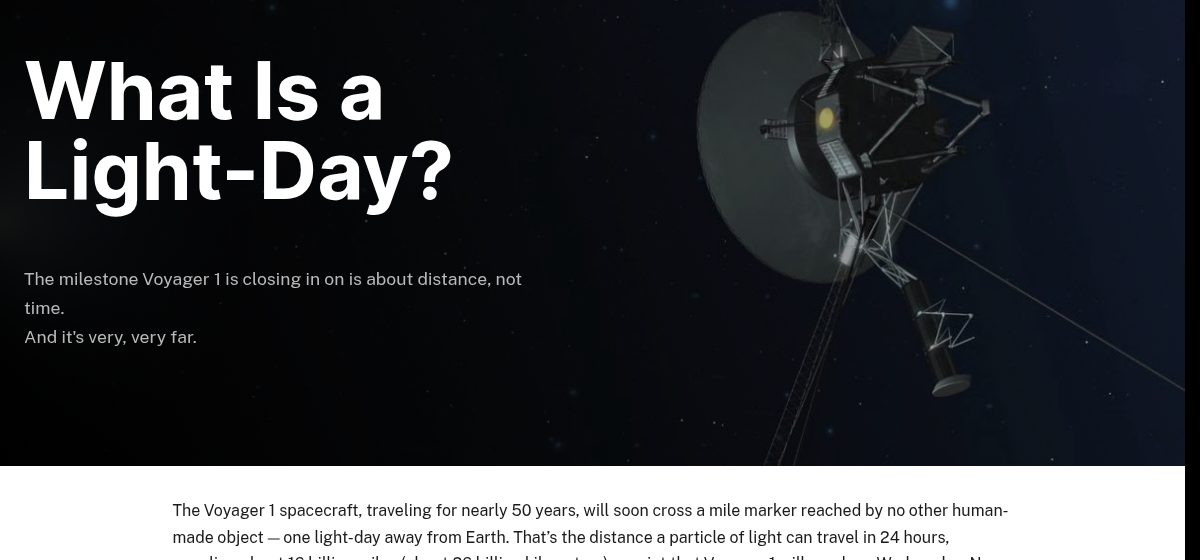
Where it is going. At nearly 38,000 miles per hour, NASA says, Voyager 1 is headed in the general direction of the star AC +79 3888, also known as Gliese 445, and will pass within 1.7 light-years of it in about 40,000 years. Plan accordingly, darling. We are told the dress code is relaxed.
How to mark it. Set an alarm, or do the civilized thing and toast it the night before. Voyager 1 lies far beyond any naked-eye view, so this is a moment for the imagination rather than the telescope, which is entirely the point.
A quiet jet flies east
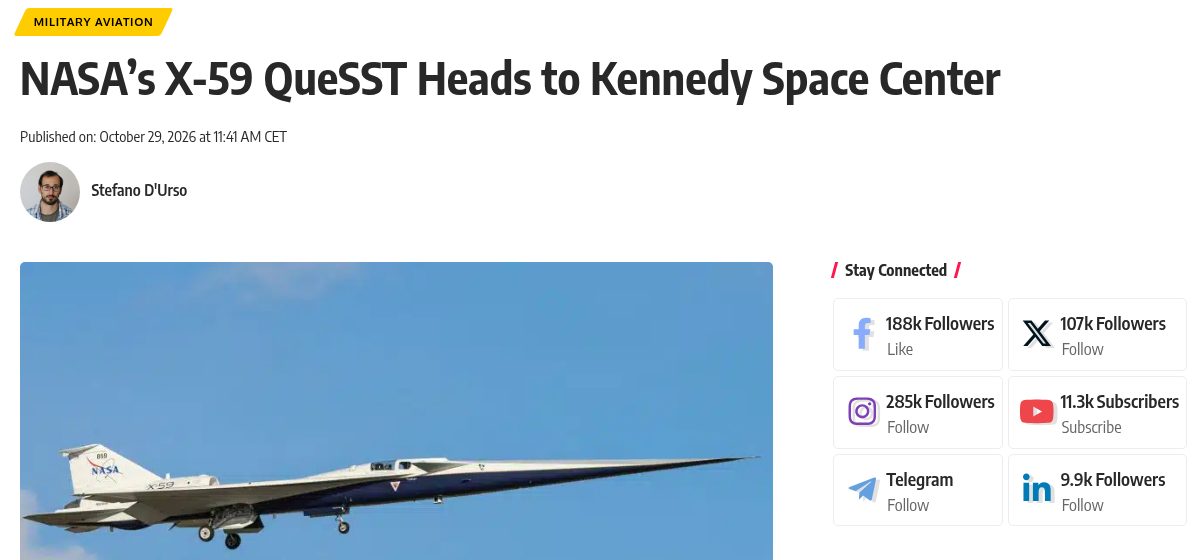
The X-59 goes on tour. On Oct. 28, exactly a year after its first flight, NASA’s X-59 QueSST left California on its first journey east, stopping in El Paso and Fort Worth on its way to Kennedy Space Center, The Aviationist reports. NASA Administrator Jared Isaacman confirmed the destination on X, and the aircraft was earlier reported to be part of NASA’s MAX POWER airshow at Kennedy on Nov. 7 and 8. Built by Skunk Works to turn a sonic boom into “a quiet thump,” the X-59 hit Mach 1.53 in September and, by its anniversary, had logged 40 additional flights and passed 56,000 feet. NASA says the thump is projected to sound like “a car door closing from about 20 feet away.” Its home base is Palmdale and Edwards, so Angelenos will want it back.
Telescopes that take requests
Plain English, at the Allen Telescope Array. In Northern California, Breakthrough Listen and the SETI Institute have connected software agents to the Allen Telescope Array, NVIDIA’s blog reports. The agents can steer the antennas, calibrate the instrument, catch data errors and plot results from a single natural-language request, processing up to 2.4 terabits per second on GPUs next to the dishes. The pipeline has already made the first real-time machine detection of a pulsar, in the Crab Nebula. “As our new agentic observatories reach out into the universe, what they find may have much more in common with themselves than with the humans who created them,” said Andrew Siemion, the SETI Institute’s Bernard M. Oliver chair for SETI. “But this isn’t something to fear. Rather, it’s a breakthrough in translation.”
The superintelligence read
Read the week together and a theme emerges: patience is the luxury good. Swift outlived its two-year plan elevenfold; Voyager took 49 years to reach a single light-day; the X-59 spent a year earning a weekend in Florida. The newest headline, telescopes that answer to plain language, is a tool for compressing that patience, not replacing it. Eileen Otte Ford, who built an agency on decades of showing up, would have recognized the style: a long career, a clean exit and an archive that keeps working after you leave the room.
Sources
- Popular Science: A NASA telescope will likely plummet to Earth on Friday
- NASA Science: What Is a Light-Day?
- The Aviationist: NASA’s X-59 QueSST heads to Kennedy Space Center
- NVIDIA Blog: Agents join the search for extraterrestrial signals at the Allen Telescope Array
Nightlife Report is funded by readers. Back the reporting at patreon.com/aperlas.
nightlifereport.app | Tips: editor@nightlifereport.app | 1049 Havenhurst Dr, Unit 67, West Hollywood, CA 90046
You might also like
 NewsCoperni Shuts Down After Eight Years. What Happened Between the Founders and Their Distributor
 ExplainersThe Minimum-Wage Portfolio Trap
 ExplainersSuperintelligence Week: Gemini 4 Carbon Tops the Board, Terra Halves the Price, Pika Opens Its Video Model
 CultureWhy It’s Harder to Hit the Sun Than to Leave the Solar System
 CultureIs There Room for You? The Full Heaven Room Investigation
 VideoWhy Thursday Is Jupiter’s Day: Dies Iovis and the Spiritual Forecast
Leave a Reply