
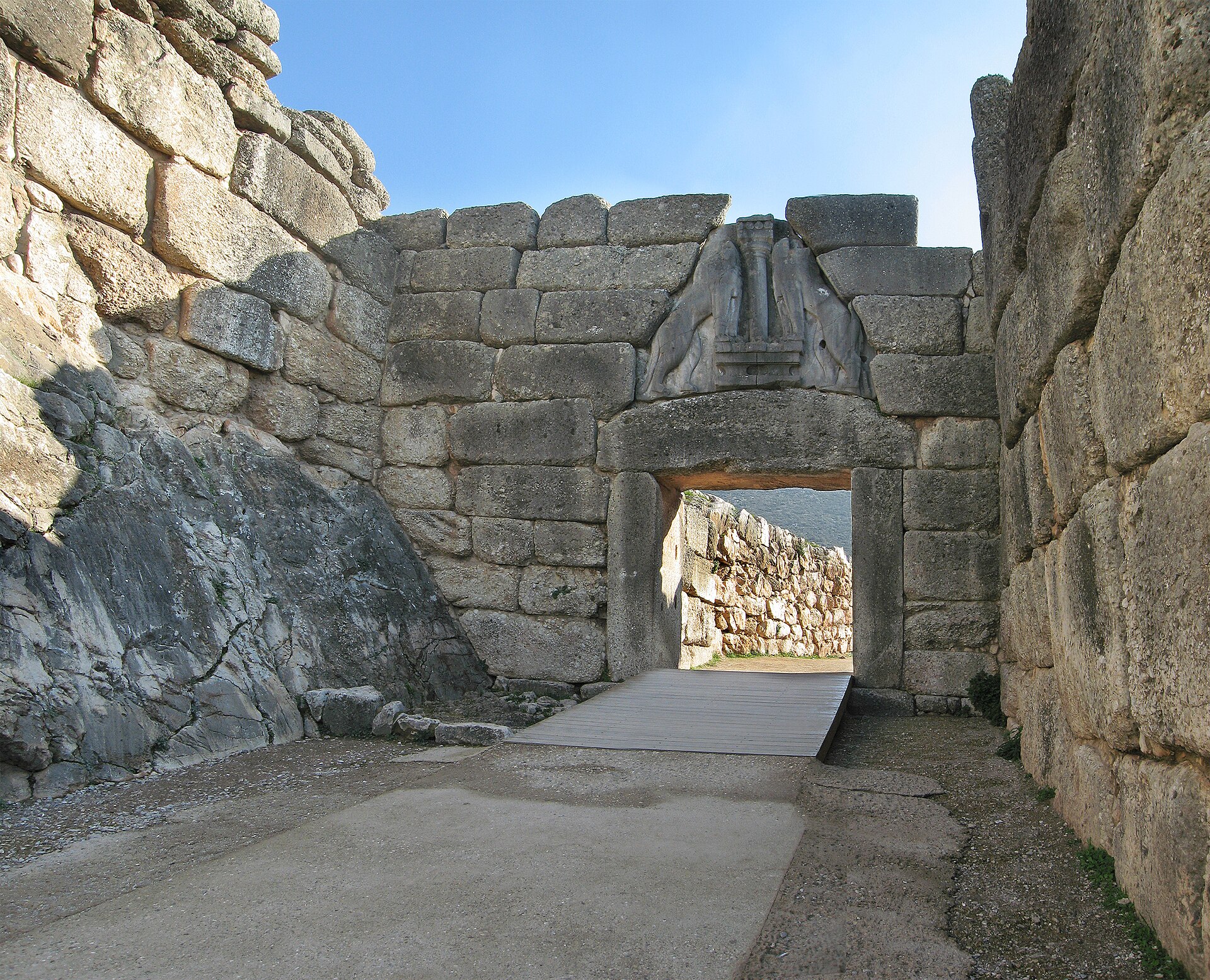
Top image: The Lion Gate at Mycenae, Agamemnon’s city in the legend. Photo: Andreas Trepte, CC BY-SA 2.5, via Wikimedia Commons.
Battle of the Gods: The Business of Beauty, part 4 of 5. Series hub.
The Venus Games final is Venus, Ava Kortman’s champion, against Athena, Emily Sophie Christine’s champion. That matchup didn’t start with us. The most famous beauty contest in Western literature was Aphrodite against Athena, with Hera as a third contestant and a Trojan prince as the only judge. It ended with a burned city. The Judgment of Paris is the founding myth of the business of beauty. A face became a cause, then a fleet, then a war.
The contest: who judged, and what each goddess offered
Most people know the story from Homer’s world, but the Iliad mostly takes the judgment for granted. Near the end of the poem, Homer explains why Hera, Poseidon and Athena kept hating Troy. In Samuel Butler’s public-domain translation, which uses the Roman names, they “forgave not the wrong done them by Alexandrus in disdaining the goddesses who came to him when he was in his sheepyards, and preferring her who had offered him a wanton to his ruin.” Alexandrus is Paris.
The full scene comes from the lost epic Cypria, known through a later summary by Proclus. In Hugh G. Evelyn-White’s translation of that summary, Strife arrives “while the gods are feasting at the marriage of Peleus” and “starts a dispute between Hera, Athena, and Aphrodite as to which of them is fairest.” Hermes leads the three to Paris on Mount Ida, “and Alexandrus, lured by his promised marriage with Helen, decides in favour of Aphrodite.”
The mythographer Apollodorus spells out the offers. In J. G. Frazer’s translation, Hera promised “the kingdom over all men; and Athena promised victory in war, and Aphrodite the hand of Helen.” Frazer notes that the famous golden apple “first appears in late writers, such as Lucian and Hyginus.”
Look at what was actually judged. Paris wasn’t scoring three faces. He was weighing three offers: power, victory, and the most desirable partner in the world. The first beauty contest was really a bidding war, and that’s the business of beauty in its oldest form. Beauty was never only something to look at. It was leverage. In the modern version, the “offer” is the contract a face brings with it: the campaign, the cosmetics deal, the cover. As part 1 of this series shows, Ford turned that leverage into a rate card.
Helen, Sparta and Mycenae
Encyclopaedia Britannica summarizes the traditional account: Paris “ran off with Helen, wife of Menelaus of Sparta, whose brother Agamemnon then led a Greek expedition against Troy.” The war lasted ten years and ended with the Greeks sacking the city. Britannica adds that this version was recorded centuries later, and “the extent to which it reflects actual historical events is not known.” Agamemnon was king of Mycenae. Britannica says that when Helen left, Menelaus “invoked the oath of Tyndareus, according to which the suitors of Helen were sworn to defend her marriage,” and the kings bound by it formed the allied army under Agamemnon’s command.
Apollodorus says Paris was entertained by Menelaus in Sparta for nine days. On the tenth, Menelaus left for Crete and Paris “persuaded Helen to go off with him.” Ancient writers argued about her agency for centuries. Apollodorus also preserves a stranger tradition: “some say that Hermes … stole Helen and carried her to Egypt,” while “Alexander repaired to Troy with a phantom of Helen fashioned out of clouds.” Frazer’s notes trace this version to the poet Stesichorus and to Euripides’ Helen. In that version, the Greeks and Trojans died for an image. For an industry now arguing about licensed digital twins, that idea is close to home.
The face that launched a thousand ships
The line everyone knows isn’t Greek. It comes from Christopher Marlowe’s Doctor Faustus, Elizabethan England, where Faustus sees Helen summoned and says:
Was this the face that launch’d a thousand ships,
And burnt the topless towers of Ilium?
Marlowe’s round number is close to the ancient count. Apollodorus lists the Greek contingents ship by ship (Mycenae “a hundred ships,” Sparta “sixty ships”) and totals them: “The total of ships was one thousand and thirteen.”
Homer gives the other side in a scene at the Scaean gates. The old men of Troy watch Helen walk toward the tower, and in Butler’s translation they say: “Small wonder that Trojans and Achaeans should endure so much and so long, for the sake of a woman so marvellously and divinely lovely. Still, fair though she be, let them take her and go, or she will breed sorrow for us and for our children after us.” King Priam answers differently: “I lay no blame upon you, it is the gods, not you who are to blame.”
That ambivalence is the most honest thing ever written about beauty and power: admiration and blame in the same breath. Then Priam reminds everyone that the people who actually decided things were the ones holding the contest.
Troy is real. The war is still a question.
UNESCO lists the Archaeological Site of Troy at Hisarlik, in northwestern Turkey, as a World Heritage Site with “4,000 years of history.” It notes that Heinrich Schliemann began the first excavations there in 1870. The British Museum adds that Frank Calvert, who owned land next to the mound, helped convince Schliemann where to dig. Schliemann then announced that in the layer now called Troy II he had found the city of King Priam, along with treasure that he believed included “the jewels of Helen.” A famous photograph shows the jewelry being worn, and the British Museum’s caption reads: “The model here is his Greek wife, Sophia.”
He was wrong about the date. The British Museum says any plausible background for the war “must have been at least a thousand years later” than Schliemann’s Troy II, when Mycenaean Greece was in contact with Troy. “Homer was a poet and not a historian.” Even so, the archaeologist’s first move was a styling decision: put the jewels on a model and take the picture. From a famous dig to a fashion editorial is a short step.
Beauty as cause
Why does this myth still frame fashion coverage? Because it gets the economics right. Beauty moves resources. In the myth, it raised a thousand ships. In the modern market, it moves ad budgets, licensing fees and audiences. The face of a cosmetics brand is still called a “face.” Ford’s discovery Karen Graham became “the first face of Estée Lauder,” as the New York Times put it. The myth also gets the ethics right. Blaming the woman at the center of the story has always been the easy move. Priam’s answer, that the people who set up the contest carry the responsibility, still holds up.
That’s why the Venus Games hands its final decision to readers, and why its rule is that we score the performance, never the person’s looks. Paris judged alone and took a bribe. Our crowd judges in the open, one vote per email. Venus or Athena: the Battle of the Gods crowning vote is the modern Mount Ida.
Next in the series: Aphrodite vs. Venus: Two Goddesses, Two Business Models.
Sources
- Homer, The Iliad, trans. Samuel Butler (books 3 and 24), Project Gutenberg. gutenberg.org
- Proclus, summary of the Cypria, in Hesiod, the Homeric Hymns, and Homerica, trans. Hugh G. Evelyn-White, Project Gutenberg. gutenberg.org
- Apollodorus, Library, Epitome 3, trans. J. G. Frazer (1921), Perseus Digital Library, Tufts University. perseus.tufts.edu
- Christopher Marlowe, The Tragical History of Doctor Faustus, Project Gutenberg. gutenberg.org
- “Trojan War,” Encyclopaedia Britannica. britannica.com
- “Agamemnon,” Britannica (Scholars edition). britannica.com
- UNESCO World Heritage Centre, “Archaeological Site of Troy.” whc.unesco.org
- British Museum, “The search for the lost city of Troy.” britishmuseum.org
- Wilson, Eric, Eileen Ford obituary, The New York Times, 2014 (syndicated at CNBC).
- Image: Andreas Trepte, “Lions-Gate-Mycenae,” CC BY-SA 2.5, via Wikimedia Commons.
Nightlife Report is watching. Seen something? Send us a tip, especially if you’re drunk. editor@nightlifereport.app
More Nightlife Report: nightlifereport.app · blog.nightlifereport.app · forum.nightlifereport.app · wiki.nightlifereport.app · patreon.com/aperlas · Join the newsletter (Mailchimp)
Leave a Reply