
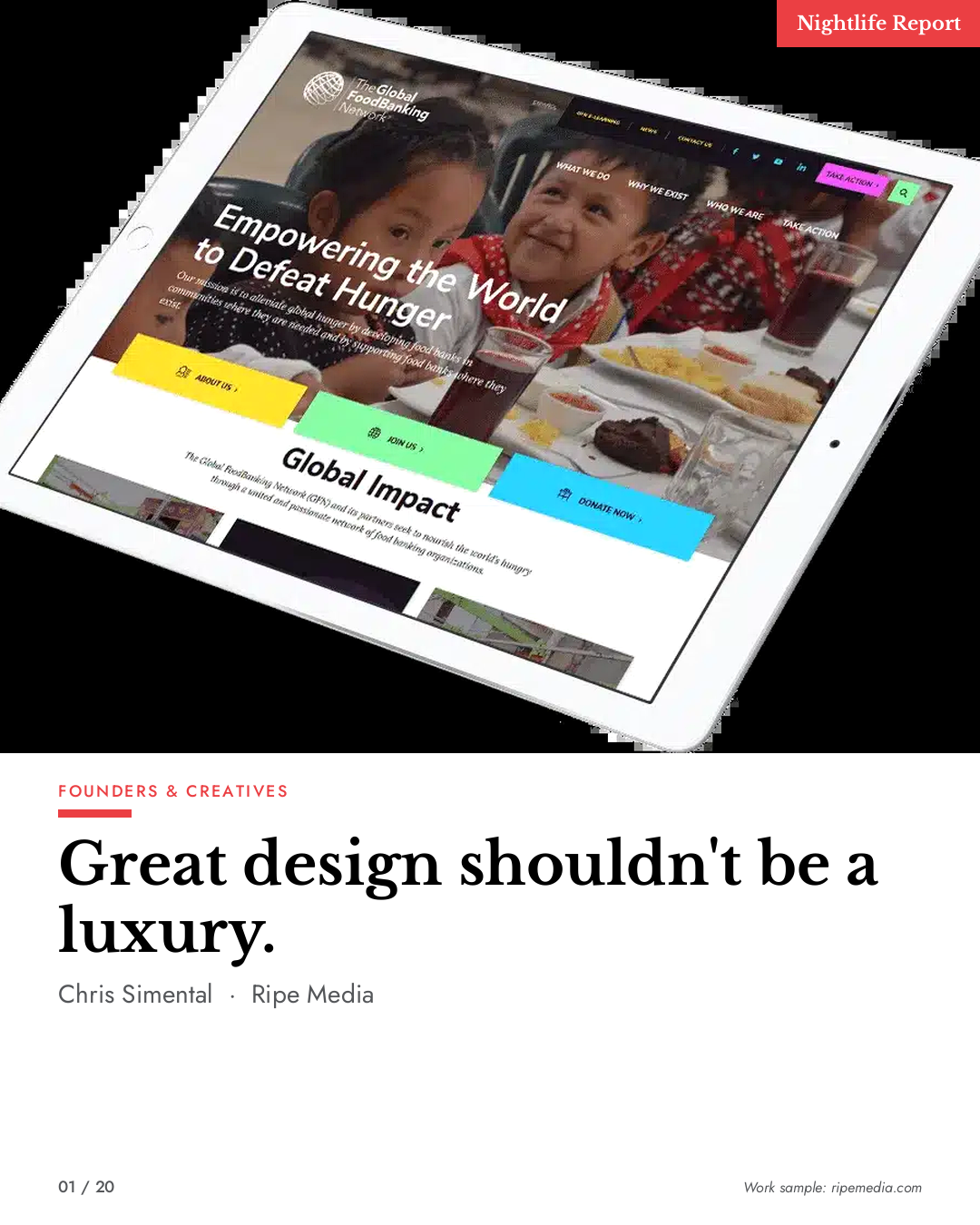
The talk he would give, if he had eighteen minutes, already has a title: “Great Design Shouldn’t Be a Luxury.” The rest of the line, in his words, is “why the organizations doing the most good often look the weakest, and what changes when they don’t.”
Chris Simental is co-founder and tech strategist of Ripe Media, the North Hollywood agency he started with Heather Richman in 2003. On Tuesday, Nov. 17, 2026, at 12:30 p.m. Pacific Time, he filed a Nightlife Report interview. The tagline he entered is four words: “Award-winning, within reach.”
The work, in his words
“RIPE makes award-winning creative work available to organizations of every size, through quality work, real partnership and fair pricing, so a small budget never means a second-rate brand.”
The vision behind that sentence is plain: “Great design is the norm, not a luxury: every mission-driven organization has the brand, website and tools to reach the people who need it.”
He describes the firm this way: “We’re RIPE, a North Hollywood agency making brands, websites and online training for mission-driven organizations. Award-winning work, within reach: 20+ years, clients from Disney to LA County, at prices smaller organizations can afford.”
The pillars he listed are Craft, Partnership, Fairness and Staying Power.
On the public site, ripemedia.com, the studio is at 4789 Vineland Ave., Suite 111, North Hollywood, and the published work includes Everybody Dance Los Angeles, the SAG-AFTRA Foundation, The Global FoodBanking Network, Tipalti, and a website overhaul for Los Angeles County’s Justice, Care and Opportunities Department. Those are Ripe’s published credits, not claims added here.
Who it is for
His ideal client is not a household consumer brand. “A communications director at a mission-driven nonprofit or public agency. They’re a team of one or two with a big mission and a tight budget, and their website and materials make the organization look smaller than it is.”
What keeps that person up at night, he wrote, is this: “The organization does important work, but funders, partners and the public can’t tell from the outside. They know a weak brand is costing them donations, enrollment or credibility, but they can’t afford a big agency, and they’ve been burned by cheap ones.”
Two fields on the form — the formal “offer” and the “10X goal” — were left blank. In the next field he wrote a line that reads as the offer anyway: “Big-agency craft, small-agency attention, and a price that fits, from a team that stays after launch.” We are not treating that sentence as a daily marketing habit, and we are not inventing a 10X goal he did not give.
A lunch in 2003
The origin is not a manifesto. It is a question over lunch.
“It was 2003, and Heather and I were having lunch. We’d been doing great work for other people’s companies and were talking about what was frustrating us at work. I said, ‘Why don’t we try doing this ourselves?’ It wasn’t a grand plan. It was a question we couldn’t stop thinking about once it was said out loud.”
Heather is Heather Richman, listed on Ripe’s site as co-founder and creative director. He went on: “We’d seen how good creative work was usually reserved for clients with big budgets. We wanted to make it available to organizations of every size, with real quality, real partnership and fair pricing. That’s still the idea behind RIPE.”
Obscurity, not criticism
Asked which he has feared more, he did not hesitate. “Obscurity. We’ve done award-winning work for 20+ years, but much of it lives on clients’ sites with their names on it, not ours. Criticism means someone is paying attention, and we can learn from it. Obscurity means the work speaks and nobody hears it.”
The practical obstacle is related. “Most of our new work comes from proposals and referrals, which makes the pipeline unpredictable. We need more clients finding us directly so we’re not starting from zero with every bid.”
Three books, used as a frame — not as his quotes
This feature uses three books as a reading frame. Chris did not cite them. The sentences below are ours.
Russell Brunson’s Expert Secrets is about offering a new opportunity rather than a slightly cheaper version of the old one. The opportunity Chris named is that great design does not have to stay a luxury.
For branding, we used Brunson’s DotCom Secrets rather than Traffic Secrets. The useful idea is the vehicle: people have to be able to see themselves inside a story before they can choose it. That is the communications director’s problem in another language. If funders cannot tell, from the outside, what the organization does, there is no vehicle to step into.
Seth Godin’s Linchpin is about becoming hard to replace by doing the work only you can do. When Chris asked himself why Ripe had not grown into a big agency, he answered: “Because that’s not the point. We’re a tight-knit core team, small enough to stay agile and senior enough for complex projects, and we bring in trusted collaborators when a project needs it. Most of our staff has been with us for 10+ years. Clients get the people who know their work, every time.”
That is a linchpin answer. Stay the team the client already knows.
Rules they will not break
He listed three, and said they hold “even when it costs you.”
- “It has to work. Everything we build works as well as promised, or better. If it isn’t solid, it doesn’t launch, even when that costs us time or margin.”
- “Original design, made by people. No rehashed templates and no AI-generated design. Every project gets contemporary design made for that client, even when a shortcut would be faster and cheaper.”
- “Design and technology are equally strong. Most agencies are great at one and get by on the other. We don’t let either side be the weak link. A beautiful site that breaks and a solid site nobody wants to use are both failures.”
He also described a practice most agencies would rather not advertise: “A lot of agencies build in lock-in: they hold the hosting account, use proprietary tools, and make the client need them forever. We think a good agency should leave clients needing it less over time. We put accounts in the client’s name, and they own everything we make.”
The lesson that cost them is in the same key. Excitement about new technology, a few times, “got ahead of what the client actually needed.” The work was good, he wrote, “but we’d strained the relationship and the client’s patience to get there.” The line he kept: “Our ambition is not the client’s scope.”
If the work lasted a thousand years, the part he would want still in use is not a logo. It is the process: “Listen, Iterate, Design, Build, Repeat as needed.”
How far ahead, and where to find them
He plans five years ahead. He ranks freedom, then wealth, then fame; he did not place impact on that list, and we are not adding it. His Instagram, written with hyphens on the form, is the live account @ripe.loves.la. The site is ripemedia.com.
Interview conducted by written questionnaire through the Nightlife Report Interview: Founders & Creatives form, November 17, 2026. Marks and work samples courtesy Ripe Media. No AI-generated likeness or design. Want to be interviewed? Get interviewed. Join the room: nightlifereport.app/discord.
You might also like
 InterviewsFrom tour guide to Fashion Week: Katie Paladon and the math of a reinvention
 InterviewsOlivier “Hero” Dressen directed for Jaguar and Coke Studio. His short film has 18 awards.
 FoundersLet Go From Her Serving Job, She Started Hemming Pants. Now She Says Fashion Forgot What It Means.
 NewsDior’s Holiday Film Is Hand-Drawn and Full of Old Hollywood. The Story Behind It
 FashionYeran Castaño broke the mold, built a career on transformation, and is aiming for bigger stages
 InterviewsNever Be Afraid to Rewrite Your Story: James Minor of Flavorkingsla
Leave a Reply