

Space · After Dark
The best part of being out at night is the sky nobody else is looking at. This weekend, it is worth the glance.
Night people have always had a private advantage over the rest of the city: we are awake when the sky does its best work. This weekend it does a great deal of it. There is a full moon on Sunday, a revised itinerary for humanity’s return to the Moon, a quarrel over the sky Vincent van Gogh actually painted, and a brand-new comet found by a telescope that was not even looking for one.
Sunday night: the Hunter’s Moon
October’s full moon, traditionally called the Hunter’s Moon, becomes officially full at 12:11 a.m. EDT on Monday, Oct. 26 — which, for Los Angeles, is 9:11 p.m. PDT on Sunday, Oct. 25. It rises around sunset on Sunday, so the best view is the early one: low, enormous and amber over the eastern horizon while the dinner reservations are still running.
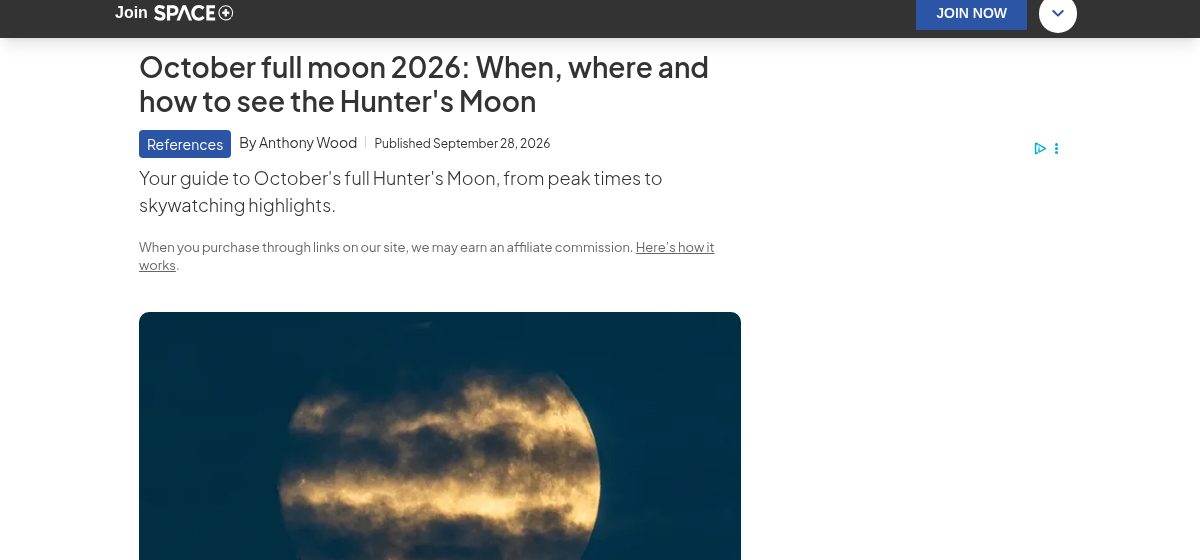
Space.com notes that Saturn sits roughly 20 degrees to the Moon’s south that night, and that before dawn on Monday Jupiter stands between Mars and the bright star Regulus. On Oct. 27 the Moon passes in front of the Pleiades for some observers; check local timings before you set an alarm. No telescope is required for any of it — merely the discipline to look up between venues.
NASA redraws the road to the Moon
At Kennedy Space Center on Oct. 23, NASA Administrator Jared Isaacman and agency leaders laid out what they called an accelerated Artemis plan. As reported by Aerospace America, Artemis III is now planned for summer 2027 as a roughly two-week mission in low Earth orbit, rather than a landing: Orion would dock with Blue Origin’s Blue Moon Mk2 lander around day three and with SpaceX’s Starship around day six, for about two hours. Isaacman described the near-term milestones as a “year-end tanking test and summer 2027 Artemis III launch.” Lunar landings are targeted on Artemis IV and V in 2028.
RelatedThe Rare Flame: A Manifesto on the Conduct That Keeps Us Small

The commercial clocks are ticking too. Per the same report, Blue Origin is “shooting for pad operations to start back up in November,” and the next Starship flight is expected in “the November time frame.” In other words: the Moon remains booked, but the reservation has been moved.

Was ‘The Starry Night’ a real sky?
A study published in Scientific Reports and covered by The Guardian on Oct. 22 argues that Van Gogh’s most famous canvas records a real dawn: the sky over Saint-Rémy around July 22, 1889, with a crescent moon, Venus and the Hyades star cluster. The first author is Elijah Jeong-hyun Kim of Kyung Hee University. The Van Gogh Museum disagrees, maintaining that the painting dates from June 1889, and the forensic astronomer Donald Olson is skeptical. A delicious dispute: the painting, like every good party, is remembered differently by everyone who was there.

A new comet, found by accident
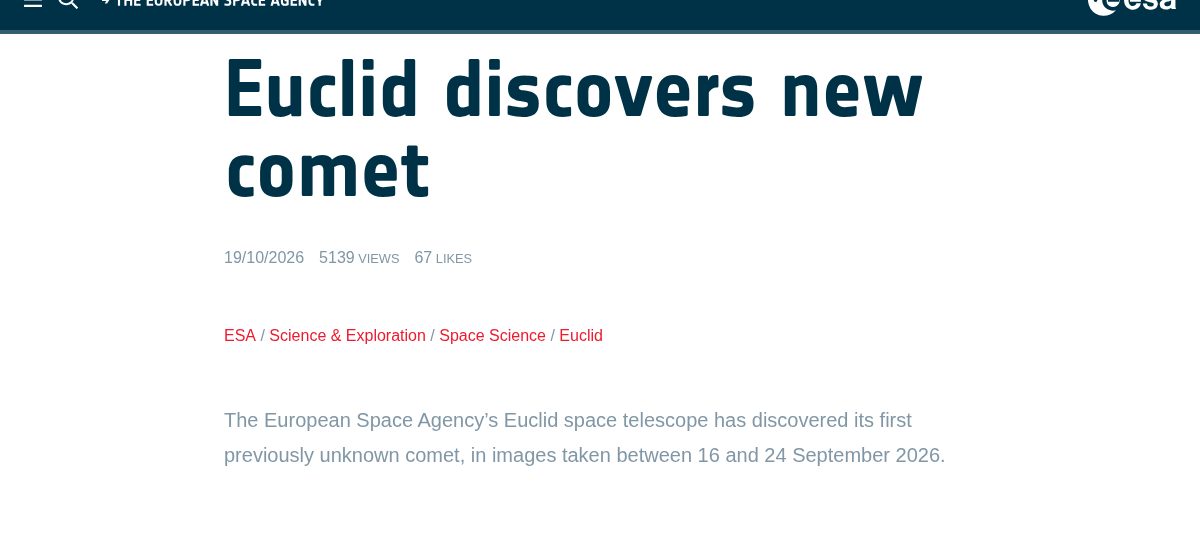
The European Space Agency announced on Oct. 19 that its Euclid telescope — built to map dark matter and dark energy — has found its first new comet, C/2026 S1 (Euclid). It was spotted by Mikko Pöntinen of the University of Helsinki in images taken Sept. 16–24, confirmed by the Minor Planet Center on Oct. 8, and lies about 1.3 billion kilometers away. It will not light up Sunset Boulevard. It is, however, proof that the universe still rewards people who look closely at things they were not asked to look at.
Your weekend sky plan
- Sunday, Oct. 25, at sunset: watch the Hunter’s Moon rise in the east; it is full at 9:11 p.m. PDT.
- Same night: find Saturn about 20 degrees south of the Moon.
- Monday before dawn: Jupiter between Mars and Regulus.
- Oct. 27: the Moon and the Pleiades — check timings for your location.
By Halloween the Moon will still be a bright waning gibbous; the light will be generous. Use it.
Sources
- Space.com: October full moon 2026, the Hunter’s Moon
- NASA: NASA shares Artemis acceleration plans for Moon missions (Oct. 23, 2026)
- Aerospace America: NASA eyeing year-end tanking test and summer 2027 launch for Artemis III
- Scientific Reports: The Starry Night sky study
- The Guardian: Astronomy and the dating of The Starry Night (Oct. 22, 2026)
- ESA: Euclid discovers new comet
You are invited: Code Red, Halloween night.
Join Nightlife Report at CODE RED’s HALLOWEEN! ft. Don Woezik — Saturday, Oct. 31, 11 p.m., secret Los Angeles location, tickets from $17.49: posh.vip/e/halloween-ft-don-woezik
Nightlife Report is funded by readers. Back the reporting at patreon.com/aperlas.
nightlifereport.app | Tips: editor@nightlifereport.app | 1049 Havenhurst Dr, Unit 67, West Hollywood, CA 90046
You might also like
 ExplainersHow Tables Work in Los Angeles: Bottle Service at Poppy, Delilah and the h.wood Rooms
 NewsYeezy Season 01 Comes to Beverly Boulevard. What to Know Before Wednesday’s Show
 NewsWhat You Missed: Tuesday, Nov 3
 ExplainersWhat the Biggest Companies Sell Us to Get Bigger
 NightlifeForty Years of Fire: How LA Opera Went From an Olympic Dream to Hercules vs Vampires on Halloween Night
 VideoWhy Thursday Is Jupiter’s Day: Dies Iovis and the Spiritual Forecast
Leave a Reply