

Sense & Simulation
Some mornings the culture argues about sequins. Other mornings a telescope older than most of the apps on your phone teaches galactic history from a swarm of ancient stars.
Messier 30, nearly as old as time
On Nov. 5, 2026, the NASA Science Hubble team released a new image of the globular cluster Messier 30 (M30), also cataloged as NGC 7099. The cluster sits about 27,500 light-years away in Capricornus — a roughly spherical swarm of tens of thousands to millions of stars, orbiting in the Milky Way’s halo “like a swarm of moths around a lightbulb,” in the release’s own phrase.
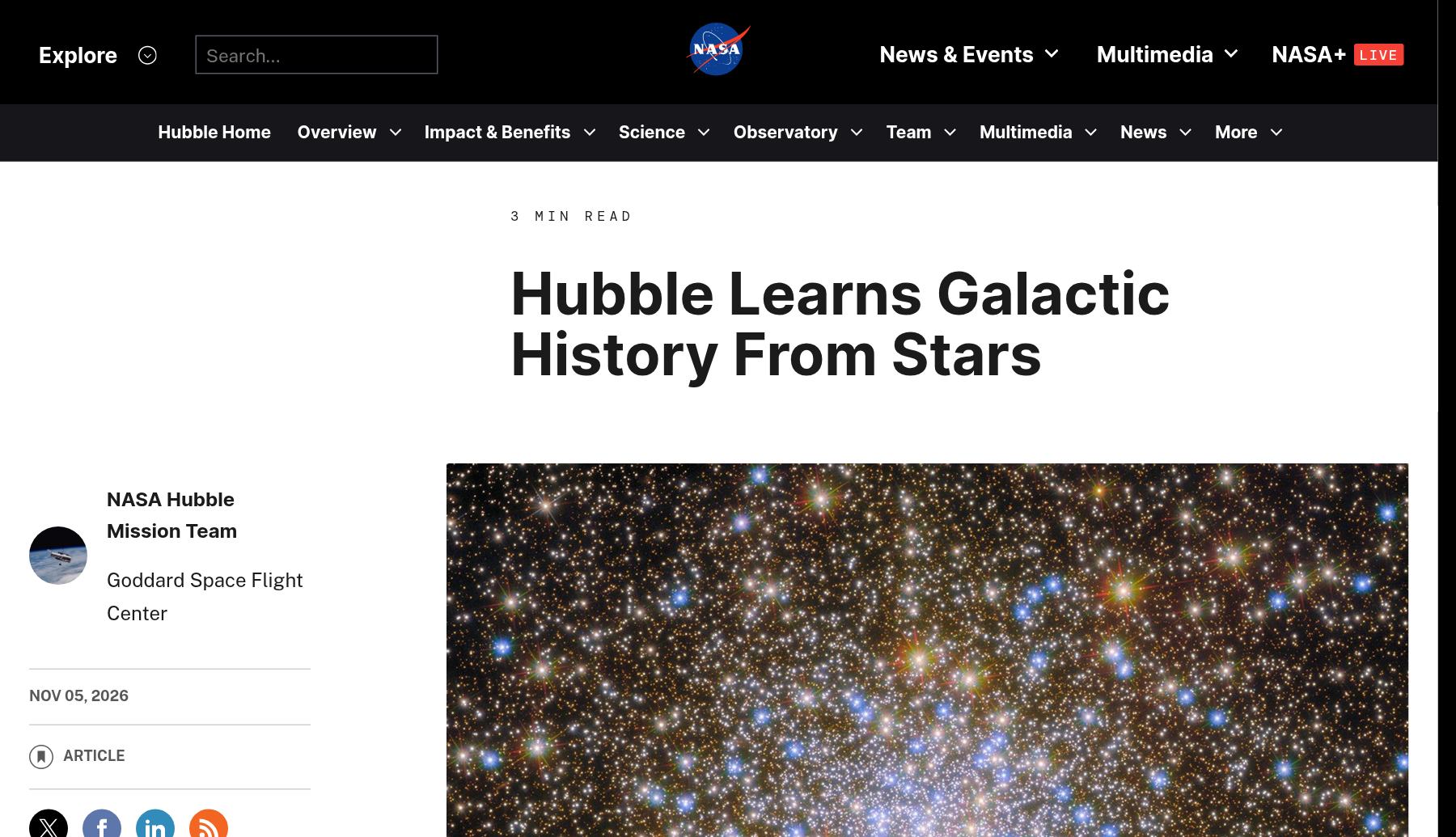
Globular clusters are ancient: astronomers estimate ages between 11.5 and 13.5 billion years, nearly as old as the universe itself. More than a century ago, Harlow Shapley used variable stars in clusters like these to show the Sun is not at the galactic center. Today, M30 remains a time capsule. Researchers note that M30 and many other clusters orbit opposite the galaxy’s spin — a hint that the Milky Way may have captured them long ago rather than forming them in place.
The new portrait combines data from three Hubble programs spanning ultraviolet, visible, and near-infrared light — Advanced Camera for Surveys and Wide Field Camera 3 observations led over the years by Sarajedini, Piotto, and Libralato — including a fifteen-year baseline that tracks how different stellar populations move. Longevity is the instrument.
Artemis, accelerated
A day earlier, on Nov. 4, NASA published an update on plans to accelerate Artemis: Artemis III as a 2027 Earth-orbit test flight with four astronauts aboard Orion, docking with Blue Origin and SpaceX lander test articles; Artemis IV as the crewed Moon landing mission targeted for 2028. Administrator Jared Isaacman framed the push as urgency against strategic competitors seeking a permanent presence beyond Earth.
RelatedOvert and Covert Hostility: Spotting Who Puts You Down
The same update described a lighter Axiom “Sortie suit” for early moonwalks, dual upper-stage options for the SLS rocket, and redesigned lander approaches from both SpaceX and Blue Origin. Hardware processing timelines for Artemis III, NASA said, have been cut roughly in half.
Why it belongs on a nightlife desk
- Wonder is a calendar item. A fresh Hubble release is as dated as a runway show — and older in every other sense.
- Scale resets taste. After a week of brand capsules, a 13-billion-year cluster is useful perspective.
- Artemis is infrastructure news: suits, docks, stages — the unglamorous checklist behind a landing postcard.
Sources
- NASA Science: Hubble Learns Galactic History From Stars — Messier 30 (Nov. 5, 2026)
- NASA: Shares Plans to Accelerate Artemis, Return to Moon (Nov. 4, 2026)
Nightlife Report is funded by readers. Back the reporting at patreon.com/aperlas.
nightlifereport.app | Tips: editor@nightlifereport.app | 1049 Havenhurst Dr, Unit 67, West Hollywood, CA 90046
You might also like
 ExplainersPeople Who Don’t Pay Are a Liability
 CultureWhy Pharaohs Built Pyramids: Memory Costs Resources
 CultureHow Big Is the Universe? An LA Freeway Answer
 CultureThe Hand Span of God: Isaiah 40:12 Run as Math
 NewsPulse: The Morning After on Both Coasts, Through an Eileen Otte Ford Lens
 VideoWhy Thursday Is Jupiter’s Day: Dies Iovis and the Spiritual Forecast
Leave a Reply