
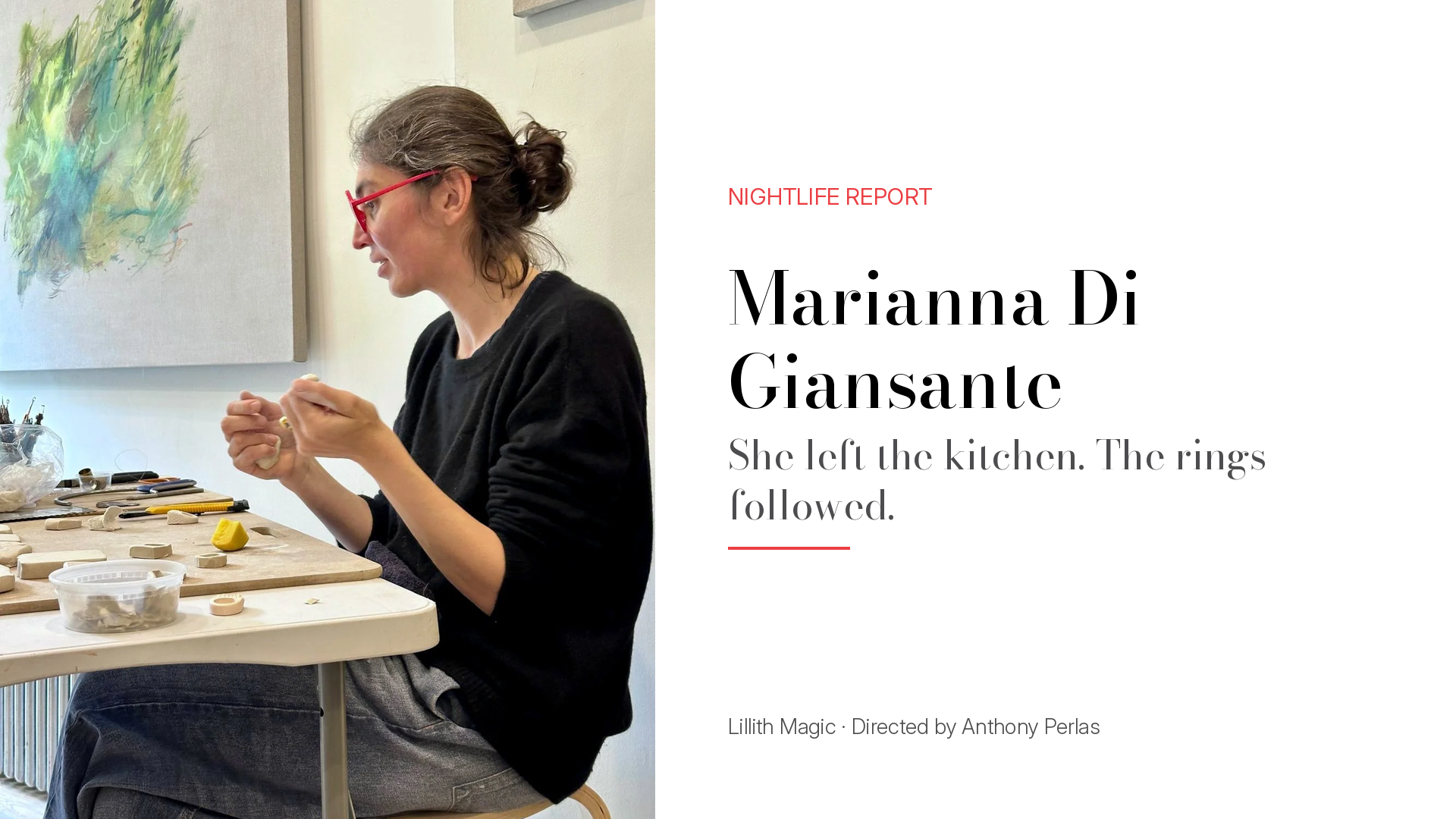
The Brooklyn founder of Argilla NYC sculpts every porcelain ring by hand, refuses the mold, and has no team to blame but herself.
By Nightlife Report Staff · October 28, 2026 · Lillith Magic · Directed by Anthony Perlas
Editor’s note: All quotes are from Marianna Di Giansante’s written interview answers, published as written with her consent.
The week the industry said the quiet part out loud
While the industry was quietly retooling how it makes pictures, one Brooklyn studio kept doing it by hand.
On October 28, 2026, two reports described a fashion industry in the middle of changing how it makes pictures. PetaPixel reported that photo studios are closing as retailers change how they produce product imagery. Its example was the European fashion retailer Zalando, which it said has closed its Berlin photo studios, along with changes at About You and its tech arm Scayle (PetaPixel). Reuters, in a report carried by The Japan Times, interviewed 15 modeling-agency directors and reviewed more than a dozen shoot contracts. It described contract language that lets brands alter, swap and reuse a person’s likeness (The Japan Times / Reuters).
The logic of that system is easy to state: faster, more uniform output from the same inputs. Whether that trade is worth it is a question for the whole industry, not any one brand. But it makes a useful backdrop for a founder who has built her business on the opposite idea.
Marianna Di Giansante, founder and creative director of Argilla NYC, starts with a ball of porcelain. She ends with a ring that has never existed before and never will again.
“A mold would be faster, but it would also make every ring a copy of the last one.”
— Marianna Di Giansante, Nightlife Report interview
The line cook who saw plates
Argilla did not start in a studio. It started in a kitchen.
“One day while working my job as a line cook in a restaurant, I found myself imagining the food I prepare served on vessels of my own making. The next day I was in my first pottery class.”
The detail that matters is the gap between those two sentences: one day. No business plan, no market research, just the next class. Plenty of founders describe a slow build. Di Giansante describes a decision that was made overnight and then lived out slowly, one firing at a time.
The kitchen also explains her eye. Line cooks think in objects meant to be held and used every day. A plate is judged by how it looks, but also by its weight, its edge and how it feels in the hand. Rings work the same way. She has not stopped looking at the world like that:
“Now I look at every object and wonder how it would come out in clay: a ring, a scoop, and a list that keeps getting longer.”
Why porcelain is hard
To see why “refuses the mold” is a real choice, it helps to know the material. Porcelain is a fine clay body that is fired at high temperatures until it becomes dense, hard and slightly translucent (Encyclopaedia Britannica: Porcelain). It is also famously unforgiving. It can warp, slump or crack in the kiln, and it shrinks as it dries and fires, so the size a maker shapes is not the size that comes out.
That is why so much commercial ceramics uses slip casting, pouring liquid clay into plaster molds to get identical pieces. Shaping each ring by hand means accepting variation, waste and time as part of the product. It is also why every ring is one of one.
A studio of one
In a season when brands measure output in images per hour, Di Giansante’s org chart has one name on it.
“There’s no team: I design, make and photograph everything myself. If something goes wrong, at least I know who to blame.”
That last line is funny, and it’s also a business philosophy. A one-person studio has no handoffs, so it has no gaps between the person who made the object and the person who presents it. The photos on her Instagram are taken by the same hands that shaped the ring. In a market where the reports above describe brands rethinking who makes their images, that is a quietly radical position.
Asked what she would do with ten times the audience, she did not talk about scale.
“I’d make rings to order. Porcelain has its own time, so ten times the audience would mean a longer list, not a faster hand or a different one.”
Asked whether she would have started sooner:
“Not sooner. Porcelain has its own time.”
Most founder interviews answer the “ten times” question with hiring plans and new markets. Hers answers it with a waiting list. Demand doesn’t change the method. It changes how long you wait.
The campaign with no face
While the industry argues over who owns a model’s face, her dream campaign doesn’t need one.
“A shadow wearing one of my rings. There’s no face and no name, but the ring is enough to imagine who’s wearing it. The ring speaks for itself.”
It’s a striking image in the context of the Reuters reporting on likeness clauses (The Japan Times / Reuters). Her answer sidesteps the whole debate. If the object is strong enough, you don’t need to borrow anyone’s identity to sell it. The viewer supplies the person.
The question everyone asks
Isn’t a porcelain ring fragile?
“About as fragile as any fine jewelry. A diamond solitaire can chip if it hits something hard, and the lustre on my rings, like a pearl, doesn’t love harsh substances. The real enemy is a marble countertop. Concrete is a close second.”
The reaction she hears most is four words long:
“Wait, that’s porcelain?”
That reaction is the whole marketing plan. A material people think they know, in a form they’ve never seen it take.
Care notes, in her terms: treat it like fine jewelry, keep the lustre away from harsh substances, and watch out for hard stone surfaces.
The detail nobody sees
“The inside of the ring. Nobody sees it, but I always polish it with care.”
There is an old idea in craft that the parts nobody sees are where you find out who the maker really is. Her answer is the jewelry version. The inside of a ring touches the wearer’s skin every day. Nobody photographs it, and it’s the part she polishes most carefully.
New fire
Clay is no longer the only material on her bench.
“I’m only now bringing soldering and metalsmithing into my work, and it’s a lot of fun. Fire still amazes me: first on the stove, then in the kiln, now under the torch.”
Read that sentence again and it’s a short autobiography: the stove of the restaurant kitchen, the kiln of the pottery studio, and now the jeweler’s torch. Each step is a new relationship with heat. Metalsmithing opens up settings, bands and combinations with porcelain that clay alone can’t do.
Two studios, two countries
Her boldest move is about to happen.
“Opening a second studio on Elba, an ocean away from Brooklyn, and splitting the year between two countries. On paper, one ceramicist with two studios doesn’t add up, but Brooklyn is where Argilla started and Italy is where I started.”
Elba is an island off the coast of Tuscany, the largest in the Tuscan Archipelago (Encyclopaedia Britannica: Elba). The name Argilla is Italian for clay. A brand named in Italian, born in Brooklyn and now planning a studio on a Tuscan island is coming full circle.
What she wants from the island:
“sea glass, sand from the beach, and whatever other treasure I find there, worked into the porcelain.”
That is the opposite of a supply chain. It’s a material list you can only gather by being somewhere, and it means the Elba pieces will carry the place in them.
What other founders can take from Argilla
Without turning her story into a checklist, a few principles stand out for anyone building a small brand:
- Let the method set the pace. “Porcelain has its own time” is a pricing, scheduling and marketing strategy in four words.
- Own your images. If you make it, consider photographing it. Nobody knows the object better.
- Polish the inside. The details only the customer will find are the ones that make them come back.
- Let place into the product. Sea glass from Elba can’t be copied by a competitor in another city.
The bottom line
The industry is betting on copies. Marianna Di Giansante is betting on the hand. Watch which one people remember.
Follow @argilla_nyc · argilla.nyc
Get the next founder interview first. Join the Nightlife Report list. Building something people should know about? Apply for a Nightlife Report interview. More founders at nightlifereport.app · Visuals by Lillith Magic · @lillithmagic
Sources
- Marianna Di Giansante, written interview answers to Nightlife Report (published as written, with consent).
- PetaPixel, Oct 28, 2026: https://petapixel.com/2026/10/28/photo-studios-are-closing-as-the-fashion-industry-embraces-generative-ai/
- The Japan Times / Reuters (Helen Reid), Oct 28, 2026: https://www.japantimes.co.jp/business/2026/10/28/tech/fashion-ai-face-swaps-clones/
- Encyclopaedia Britannica, “Porcelain”: https://www.britannica.com/art/porcelain
- Encyclopaedia Britannica, “Elba”: https://www.britannica.com/place/Elba
- Argilla NYC: https://www.argilla.nyc · Instagram: https://www.instagram.com/argilla_nyc/
Lillith Magic · Directed by Anthony Perlas
You might also like
 Field ReportsThe Nightlife Report Investigation: The Producer Will See You Now (Part Six)
 NewsLA Fashion Week in November: The Runway Nights on the Calendar, From West Hollywood to DTLA
 NewsRichard Avedon’s Hollywood Just Opened Free at Gagosian. Here’s How to See It
 CultureHow Big Is the Universe? An LA Freeway Answer
 InterviewsPrincess Keilani: Freedom Over Fame
 VideoWhy Thursday Is Jupiter’s Day: Dies Iovis and the Spiritual Forecast
Leave a Reply