
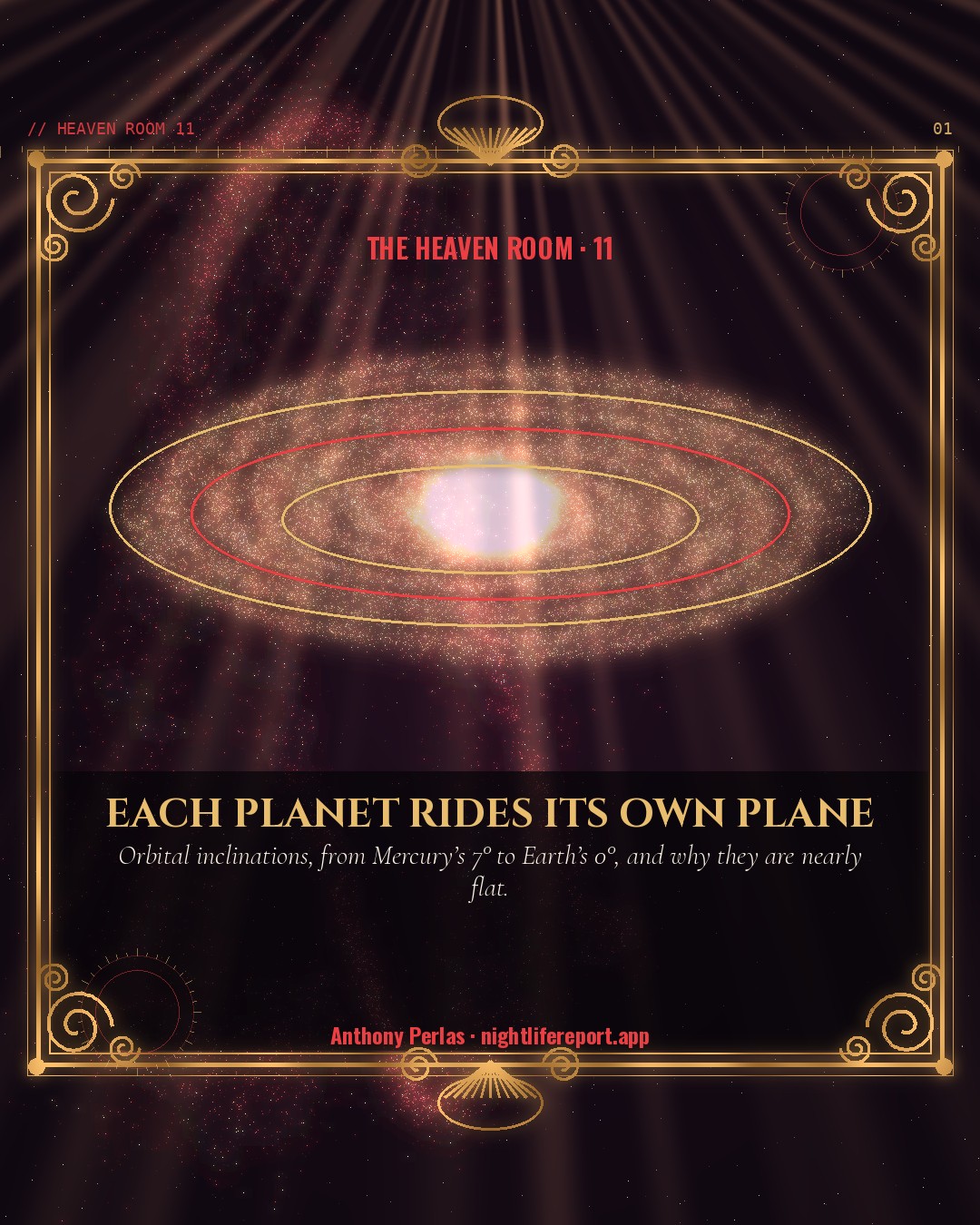
Orbital inclinations, from Mercury’s 7° to Earth’s 0°, and why they are nearly flat.
The flat solar system
All eight planets orbit the Sun in nearly the same flat disk. Seen edge-on, the solar system is almost a plate.
The reference plane
Astronomers measure tilt against the ecliptic, the plane of Earth’s orbit. By definition, Earth sits at zero.
Mercury
Mercury’s orbit tilts about 7.0 degrees, the most of any planet. It is also the most stretched-out orbit, with an eccentricity near 0.21.
Venus and Mars
Venus tilts about 3.4 degrees. Mars tilts about 1.85 degrees.
The giants
Jupiter tilts about 1.3 degrees, Saturn about 2.5, Uranus about 0.8 and Neptune about 1.8.
RelatedIs There Room for You? The Full Heaven Room Investigation
Pluto breaks ranks
Pluto, reclassified as a dwarf planet in 2006, tilts about 17 degrees and crosses inside Neptune’s orbit for part of its path.
Why so flat?
The solar system formed about 4.6 billion years ago from a spinning cloud of gas and dust. Spinning clouds flatten into disks.
An old idea
Immanuel Kant in 1755 and Pierre-Simon Laplace in 1796 proposed that the planets formed from such a disk. It is now called the nebular hypothesis.
We see it happen
Telescopes such as ALMA have photographed flat dusty disks around young stars, with gaps where planets may be forming.
Why not perfectly flat?
Collisions, gravity from other planets and the chaos of formation nudged each orbit slightly off the plane.
Transits are rare
Because Venus tilts 3.4 degrees, it usually passes above or below the Sun from our view. Transits of Venus come in pairs more than a century apart.
Same disk, own lane
Every planet shares the disk but rides its own plane. Close together, never identical.
Anthony’s lesson
You share space with everyone in your city. You still ride your own plane, set by your own speed and your own start.
Stay in your lane, on purpose
Planets do not collide because each holds its own orbit. Know your lane and move with intent.
The takeaway
Shared space, separate paths. Choose yours and keep it steady.
First principles
Spinning things flatten. Small tilts are normal. Share the disk, keep your own plane.
Sources
- NASA NSSDCA, Planetary Fact Sheet (orbital inclinations).
- NASA Solar System Exploration, “Pluto.”
- I. Kant, Universal Natural History and Theory of the Heavens (1755).
- P.-S. Laplace, Exposition du système du monde (1796).
- ALMA Observatory, HL Tauri disk image (2014).
Part of Is There Room for You? The Heaven Room series.
Join the Heaven Room
Talk it through with the group on Discord. Support the series and get the full carousels on Patreon.
Anthony Perlas · nightlifereport.app
You might also like
 CultureEverything in Space Is Falling: Orbit as Free Fall
 ExplainersLA Promoter Math: Bring Five or Pay
 ExplainersAgents Go Shopping Before Black Friday: Shopify’s Quarter, Dots’ Second Brain and a Checklist for Your Wallet
 ExplainersOvert and Covert Hostility: Spotting Who Puts You Down
 InterviewsOlivier “Hero” Dressen directed for Jaguar and Coke Studio. His short film has 18 awards.
 VideoWhy Thursday Is Jupiter’s Day: Dies Iovis and the Spiritual Forecast
Leave a Reply