
Space · This Week
Seven hours outside, a probe back from silence, and the next spacewalk on the calendar.
Darlings, while Los Angeles was choosing costumes, two astronauts spent seven hours outside the International Space Station unrolling the station’s seventh new solar array, and NASA quietly closed the book on a two-day scare with the most distant spacecraft humanity has ever built. Here is what happened this week above our heads, and when to watch the next act.
Spacewalk 100: the seventh array is in
NASA astronauts Anil Menon and Canadian Space Agency astronaut Joshua Kutryk finished their spacewalk at 3:08 p.m. Eastern (12:08 p.m. Pacific) on Oct. 29, after 7 hours and 11 minutes, according to NASA’s space station blog. The pair installed and unfurled the seventh ISS Roll-Out Solar Array, called an IROSA, on the station’s 2A power channel.
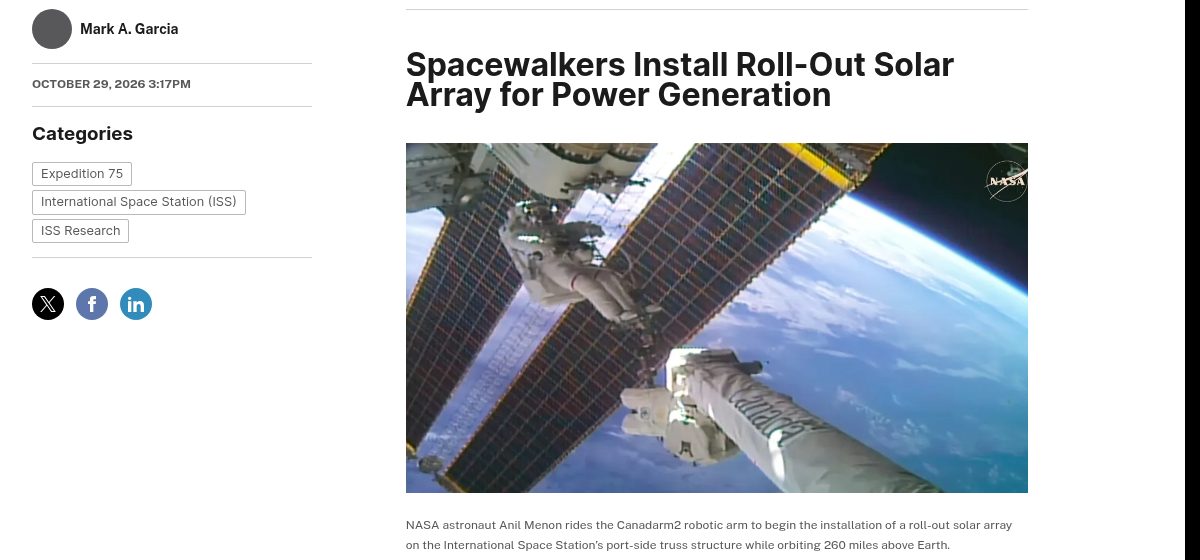
NASA says the new arrays will help power the station for the rest of its working life, including operations for “a safe and controlled deorbit.” Together, the upgraded arrays can raise the station’s power by up to 30 percent, from about 160 kilowatts to about 215 kilowatts.
A milestone in the record book. According to NASA, it was the 100th U.S. spacewalk at the station and the 285th spacewalk devoted to station assembly, maintenance and upgrades. It was Menon’s fourth spacewalk and Kutryk’s first. Spaceflight Now’s report has the step-by-step account of the unfurling.
RelatedWhat You Missed: Thursday, Nov 5
Watch the finale: Thursday, Nov. 5
The eighth and final array goes up next week. NASA plans to install it on power channel 3B during a spacewalk on Thursday, Nov. 5, with live coverage beginning at 6:45 a.m. Eastern, which is 3:45 a.m. Pacific, at nasa.gov/live. Set an alarm, or watch the replay with breakfast.
Voyager 1: a two-day silence, solved
The most distant spacecraft went quiet, then came back. NASA’s Jet Propulsion Laboratory says Voyager 1 missed scheduled contacts on Oct. 18 and 19 and that communications were restored on Oct. 20, roughly 48 hours later. According to the reports, backup thrusters engaged automatically after a thruster fault, triggering the spacecraft’s fault protection; engineers are still investigating the cause.
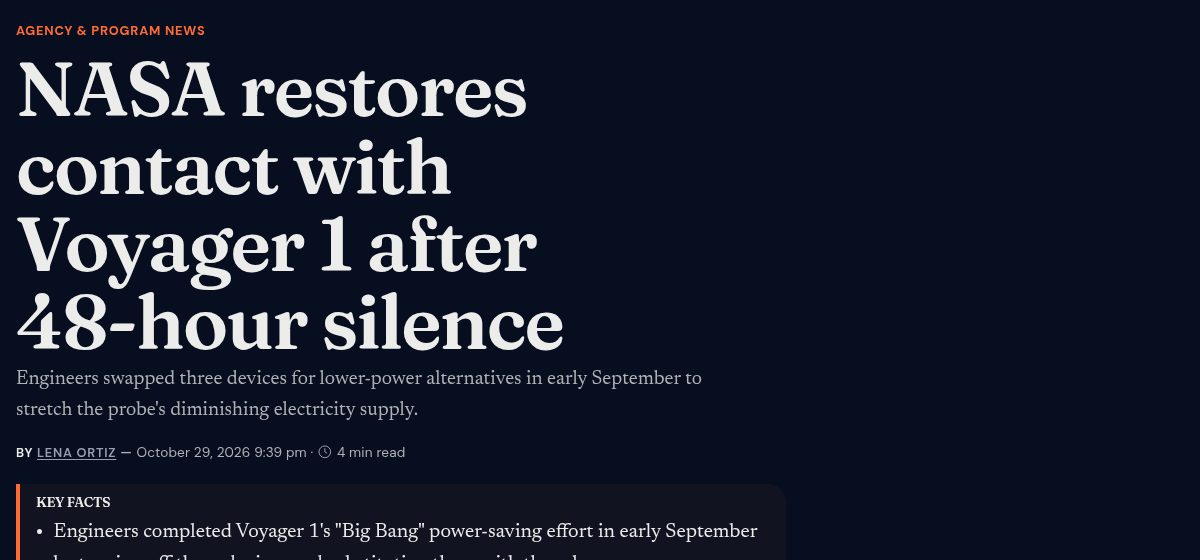
Voyager 1 is now about 16 billion miles from Earth, and power is the mission’s constant budget. Earlier this fall, engineers swapped three devices for lower-power alternatives to conserve electricity. Launched in 1977, the probe is still sending back data from interstellar space, which makes every recovered signal a small triumph.
TRACERS: first results on a violent process
NASA’s TRACERS mission has published its first science. In a paper in the Journal of Geophysical Research, the team reports that magnetic reconnection, the explosive snapping and rejoining of magnetic field lines where Earth’s field meets the solar wind, changes largely in space rather than in time: the site moves, NASA says, rather than switching on and off in place.
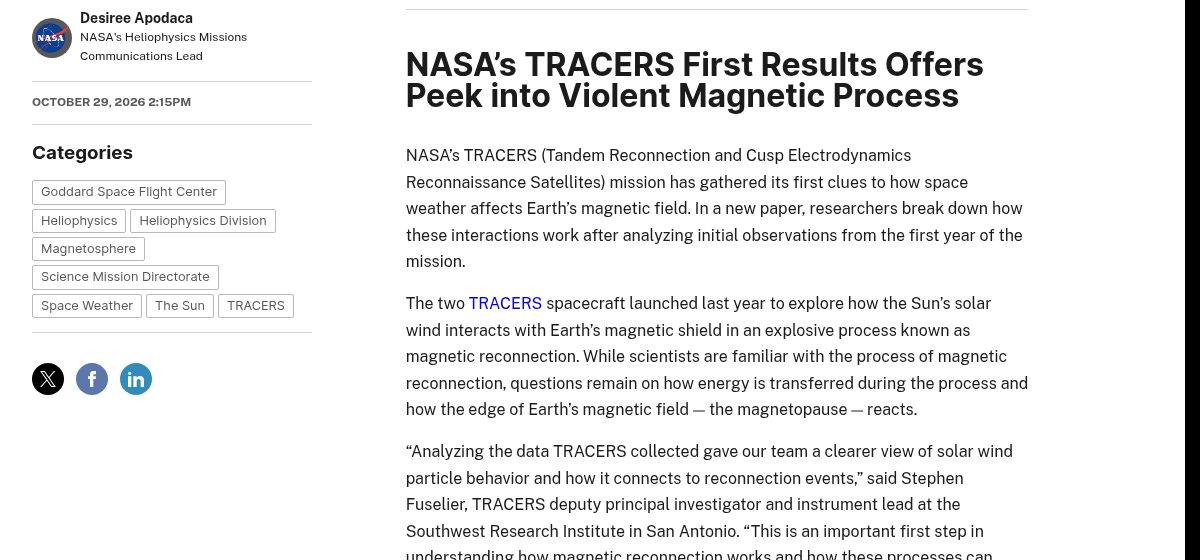
“This is an important first step in understanding how magnetic reconnection works and how these processes can affect Earth,” said Stephen Fuselier of the Southwest Research Institute, according to NASA. David Miles of the University of Iowa added, “I am excited to see what is revealed by future measurements.” NASA has extended the mission into spring 2027. There is a local angle, too: UCLA leads one of the mission’s instruments.
Why it matters on the ground
Reconnection drives the auroras and the space-weather storms that can disturb satellites, GPS and power grids, so understanding it is practical science. Solar arrays, thruster faults and magnetic fields may feel far from a Saturday night in West Hollywood, but the phone in your clutch depends on all three. Superintelligence-era life still runs on very old physics.
Sources
- NASA Space Station Blog: Spacewalkers install roll-out solar arrays for power generation (Oct. 29, 2026)
- Spaceflight Now: Spacewalking astronauts unfurl upgraded solar array to boost space station power (Oct. 29, 2026)
- NASA JPL: NASA’s Voyager 1 conserves power, resolves brief communications pause
- Orbital Wire: NASA restores contact with Voyager 1 after silence
- NASA Science: TRACERS first results offer peek into violent magnetic process (Oct. 29, 2026)
You are invited: Code Red, Halloween night.
Join Nightlife Report at CODE RED’s HALLOWEEN! ft. Don Woezik — Saturday, Oct. 31, 11 p.m., secret Los Angeles location, tickets from $17.49: posh.vip/e/halloween-ft-don-woezik
Nightlife Report is funded by readers. Back the reporting at patreon.com/aperlas.
nightlifereport.app | Tips: editor@nightlifereport.app | 1049 Havenhurst Dr, Unit 67, West Hollywood, CA 90046
You might also like
 ExplainersThe 15-Minute Close
 NewsWhat You Missed: Tuesday, Nov 3
 NewsKeke Palmer Hosted the CFDA Awards in Raquel Welch’s 1975 Bob Mackie. Why Vintage Won the Night
 CultureThe Sun’s “Sink”: The Rubber-Sheet Picture and Where It Breaks
 ExplainersThe Minimum-Wage Portfolio Trap
 VideoWhy Thursday Is Jupiter’s Day: Dies Iovis and the Spiritual Forecast
Leave a Reply