

By Anthony Perlas · Nightlife Report · November 1, 2026 · Part Three of a series. Part One: The Game You Didn’t Agree to Play · Part Two: Exposing the Vampires and Werewolves of Los Angeles
The table is already paid for when you arrive. Somebody you just met calls you “brother.” Somebody else asks where you’re from, and waits a beat too long for the answer. This is Part Three of the Nightlife Report investigation: how the creatures of the dark in Los Angeles nightlife talk, how they signal, how the money and the drugs move behind them, and how to read them early enough to walk away. Every claim from a government record is quoted word for word and linked. Everything marked “our reporting” comes from Anthony Perlas’s own reporting on the scene and is not an official finding.
“Some 33,000 violent street gangs, motorcycle gangs, and prison gangs are criminally active in the U.S. today. Many are sophisticated and well organized; all use violence to control neighborhoods and boost their illegal money-making activities, which include robbery, drug and gun trafficking, prostitution and human trafficking, and fraud.”
A word on the creatures
Vampires, werewolves, lions: these are metaphors, not descriptions of any people. A vampire, in this series, is the person who lives off other people’s energy, work and bodies. Nobody here is named except people a federal court has convicted. No race, ethnicity, nationality or faith is blamed. The FBI’s count of 33,000 gangs covers every background there is, and so do the people who stop them.
The scene: producers, minimums and mansions
Our reporting. In Los Angeles, the people insiders describe to us as running brothel-style operations rarely call themselves anything of the kind. They call themselves producers. They host. Their stage is the VIP section with a minimum spend, the after-party at a rented mansion in the hills, and the influencer who posts the night and makes it look like the place to be. The influencer is the bait; the minimum is the hook. Someone has to cover the table, and the people who can’t pay with money are told, sooner or later, that they can pay another way.
RelatedOn the Water: Surreal by Viibz, Four Reels From a Los Angeles Yacht Night
The federal record shows how old this playbook is. In a Los Angeles case prosecuted in 2016, the U.S. Attorney said the defendant “was able to seduce child victims into prostitution by tricking them into thinking he was their boyfriend, but he turned violent when the girls tried to leave or violated his ‘rules.’” (ICE / HSI Los Angeles)
How to spot a vampire: the tone
Our reporting. The first sign isn’t a word. It’s a temperature. The people we describe as vampires run low: flat, bored, faintly contemptuous, never glad to see anyone, never curious about anything you say. Around them, people get quieter and smaller. Your own mood drops in their company and comes back when you leave. Track the tone. If every conversation leaves you heavier than it found you, that is information.
The code words
Our reporting. These phrases are ordinary English almost everywhere. Inside the scene we cover, Anthony Perlas reports that they carry a second meaning. No government glossary confirms these meanings, and in most conversations they are innocent. Read them as patterns, not proof.
- “Be chill.” Don’t ask questions. Don’t object. Don’t notice.
- “I don’t vibe with you.” A verdict, not a mood. You’ve been judged as not one of us, and the room may follow.
- “You have bumps.” You’re being flagged as a problem: friction, rough edges, someone who might talk.
- “He’s cool.” Not a compliment. In this usage, it means he’s aligned: he goes along with what happens and stays quiet about it.
- “Brother.” An invitation into loyalty you never agreed to, with debts that come later.
- “Where are you from? What city?” Covered below. Sometimes small talk; sometimes a check on territory.
Polaris, which runs the National Human Trafficking Hotline, notes that its financial intelligence unit “has been able to identify coded language related to domestic minor sex trafficking (DMST) online on social media platforms.” (Polaris Project) The specific phrases above are our reporting, not Polaris’s list.
The broken thread: how they talk
Our reporting. Listen to the shape of the conversation, not just the words. They open a thread and drop it. They answer a question with a question. They switch subjects mid-sentence, circle back to something you said an hour ago, and never finish the thought. It feels random. It isn’t always. A conversation with no straight line is hard to quote later, hard to repeat to a friend, and hard to say no to, because nothing was ever plainly asked.
The defense is simple and quiet. Track three things:
- The phrases. Which words keep coming back? Which ones do you not understand?
- The threads. What was the question they never finished? What did they want before the subject changed?
- The loops. What do they keep circling back to: your city, your friends, your money, your body, your silence?
Then ask, out loud, in a plain sentence: “What are you actually asking me?” A straight question breaks a crooked conversation.
The trap of agreeing
Our reporting. Saying yes to the small things feels safe. You’re chill. You’re cool. You’re a brother now. But every small agreement is recorded. Once you’re inside, you become something new to them: a risk. A person who knows things, who might talk, who has to be watched and kept close. The friendlier you were, the more dangerous you look when you try to leave.
The State Department lists the levers used to keep people inside: “threats of force, debt manipulation, withholding of pay, confiscation of identity documents, psychological coercion, reputational harm, manipulation of the use of addictive substances, threats to other people, or other forms of coercion.” (U.S. Department of State, 2024 Trafficking in Persons Report)
Stick to your oath: whatever you have already promised, to your family, your faith, your craft, your profession, your country. A prior commitment is the cleanest answer there is. “I can’t. I gave my word.”
“Where are you from?”
“This article investigates how young people in an inner-city ecology invoke the relevance of gangs by demanding, ‘Where you from!’”
— Robert Garot, “Where You From!”, Journal of Contemporary Ethnography (2007)
Our reporting. In the rooms we cover, the question can mean whose territory you belong to, and who might be watching over that territory. The safe answer is the true and boring one: “Just here with friends.”
Ink and hands: tattoos, signs and screenshots
Tattoos can be ownership. In the Los Angeles case above, “the jury also saw photos of tattoos with the ‘Birdd’ moniker that victims were forced to get.” (ICE / HSI Los Angeles)
Our reporting. Hand signs flashed in a photo, a new tattoo that appears after a new “friendship,” a name or symbol someone is pressured to wear: these can signal alignment. Most tattoos mean only what their owner says. The warning sign is pressure, not ink.
The risk of screenshots. A screenshot is evidence, and evidence cuts both ways. Keep it, back it up privately and give it to police or the FBI. Don’t post it, don’t send it to the group chat, and don’t confront anyone with it. Your own photos can also be screenshotted and used against you, so assume anything you send can travel.
The hive
Our reporting. A beehive and a termite mound have no visible boss on the floor. Each worker does one small job: the promoter fills the room, the host buys the table, the driver knows the address, the influencer posts the night. Nobody holds the whole picture, so everybody can say they didn’t know. That is the design. The DEA describes the same structure at the top of the supply chain: the Sinaloa Cartel’s members work “in decentralized networks under the larger CDS umbrella.” A hive protects the queen by making every worker replaceable, including you.
Gangs beyond the Bloods and the Crips
The FBI names transnational gangs on the record: “The Mara Salvatrucha (MS-13) and 18th Street gangs continue to expand their influence in the United States. FBI investigations reveal these transnational gangs are present in almost every state and continue to grow their memberships, now targeting younger recruits more than ever before.” (FBI, Gangs)
The DEA’s 2025 National Drug Threat Assessment profiles organizations designated as terrorist groups, “including the Sinaloa Cartel, Jalisco New Generation Cartel (CJNG), Northeast Cartel, the New Michoacán Family, Gulf Cartel, United Cartels, Tren de Aragua (TdA), and Mara Salvatrucha (MS-13).” (DEA) These are organizations. Their members come from many backgrounds; so do their victims.
The supply line: Mexico’s cartels and fentanyl
“The Sinaloa Cartel (Cártel de Sinaloa, aka CDS) is one of the world’s most powerful drug cartels and one of the largest producers and traffickers of fentanyl and other illicit drugs to the United States.”
The same report calls the Jalisco New Generation Cartel “one of Mexico’s most powerful, influential, and ruthless transnational criminal organizations and a key supplier of illicit fentanyl to the United States,” and says Sinaloa-run laboratories “produce millions of illicit fentanyl pills and thousands of pounds of illicit fentanyl powder every year.”
What that means in a VIP room: the powder or pill passed to you may not be what you were told it is. One counterfeit pill is the end of the night for good.
The Iran question: Hizballah’s drug money
We looked for a public record tying Iran to Los Angeles nightlife and found none. What the record does contain is the DEA’s case against Hizballah, the group the State Department designated a Foreign Terrorist Organization in 1997. In 2016 the DEA announced arrests under Project Cassandra, which “targets a global Hizballah network responsible for the movement of large quantities of cocaine in the United States and Europe,” and said the network launders drug proceeds through “a trade based money laundering scheme known as the Black Market Peso Exchange.” (DEA) Federal prosecutors in Manhattan alleged that “proceeds of narcotics trafficking” were “funneled to Lebanon through Hizballah-controlled money laundering channels.” (U.S. Attorney, SDNY) The lesson for a partygoer is not geopolitics. It’s that the bump in a bathroom stall sits at the end of a chain that can run through cartels and armed groups.
What the CIA knows
We found no public CIA material on Los Angeles nightlife, gangs in the city or the slang in this series. The CIA collects foreign intelligence; it is not where you report a crime in America. Domestic tips go to the FBI, the DEA, Homeland Security Investigations and your local police.
Case studies from the federal record
The boyfriend who became a pimp (Gardena, 2016). Laron Darrell Carter, described by prosecutors as “a Crip gang member,” was sentenced to 40 years in federal prison after a jury convicted him of seven counts of sex trafficking of a minor by force, fraud or coercion. He “trafficked girls as young as 13,” and the jury saw Facebook posts in which he called himself a “cross country pimp.” The case was investigated by HSI and the Los Angeles County Sheriff’s Department. (ICE / HSI)
The stable (Compton, 2016). Darrius Marques Sutton pleaded guilty to sex trafficking of a child and was sentenced to 160 months in federal prison. Prosecutors said he had posted “at least 60 advertisements for prostitution” online over five months. The case was investigated by “the FBI’s Innocence Lost Task Force and the Los Angeles Police Department Detective Support and Vice Division, Human Trafficking Unit.” (U.S. Attorney, Central District of California)
Both cases began with someone who came forward or was found. Reports work.
The damage
The FBI lists the behavioral signs in victims: “fear, anxiety, or submissiveness. Victims may avoid eye contact or seem disoriented, withdraw or isolate themselves from family and friends, or defer to other for answers to simple questions.” (FBI, Human Trafficking) Polaris names what keeps people stuck: “Fear, isolation, guilt, shame, misplaced loyalty and expert manipulation.” (Polaris Project)
Our reporting. The damage outlasts the night: anxiety, sleeplessness, distrust of anyone kind, the sense of being watched, and the shame that stops people from calling home. That shame belongs to the people who caused it.
Why they avoid the police
Our reporting. The people we describe avoid police, avoid courts and openly hate ICE. That is exactly why reporting works. Under federal law, the FBI says, “the victim’s consent is irrelevant in trafficking cases,” and “any commercial sex involving a minor is legally considered sex trafficking.” (FBI) Victim recovery, the Bureau says, “is the primary goal of trafficking investigations.” You are not the one in trouble.
How to report
- Danger right now: 911.
- Local police: your LAPD division or sheriff’s station, or 911 if it’s urgent.
- FBI: tips.fbi.gov or 1-800-CALL-FBI (1-800-225-5324). You can share information anonymously.
- DEA (drug trafficking): dea.gov/submit-tip, or the DEA Contact Center at (202) 307-1000.
- Homeland Security Investigations tip line: 1-866-347-2423.
- National Human Trafficking Hotline: 1-888-373-7888, or text 233733.
- A child in danger: NCMEC CyberTipline, or 1-800-THE-LOST.
- Crisis, trauma and emotional support: call or text 988 (Suicide & Crisis Lifeline), free and confidential, 24/7.
Tell them when, where and what you saw. Hand over your screenshots. Don’t investigate on your own, and don’t confront anyone.
How to stay human
- Track the tone, the thread and the loop. If you can’t tell what’s being asked, ask plainly or leave.
- Don’t agree to what you don’t understand. “Chill,” “cool” and “brother” are words, not contracts. You can decline them.
- Keep your oath. Your prior word to your family, your craft and your conscience outranks anyone’s table.
- Keep your people close. Tell your family and friends where you are, who invited you and when you’ll check in. Pick a code word.
- Keep your distance. You don’t have to expose anyone yourself. Step back, report quietly, and let the people with badges do the rest.
- Keep your own. Your ride, your ID, your phone, your drink.
The creatures of the dark need you to stay in the dark. Turn on the light, keep your name, and go home.
Sources are quoted word for word and linked. Passages marked “our reporting” come from Anthony Perlas’s reporting in Los Angeles nightlife and are not official findings. The only people named are people convicted in federal court, as named in the government’s own press releases. No race, ethnicity, nationality or religion is blamed for any crime described here. Read Part One · Read Part Two.
Update: the mission, and where to go next
Vampires and werewolves are real. In our reporting, the werewolf is a king lion or lioness: charismatic, high emotional bandwidth, fronting for a recruiter and a hidden pimp. Our mission is to get promoters away from exploiters who keep them unpaid and models off free fashion-show work. Hire a real agent: in California anyone procuring engagements for models must hold a talent agency license (Labor Code 1700.5). For safe, paid work, sign up with Anthony Perlas · Nightlife Report at nightlifereport.app.
Federal law: forced labor (18 U.S.C. 1589), sex trafficking (18 U.S.C. 1591), the Mann Act (18 U.S.C. 2421 to 2423). California: Penal Code 236.1, 266h, 266i, 647(b). New York: Penal Law 230.34, 230.25, 230.30, 135.35. Full law box, evidence checklist and step-by-step reporting guide in Part Four.
Report: tips.fbi.gov or 1-800-CALL-FBI · ICE HSI 1-866-347-2423 · Hotline 1-888-373-7888, text 233733 · LAPD non-emergency 1-877-ASK-LAPD · Danger: 911. The CIA is not a domestic reporting channel.
You might also like
 Field ReportsThe Nightlife Report Investigation: From the Free Gig to the Private Dinner, Identifying the Debauchery (Part Four)
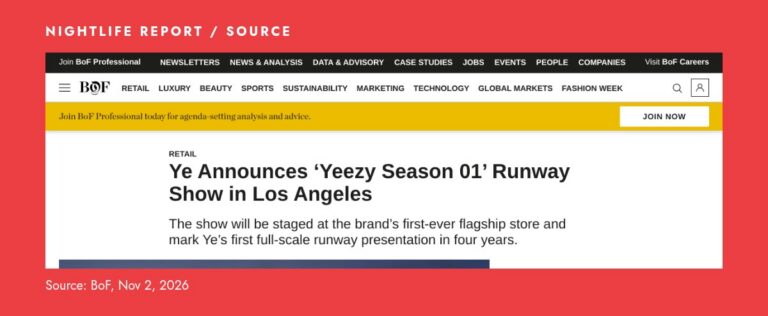 NewsYeezy Season 01 Comes to Beverly Boulevard. What to Know Before Wednesday’s Show
 NewsThe Pulse: Fifty Years of Five Boroughs, LA’s Library-Card Costume and Eileen Otte Ford’s Business of Showing Up
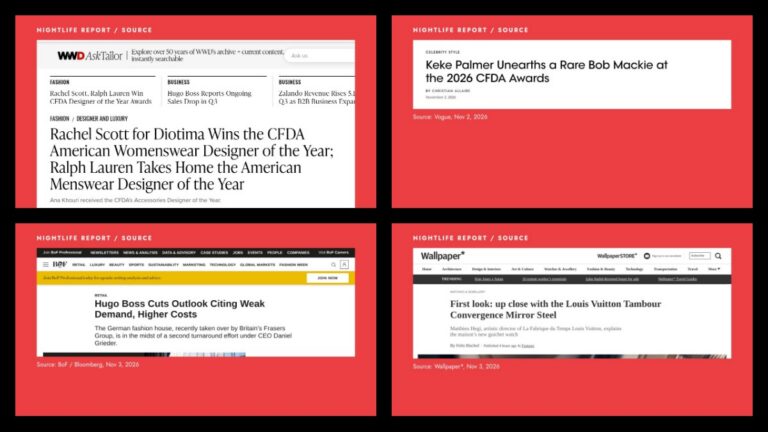 NewsWhat You Missed: Tuesday, Nov 3
 GuidesDeal Desk: Free Rides to the Polls, a Doughnut for Your Sticker and the First Early Black Friday Drops
 VideoWhy Thursday Is Jupiter’s Day: Dies Iovis and the Spiritual Forecast
Leave a Reply