
How psychopaths, sociopaths and narcissists heal you, then exploit you, and how Jupiter’s rules get you out.
Lillith Magic · Directed by Anthony Perlas
1. The myth, once more
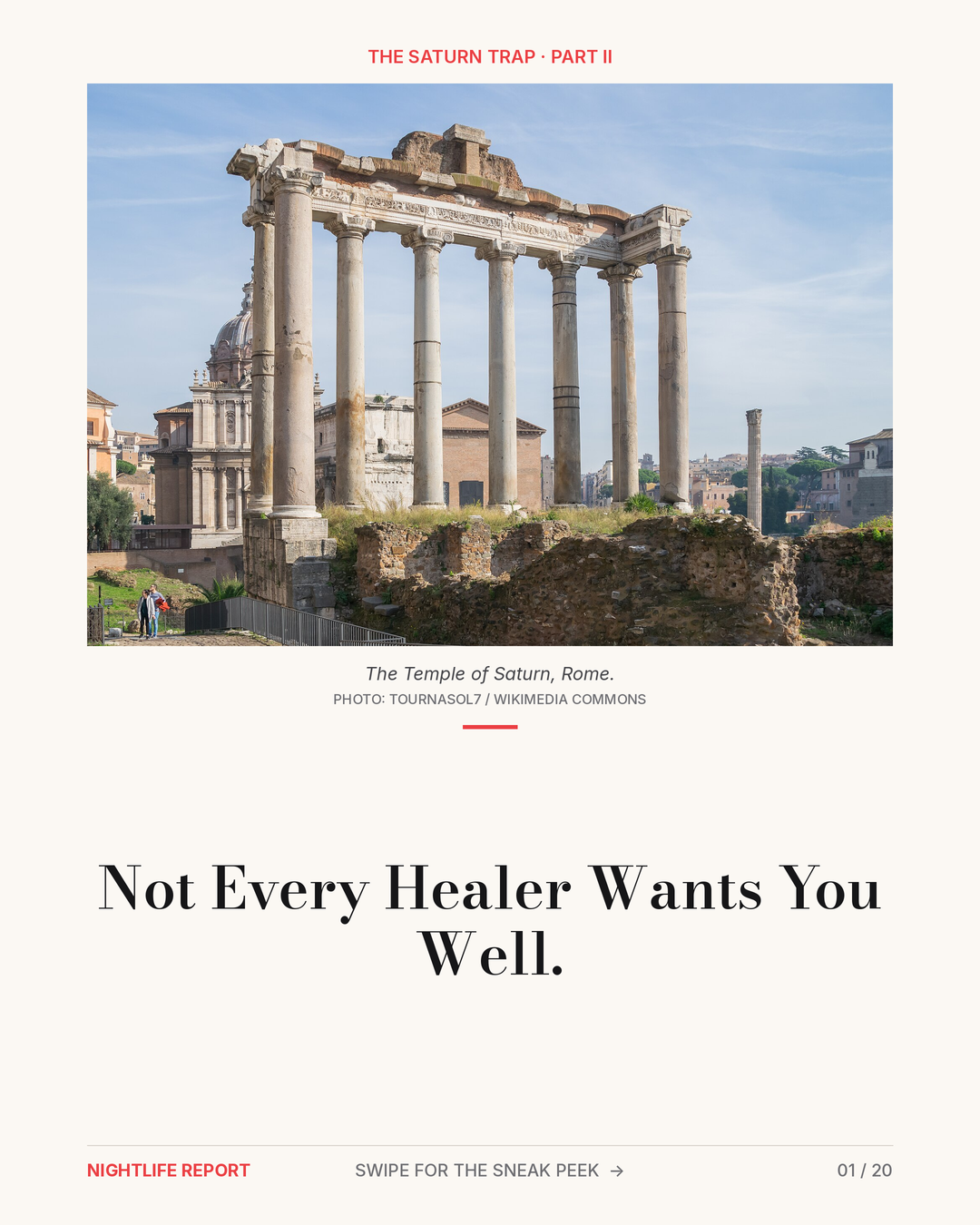
In Hesiod’s Theogony, Cronus (the Romans’ Saturn) learns that a child will overthrow him, so he swallows each of his children the moment they are born: Hestia, Demeter, Hera, Hades and Poseidon. Rhea hides the infant Zeus (Jupiter) on Crete and hands Cronus a stone wrapped in swaddling clothes. Grown, Zeus makes his father vomit up the stone and then the children he had swallowed.
Part One used this story to describe traps from the outside: debt bondage, held documents, fees to be “discovered”, isolation. Part Two turns to the people who build those traps. Saturn does not look like a monster when he opens his arms. He looks like a father. That is the point.
2. Three names, one family: the Dark Triad
In 2002, psychologists Delroy Paulhus and Kevin Williams at the University of British Columbia studied three “offensive yet non-pathological” personalities: narcissism, Machiavellianism and subclinical psychopathy. They called them the Dark Triad. The three overlapped but were not the same. The only Big Five trait all three shared was low agreeableness. Narcissists showed the most self-enhancement; psychopaths stood out for low anxiety.
- Psychopathy is rare. In a representative survey of households in England, Wales and Scotland, Coid and colleagues (2009) found a weighted prevalence of 0.6 percent using the Psychopathy Checklist: Screening Version, while noting that milder traits are spread on a continuum.
- Narcissistic personality disorder is more common. The U.S. NESARC Wave 2 survey (Stinson et al., 2008) estimated a lifetime prevalence of 6.2 percent, higher in men (7.7 percent) than women (4.8 percent).
- “Sociopath” is not a formal diagnosis. Linda Mealey (1995) used it for people who pursue a manipulative, predatory social strategy, and argued that some are born with it (primary) while others develop it in response to harsh environments (secondary).
The lesson: you will meet them. Not most people, but enough people. A diagnosis is a clinician’s job; spotting a pattern of behavior is yours.
RelatedTombs: Who Gets Remembered, and Who Gets Brought Back
3. The cycle: idealize, devalue, discard
Saturn’s love is the first course of the meal.
Love-bombing. In the first empirical study of the behavior, Strutzenberg, Wiersma-Mosley, Jozkowski and Becnel (2017) defined love-bombing as excessive communication at the start of a relationship used to obtain power and control over another person’s life, as a means of narcissistic self-enhancement. Among 484 college students, love-bombing correlated with narcissism and lower self-esteem, and love-bombers reported heavier texting in their relationships.
Assessment, manipulation, abandonment. Industrial psychologist Paul Babiak and Robert Hare, who developed the Psychopathy Checklist, describe in Snakes in Suits (2006) how corporate psychopaths sort people into pawns and patrons, charm them, use them, and then discard them once they stop being useful. Their workplace model runs entry, assessment, manipulation, confrontation and ascension.
The trauma bond. Dutton and Painter (1981), cited in Part One, showed why victims stay: power imbalance plus intermittent good and bad treatment builds a bond stronger than steady kindness. The healer who sometimes hurts you is harder to leave than a stranger who always does.
Coercive control. Sociologist Evan Stark (Coercive Control, Oxford University Press, 2007) described abuse as a pattern of intimidation, isolation and control, with or without physical violence. The cage is built of rules, monitoring and fear, not only fists.
Put together, the cycle looks like this:
- Idealize. You are special, gifted, chosen. They understand you like no one else.
- Heal. They meet a real need: money, a place to stay, a gig, a community, a faith, a cure for loneliness.
- Isolate. Your old friends “don’t get you”. Your family is “toxic”.
- Devalue. Praise turns into criticism. You start apologizing for things you did not do.
- Extract. Your time, money, art, body or reputation now serve them.
- Discard, or hoover. They leave you, or pull you back with another round of love when you try to go.
That is Saturn’s method: feed the child the hope of rising, then swallow it.
4. Why creatives and newcomers are the favorite meal
The research above does not single out artists. But the predator’s playbook works best on people with three things: a big dream, a thin support network, and a habit of trusting the person who opens a door. That describes many creatives and many people who are new to a city, an industry or a scene.
- The dream is leverage. “I can get you seen” is the oldest love-bomb in entertainment.
- Distance is isolation already done. Someone far from home has fewer people to check a story with.
- Sensitivity reads as weakness. Creatives notice everything and feel everything. A manipulator reads that as a lock to pick.
- “You’re weird” is a tool. Telling a creative they are strange, too much, or lucky to be included makes them grateful for crumbs.
None of this is about a race, a religion or a nationality. Manipulators come from every group, and so do their targets. It is a mechanism, not an identity.
5. Game theory: why Saturn wins short games and loses long ones
Political scientist Robert Axelrod ran computer tournaments of the repeated Prisoner’s Dilemma, published as The Evolution of Cooperation (1984, building on Axelrod and Hamilton, Science, 1981). The winner, twice, was the simplest entry: Tit for Tat, submitted by Anatol Rapoport. It cooperates on the first move, then copies whatever the other player did last. Axelrod found that winning strategies share four properties: they avoid unnecessary conflict, they are provocable when the other side defects, they forgive after one response, and they are clear.
Mealey (1995) applied the same logic to sociopathy: a “cheater” strategy can survive at low frequency, especially where people meet once, move often and cannot check reputations. Cheaters thrive in crowds of strangers. They starve in communities that remember.
What that means for you:
- Start nice. Openness is not the mistake.
- Be provocable. The first serious betrayal gets a response, not an excuse.
- Forgive once, not forever. If the pattern repeats, the game is over.
- Be clear. State your terms so they cannot be twisted.
- Make reputation matter. Talk to each other. Share notes. A scene where creatives compare stories is a scene where Saturn cannot feed.
That is the Jupiter strategy. Zeus did not beat Cronus alone. He freed his siblings and fought beside them.
6. How to spot Saturn early
- Intensity that outruns the relationship: daily gifts, constant messages, “soulmate” talk in week one.
- Help that comes with a hook you discover later.
- A story where everyone before you betrayed them.
- Rules about who you can see, what you can post, or what you can question.
- Kindness that switches off the moment you say no.
- You feel confused, guilty or tired after every conversation.
- Your money, documents, passwords or art drift into their hands.
7. How to exit: the Jupiter rules
- If someone makes you uncomfortable, leave. You do not need a diagnosis to walk away.
- Go no-contact or low-contact. Fewer channels means fewer hooks.
- Keep your own documents, passwords and money.
- Write it down. Dates, messages, screenshots. Memory gets rewritten; records do not.
- Rebuild your circle. Call the friend they told you to drop.
- Expect the hoover. A sudden apology or gift after you leave is part of the cycle, not proof of change.
- Get professional help from a licensed therapist, especially one trained in trauma.
- Unite. Creatives who tell each other the truth are the thunderbolt.
Get help (U.S.): National Domestic Violence Hotline: 1-800-799-7233 (24/7, confidential, thehotline.org). National Human Trafficking Hotline: 1-888-373-7888, or text 233733. In danger, call 911.
8. Closing
Saturn swallows what he fears will outgrow him. That is why the people who heal you and then consume you so often aim at the gifted. The myth’s ending is the instruction: Jupiter does not negotiate with the stomach. He forces it open, frees the others, and builds a new order with them. Leave. Tell the truth. Stand together.
Sources (each verified online on Oct 29, 2026)
- Hesiod, Theogony, lines 453-506. Theoi Classical Texts Library: https\://www.theoi.com/Text/HesiodTheogony.html ; Perseus: http\://www.perseus.tufts.edu/hopper/text?doc=Hes.+Th.+492
- Paulhus, D. L., & Williams, K. M. (2002). The Dark Triad of personality: Narcissism, Machiavellianism, and psychopathy. Journal of Research in Personality, 36(6), 556-563. https\://doi.org/10.1016/S0092-6566(02)00505-6
- Coid, J., Yang, M., Ullrich, S., Roberts, A., & Hare, R. D. (2009). Prevalence and correlates of psychopathic traits in the household population of Great Britain. International Journal of Law and Psychiatry. https\://pubmed.ncbi.nlm.nih.gov/19243821/
- Stinson, F. S., et al. (2008). Prevalence, correlates, disability, and comorbidity of DSM-IV narcissistic personality disorder. Journal of Clinical Psychiatry, 69(7), 1033-1045. https\://ncbi.nlm.nih.gov/pmc/articles/PMC2669224/
- Mealey, L. (1995). The sociobiology of sociopathy: An integrated evolutionary model. Behavioral and Brain Sciences, 18(3), 523-541. https\://doi.org/10.1017/s0140525x00039595
- Strutzenberg, C. C., Wiersma-Mosley, J. D., Jozkowski, K. N., & Becnel, J. N. (2017). Love-bombing: A narcissistic approach to relationship formation. Discovery, 18(1), 81-89. https\://doi.org/10.54119/discovery.zxgc9960
- Babiak, P., & Hare, R. D. (2006). Snakes in Suits: When Psychopaths Go to Work. HarperCollins. https\://en.wikipedia.org/wiki/Snakes_in_Suits:_When_Psychopaths_Go_to_Work
- Stark, E. (2007). Coercive Control: The Entrapment of Women in Personal Life. Oxford University Press. https\://doi.org/10.1093/oso/9780195154276.001.0001
- Axelrod, R. (1984). The Evolution of Cooperation. Basic Books; Axelrod, R., & Hamilton, W. D. (1981), Science. https\://ee.stanford.edu/\~hellman/Breakthrough/book/chapters/axelrod.html ; https\://websites.umich.edu/\~axe/research/Axelrod%20and%20Hamilton%20EC%201981.pdf
- Dutton, D. G., & Painter, S. L. (1981). Traumatic bonding. Victimology, 6. (Cited in Part One.)
- National Domestic Violence Hotline: https\://www.thehotline.org/
No quotations are used in this report. Every claim above is paraphrased from the listed source.
You might also like
 CultureThe Hand Span of God: Isaiah 40:12 Run as Math
 GuidesLos Angeles After Halloween: Free and Low-Ticket Culture for Mid-November
 FashionYeran Castaño broke the mold, built a career on transformation, and is aiming for bigger stages
 GuidesLuxury for Less: 10 Real Deals Worth a Look This Week (Nov 4, 2026)
 VideoWhy Thursday Is Jupiter’s Day: Dies Iovis and the Spiritual Forecast
 InterviewsOlivier “Hero” Dressen directed for Jaguar and Coke Studio. His short film has 18 awards.
Leave a Reply