
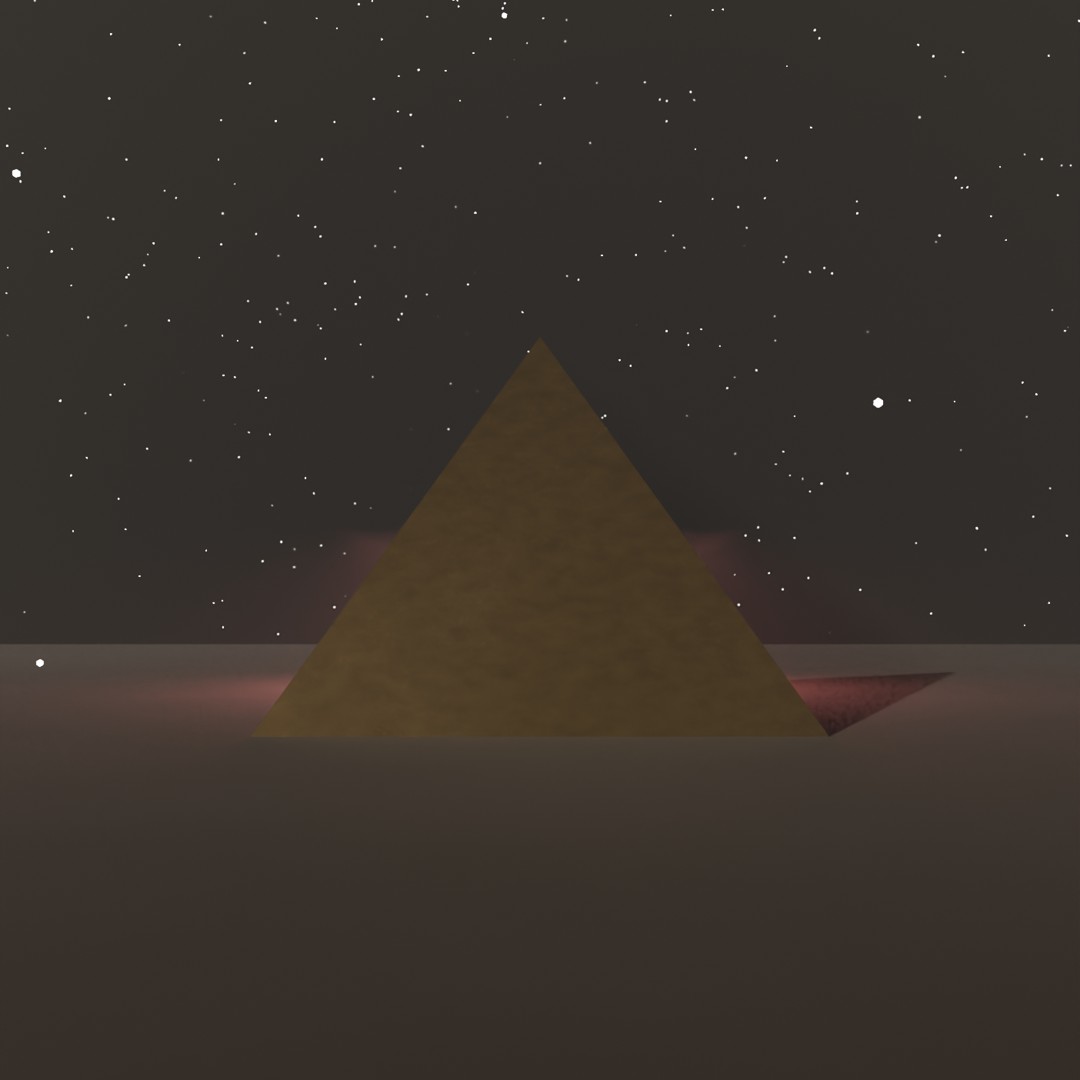
Pharaohs built pyramids. Most people got a pit in the sand. Anthony on why your legacy is the only tomb you can build, and why your brain is the only copy of you.
A tomb is a message
A grave holds a body. A tomb sends a message. Khufu's Great Pyramid at Giza, built around 2560 BC, has carried his name for about 4,500 years. That was the point: a structure built to outlast its builder and speak to people who had not been born yet.
Anthony's vision: the message may be answered
This part is vision, not fact. Anthony's view is that a far-future civilization, human or not, may one day read what we preserved and rebuild the people behind it. Nobody can promise that. But if it ever happens, it can only work from what was kept: bodies, records, names, work. What is lost is lost.
Most people never got a pyramid
The pyramids were for kings. Most ancient Egyptians were buried in simple pits in the desert, often with only a few pots or personal items. At Saqqara, Egyptologist Aidan Dodson told Smithsonian that the poorest were probably buried "in the desert in a sheet." Most of their names are lost. That is the default outcome for almost everyone who has ever lived.
You get about a hundred years
In the United States, life expectancy at birth is about 79 years (CDC). A lucky few reach 100. That is the whole window to build a name, a body of work and people who carry it after you.
Remembered is not the same as awake
In the Epic of Gilgamesh, the king searches for eternal life and comes home with only his name and his walls at Uruk. A legacy keeps your story alive. It does not keep you aware. That gap is what makes the question of preservation so urgent in Anthony's vision.
Related“Many Rooms”: What John 14:2 Actually Says About Space in Heaven
Earth is not forever
The Sun grows slowly brighter as it ages. A 2021 study by Kazumi Ozaki and Christopher Reinhard in Nature Geoscience, part of NASA-supported research, estimates that Earth's oxygen-rich atmosphere will last about another billion years. NASA climate modeling (Wolf and Toon) puts the end of human-habitable conditions within roughly 1.3 to 1.5 billion years. Every tomb on this planet has an expiration date. Only a legacy that leaves Earth outlasts it.
Your brain is the only copy
The Dunedin study followed 1,037 people from birth to age 38. Meier and colleagues (PNAS, 2012) found the most persistent cannabis users who started as teenagers lost about 8 IQ points on average from childhood to adulthood, and quitting did not fully restore function. It is an observational study and some researchers have argued other factors play a part, but the authors found the link held after their controls. Protect the brain you are building with.
You are three people
In the 1960s, Roger Sperry and Michael Gazzaniga studied patients whose corpus callosum, the bridge between the brain's two hemispheres, had been cut to treat severe epilepsy. In lab tests, each hemisphere could perceive and respond on its own, sometimes without the other half knowing. Sperry shared the 1981 Nobel Prize in Physiology or Medicine for this work. Add the nervous system that runs your body, and Anthony counts three of you. Calling it "three people" is a metaphor. The lesson is real: get all three working on the same pyramid.
Build your pyramid
You cannot buy a pyramid. You can build one: the work, the name, and the people who will keep both. Start today.
Sources
- Britannica: Pyramids of Giza; Khufu
- HistoryExtra (BBC History Magazine): "The vast majority of Egypt's dead were buried in simple pits in the desert." historyextra.com/period/ancient-egypt/facts-ancient-egypt-mummification-cleopatra-pharaohs-tutankhamun-life-death/
- Smithsonian Magazine (2021): Inside the Tombs of Saqqara. smithsonianmag.com/history/inside-tombs-saqqara-180977932/
- CDC NCHS: United States life expectancy
- The Epic of Gilgamesh (Standard Babylonian version)
- Ozaki, K. & Reinhard, C. T. (2021). The future lifespan of Earth's oxygenated atmosphere. Nature Geoscience 14, 138-142.
- Wolf, E. T. & Toon, O. B. (2015). The evolution of habitable climates under the brightening Sun. JGR Atmospheres. NASA Astrobiology: Under the Bright Lights of an Aging Sun.
- Meier, M. H. et al. (2012). Persistent cannabis users show neuropsychological decline from childhood to midlife. PNAS 109(40):E2657-E2664. Rogeberg (2013) PNAS critique and authors' reply.
- Gazzaniga, M. S. (2005). Forty-five years of split-brain research. Nature Reviews Neuroscience. Nobel Prize in Physiology or Medicine 1981 (Roger W. Sperry).
Full story, every week
Talk it through with us on Discord. Support the series on Patreon.
Anthony Perlas · @lillithmagic · nightlifereport.app
You might also like
 CultureWhy It’s Harder to Hit the Sun Than to Leave the Solar System
 ExplainersLA Promoter Math: Bring Five or Pay
 ExplainersSpace Week: Swift’s Fiery Farewell, Voyager 1’s Light-Day and a Quiet Jet Flies East
 ExplainersOppression vs. Suppression: Know Which One Is Holding You Down
 NewsWhat You Missed: Thursday, Nov 5
 VideoWhy Thursday Is Jupiter’s Day: Dies Iovis and the Spiritual Forecast
Leave a Reply