
How Manipulators Groom, Bind and Exploit People, and How Jupiter Sets Them Free
Lillith Magic · Directed by Anthony Perlas
The Myth in One Paragraph
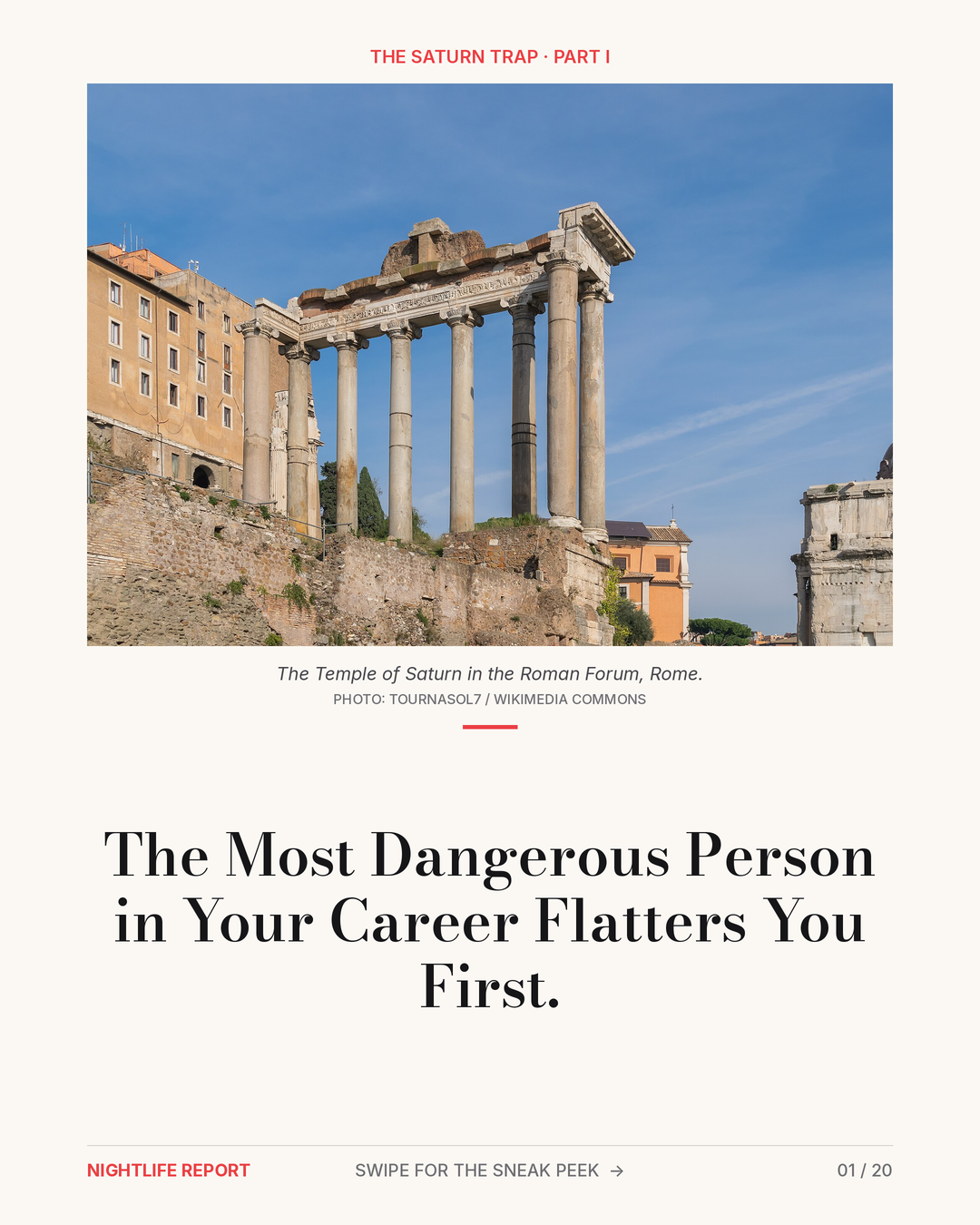
In Hesiod’s Theogony, Kronos, whom the Romans called Saturn, swallows his children so that none can grow up to replace him. Zeus, whom the Romans called Jupiter, is hidden away, grows up, forces his father to give the swallowed children back, and frees them. This report uses that story as a working analogy. Saturn stands for any system that feeds on the people inside it. Jupiter stands for knowledge, allies and the courage to walk out. The analogy is a lens, not a diagnosis. Every factual claim below is tied to a source.
1. Saturn Devours: How Abuse Binds a Person (core section)
1.1 The grooming-to-exploitation sequence
Researchers and anti-trafficking agencies describe the same pattern again and again, whether the setting is a relationship, a workplace, a religious group or a gang:
- Target. The manipulator looks for need: isolation, debt, a new arrival in a city or country, grief, addiction, or a hunger to belong.
- Gain trust (love-bombing). Intense attention, gifts, promises of work, love, fame or salvation.
- Fill the need. The manipulator becomes the source of money, papers, spiritual approval or a career break.
- Isolate. Contact with family, friends and outside information is cut off.
- Exploit and control. Demands rise, and with them threats, shame and debt.
- Maintain. Cycles of punishment and reward keep the person in place.
The Polaris Project, which operates the U.S. National Human Trafficking Hotline, says that traffickers most often recruit through people the victim already knows, such as partners, family members and employers, and not through strangers who kidnap them.
1.2 Coercive control
The sociologist Evan Stark, in Coercive Control: How Men Entrap Women in Personal Life (Oxford University Press, 2007), describes abuse as an ongoing pattern of domination: isolation, degradation, micro-regulation of daily life and the removal of liberty. It is not a series of separate violent incidents. England and Wales made coercive or controlling behaviour a crime under Section 76 of the Serious Crime Act 2015.
An older framework still predicts these tactics well. Albert Biderman’s 1957 study of coercion against prisoners of war lists isolation, monopolization of perception, induced exhaustion, threats, occasional indulgences, demonstrations of omnipotence, degradation and enforcement of trivial demands. Amnesty International later published it as “Biderman’s Chart of Coercion”. Survivors of abusive relationships, high-control groups and trafficking describe the same eight levers.
RelatedSaints Under the Vatican: How a Church Remembers
1.3 The cycle and the trauma bond
- The cycle of abuse. Lenore Walker (The Battered Woman, 1979) described tension building, an incident, reconciliation and calm, and then a repeat.
- Traumatic bonding. Donald Dutton and Susan Painter (1981) showed that power imbalance combined with intermittent abuse and kindness creates an unusually strong attachment. The reward that sometimes comes binds a person harder than steady kindness would. This is why victims often defend abusers and return to them.
- Love-bombing and devaluation. Clinicians use these terms for the idealize-devalue-discard pattern seen in relationships with people high in narcissistic traits. The terms are descriptive and are not formal DSM diagnoses.
1.4 Modern slavery: the scale
- The ILO, Walk Free and IOM Global Estimates of Modern Slavery (2022) count about 50 million people in modern slavery on any given day in 2021. That figure is made up of 27.6 million in forced labour and 22 million in forced marriage.
- The ILO’s eleven indicators of forced labour are abuse of vulnerability, deception, restriction of movement, isolation, physical and sexual violence, intimidation and threats, retention of identity documents, withholding of wages, debt bondage, abusive working and living conditions, and excessive overtime.
- Debt bondage means a worker is made to pay off a debt for recruitment, transport or “fees” that grows faster than it can be paid. The ILO identifies it as one of the most common forms of forced labour.
- The U.S. Department of Labor’s Bureau of International Labor Affairs publishes the List of Goods Produced by Child Labor or Forced Labor. The DOL Wage and Hour Division enforces wage and hour law for every worker.
1.5 Why newcomers and creatives are targeted
This is a mechanism, not an ethnicity. Polaris and the U.S. State Department’s Trafficking in Persons Report name the same set of vulnerabilities:
- language barriers
- fear of authorities
- recruitment debt
- isolation from family
Anyone of any background can be the victim, and anyone of any background can be the exploiter. Creatives face a parallel trap: unpaid “exposure” work, fake modeling and talent agencies that charge upfront fees, and promises of fame. Polaris lists fraudulent modeling and entertainment offers among recruitment lures.
1.6 Control inside religious and gang structures
High-control groups of any kind, whether religious, political, commercial or criminal, can use the same levers:
- loyalty tests
- confession used later as leverage
- shunning
- debts to the group
- “us versus them” thinking
- punishment for questioning
Gangs recruit with belonging and protection, then keep members through debt, blackmail and threats against family. Robert Jay Lifton’s Thought Reform and the Psychology of Totalism (1961) sets out eight criteria for this kind of milieu, including milieu control, demand for purity and the cult of confession. These are traits of structures, not of any faith or people as a whole.
1.7 The predator profile: what the research says
- Psychopathy. Robert Hare’s Psychopathy Checklist-Revised (PCL-R) scores 20 items, such as glibness, grandiosity, pathological lying, conning, lack of remorse, callousness and a parasitic lifestyle. A trained clinician scores each item 0, 1 or 2, for a maximum of 40.
- The Dark Triad. Delroy Paulhus and Kevin Williams (2002) grouped narcissism, Machiavellianism and subclinical psychopathy as overlapping “dark” traits.
- “Sociopath” is a popular term, not a DSM-5 diagnosis. The closest clinical label is antisocial personality disorder.
- Game theory. In repeated-game models such as Axelrod’s The Evolution of Cooperation (1984), exploiters do well in one-shot encounters and among strangers, and do badly where people remember, talk and refuse to cooperate again. The lesson is practical: compare notes, keep records, and stop the game early. Exploiters depend on isolation because isolation turns a repeated game back into a one-shot game.
Credible YouTube educators (verified channels):
- Dr. Ramani Durvasula: licensed clinical psychologist and author of It’s Not You (2024). Her channel is DoctorRamani and covers narcissistic abuse.
- Dr. Todd Grande: licensed counselor with a PhD in counselor education. His channel covers personality disorders, psychopathy and narcissism.
Treat any YouTube creator as education, not diagnosis.
2. Jupiter Liberates: Rules for Escape (core section)
2.1 Rules
- If someone makes you uncomfortable, leave. You do not need proof to protect yourself. Discomfort is data.
- Never hand over your passport, ID or phone to an employer, recruiter, partner or group leader. Holding someone’s documents is an ILO forced-labour indicator.
- Never pay to get a job. Upfront recruitment, modeling or “placement” fees are a classic route into debt bondage.
- Get every offer in writing, in a language you read.
- Keep a record: dates, messages, payments, screenshots, stored somewhere the other person cannot reach.
- Keep one outside friend who knows where you are and what you were promised.
- Watch for intermittent reward. When kindness comes only after punishment, that is the trauma-bond pattern, not love.
- Questions are allowed. Any group that punishes questions is showing you its structure.
2.2 Help resources (U.S.)
- National Human Trafficking Hotline: 1-888-373-7888, text 233733, chat at humantraffickinghotline.org. Open 24/7, confidential, in more than 200 languages.
- Immediate danger: call 911.
- National Domestic Violence Hotline: 1-800-799-7233, or text START to 88788.
- 988 Suicide and Crisis Lifeline: call or text 988.
- U.S. Department of Labor Wage and Hour Division: 1-866-487-9243, for unpaid wages.
3. Supporting Section: The Oldest Layer of the Story
- Sumer and Mesopotamia left the oldest written religious texts. The Standard Babylonian Epic of Gilgamesh, Tablet XI, tells how Utnapishtim survived a god-sent flood by building a boat, loading it with living things and releasing birds to find land. George Smith announced the find in London in 1872, and scholars have compared it with the flood in Genesis 6–9 ever since. Most scholars see shared Near Eastern tradition and literary influence. They do not see a simple copy.
- Egypt. The myth of Osiris, his murder, restoration and judgment of the dead, is recorded from the Pyramid Texts of the Old Kingdom, around the 24th century BCE.
- Interpretatio graeca and romana. Herodotus matched Egyptian gods with Greek ones. Tacitus (Germania 43) used the phrase interpretatio Romana. Rome mapped Zeus onto Jupiter, Kronos onto Saturn and Hera onto Juno.
- “Pagan” comes from the Latin paganus, “rural person” or “civilian”. From the 4th century, Christians used it for followers of the old gods, including worshippers of Jupiter and Zeus. Many modern polytheists now reclaim the word.
4. Supporting Section: The Library of Alexandria and the Serapeum
- 48 BCE. During Julius Caesar’s civil war in Alexandria, fire spread from the harbor. Plutarch and Seneca report that books burned. Historians debate how much of the Library was lost.
- c. 272 CE. Aurelian’s war against Zenobia of Palmyra devastated the Brucheion, the palace quarter where the Library stood.
- 391 CE. Under Bishop Theophilus, after Emperor Theodosius I’s anti-pagan decrees, Christians destroyed the Serapeum, the temple of Serapis that held the Library’s daughter collection. Rufinus and Socrates Scholasticus record it.
- Accurate framing: the great Library declined over centuries through war, loss of funding and the purges of scholars. The 391 destruction of the Serapeum is well documented. The story that the Arabs burned the Library in 642 is generally treated as a later legend.
5. Supporting Section: Religious Trauma and the Price of Healing
- Religious Trauma Syndrome. Psychologist Dr. Marlene Winell coined the term in 2011 for the symptoms some people show after leaving authoritarian or dogmatic religion: anxiety, depression, fear of hell, loss of identity and of community. RTS is not a DSM diagnosis.
- Complex PTSD is recognized in the WHO’s ICD-11 (6B41). It adds problems with emotion regulation, self-worth and relationships to the core symptoms of PTSD, and it is linked to prolonged, inescapable trauma.
- Cost. In the U.S., private therapy often costs about 100 to 250 dollars a session, and specialists charge more. Low-cost options include community mental health centers, sliding-scale clinics, university training clinics and Open Path Collective.
- Gnosticism. Many Gnostic texts, such as some of those found at Nag Hammadi in 1945, describe the material world as the work of a lesser creator, the demiurge. The divine spark escapes through gnosis, or knowledge. Holding a minority spiritual belief is not mental illness. Clinicians are trained to respect cultural and religious beliefs (DSM-5 Cultural Formulation).
- In his own words (first person): “In my time in the Catholic Church, I experienced what felt like being healed and then bullied, as if my energy was being taken. Leaving was my Jupiter moment.” This is the Admiral’s own account of his experience, not a claim about the Church as a whole. He should approve the wording before anything is published.
6. Supporting Section: The “Weird” Ones, the Two-Chambered Mind and the Lost Humans
- “Weird.” Elon Musk, Sam Altman and Mark Zuckerberg have all been called “weird” in public, and Musk has said publicly that he has Asperger’s (Saturday Night Live, May 2021). Outsider status is a common thread in founder and artist biographies. It is not a defect.
- Attribution correction. The idea that the two hemispheres of the brain once worked as separate units, with one “speaking” and the other obeying, before modern consciousness began, comes from Julian Jaynes, The Origin of Consciousness in the Breakdown of the Bicameral Mind (1976). It does not come from “Horowitz”. It remains a speculative hypothesis. Iain McGilchrist’s The Master and His Emissary (2009) is a related modern work on the two hemispheres.
- Other humans. At least several other human species lived alongside Homo sapiens, including Neanderthals, Denisovans, Homo floresiensis and Homo luzonensis. Neanderthals disappeared about 40,000 years ago. Proposed causes include competition, climate, small population size and interbreeding: most non-Africans today carry about 1–2% Neanderthal DNA. Mass extermination by humans is not established.
- Fringe sources. No verifiable Why Files or Eric Dubay quotes are used in this report. Eric Dubay promotes flat-earth claims and is a fringe source. He should not be cited for fact.
Closing: Creatives Must Unite
Saturn’s whole strategy is isolation: one person, one debt, one secret, one voice that says you are the weird one. Jupiter’s answer has always been alliance. In the myth, Zeus did not win alone. He freed his swallowed brothers and sisters and fought beside them. Creatives, newcomers and survivors win the same way: by comparing notes, refusing the upfront fee, keeping the passport, leaving the room that feels wrong, and calling 1-888-373-7888 when someone needs out. Alone, a creative is prey. Together, creatives are a guild.
Sources
- Hesiod, Theogony, lines 453–506.
- Polaris Project: polarisproject.org; National Human Trafficking Hotline: humantraffickinghotline.org.
- ILO, Walk Free and IOM, Global Estimates of Modern Slavery (2022): ilo.org.
- ILO, Indicators of Forced Labour (2012): ilo.org.
- U.S. DOL ILAB, List of Goods Produced by Child Labor or Forced Labor: dol.gov/agencies/ilab; DOL Wage and Hour Division: dol.gov/agencies/whd.
- U.S. Department of State, Trafficking in Persons Report: state.gov.
- Stark, E. (2007). Coercive Control. Oxford University Press. UK Serious Crime Act 2015, s.76.
- Biderman, A. (1957). Communist attempts to elicit false confessions. Bulletin of the NY Academy of Medicine.
- Walker, L. (1979). The Battered Woman. Harper & Row.
- Dutton, D. and Painter, S. (1981). Traumatic bonding. Victimology, 6.
- Lifton, R. J. (1961). Thought Reform and the Psychology of Totalism.
- Hare, R. D. (2003). Hare PCL-R, 2nd ed. MHS.
- Paulhus, D. and Williams, K. (2002). The Dark Triad of personality. Journal of Research in Personality, 36.
- Axelrod, R. (1984). The Evolution of Cooperation.
- Durvasula, R. (2024). It’s Not You; YouTube: DoctorRamani. Grande, T., YouTube: Dr. Todd Grande.
- Epic of Gilgamesh, Tablet XI (trans. A. George, Penguin, 2003).
- Tacitus, Germania 43; Herodotus, Histories Book II.
- Plutarch, Life of Caesar 49; Rufinus, Ecclesiastical History 11.22–30; Socrates Scholasticus 5.16.
- Winell, M. (2011). Religious Trauma Syndrome. Cognitive Behaviour Therapy Today.
- WHO, ICD-11, 6B41 Complex PTSD.
- Jaynes, J. (1976). The Origin of Consciousness in the Breakdown of the Bicameral Mind. McGilchrist, I. (2009). The Master and His Emissary.
- Smithsonian Human Origins Program: humanorigins.si.edu.
You might also like
 CultureThe Sun Moves 230 km/s. Why Does the Sky Look Frozen?
 CultureWhy Pharaohs Built Pyramids: Memory Costs Resources
 GuidesA Free-ish LA Day: Griffith, The Hammer, The Broad and a Market Lunch
 NewsPalace Opened a Soho Flagship With a Burberry Capsule You Can Only Buy There
 GuidesNYC Clubs and Apps for Making Friends: A Run Club, a Book Club and a Dinner App
 VideoWhy Thursday Is Jupiter’s Day: Dies Iovis and the Spiritual Forecast
Leave a Reply