
Lillith Magic · Directed by Anthony Perlas
A viral episode of the YouTube channel My Lunch Break opens with a promise: “Welcome to the destruction of the mainstream history.” Its subject is Borobudur in Central Java, and its question is a good one: who decides which parts of the past we get to see? The episode asks why 160 relief panels at the temple’s base were covered, and says, “I want to see them.”
We took that instinct and paired it with a method: the D.A.R.E. framework from the First Principles Thinking prompt pack. D.A.R.E. stands for “Decompose the problem. Audit assumptions. Recombine facts. Experiment against reality.” The audit step asks us to “uncover and question inherited assumptions” and to classify each one as “a fact, convention, or unknown based on the evidence available.” Then we pointed it at the Philippines, with four Filipino creatives as our guides: model Sofhia Flores (@sofhiafloress), model and nurse Bryan Vargas (@d.bryanbryxph), Lance Raymundo (@lanceraymundo) and model Nicole Anne Williams (@nicolewilliams919). Each one carries one of the four findings below. Their lines are paraphrased from their Nightlife Report interviews, and all four agreed to be featured.
D: Decompose the story
The standard short version of Philippine history rests on four load-bearing claims:
- People arrived late.
- Writing and recorded history began with Spain in 1521.
- The islands were a backwater until the galleons.
- The rice terraces are 2,000 years old.
Each one has been rewritten by evidence, and each one gets a collaborator.
A: Audit, four findings, four collaborators
Finding 1, with Bryan Vargas: we were here far earlier
Bryan (@d.bryanbryxph) told us he stopped asking whether he belonged and started backing what he brings. The evidence says Filipinos never needed to ask either.
RelatedTombs: Who Gets Remembered, and Who Gets Brought Back
In 2018 a team led by Thomas Ingicco reported a butchered rhinoceros skeleton and 57 stone tools at Kalinga, Luzon, dated to about 709,000 years ago (Nature 557). In 2019, Florent Détroit and colleagues named Homo luzonensis from teeth and bones in Callao Cave, at least 50,000 years old (Nature 568). Earlier work at Callao had already dated a human foot bone to about 67,000 years (Mijares et al., Journal of Human Evolution, 2010). Verdict: fact. The “late arrival” story was a convention.
Finding 2, with Sofhia Flores: we were writing before Magellan
Sofhia (@sofhiafloress), from Nueva Ecija, says she walks to carry her Filipino heritage with pride and to show others they can chase their dreams too. That heritage is written down, and it is older than most textbooks admit.
The Laguna Copperplate Inscription is dated Saka 822, which is 900 AD. It records the cancellation of a debt and names places including Tondo. It surfaced in 1989 and was translated by Antoon Postma (Philippine Studies, 1992). Verdict: fact. “No history before 1521” was a convention.
Finding 3, with Nicole Anne Williams: we were a sea power and a gold economy
Nicole (@nicolewilliams919) walks the runway while earning her bachelor’s degree, and her next move is producing the show, not just walking it. Our ancestors did the same at sea: they built the ships and ran the trade.
Butuan’s balangay plank boats, excavated from 1976, carry radiocarbon dates as early as 320 AD according to the National Museum of the Philippines. The Golden Tara, about 1.8 kg of cast gold, was found in Agusan in 1917 and is now held by the Field Museum in Chicago. The Song dynasty history (Songshi) records envoys from Butuan in 1001. Verdict: fact. The idea that King Solomon’s Ophir was in the Philippines remains a theory with no direct evidence.
Finding 4, with Lance Raymundo: the terraces may be younger, and that is the brave part
Lance (@lanceraymundo) warns that TikTok and Instagram trends can flatten creativity, and his answer is to stay original. The Ifugao terraces are a monument to exactly that.
For most of the 20th century, guidebooks said the Ifugao terraces were 2,000 to 3,000 years old. That number traces to estimates by the American anthropologist H. Otley Beyer, not to dating. Filipino archaeologist Stephen Acabado ran radiocarbon and Bayesian analysis and found that many terraces were built after about 1600 (Antiquity 83, 2009). His later work argues that Ifugao communities expanded the terraces while resisting Spanish control in the mountains (Journal of Archaeological Method and Theory, 2017). Verdict: the old number was a convention. The new one is strongly supported and still being tested.
Here the “debunk” did not shrink our history. It made it braver.
Audit the video with the same rules
Fairness means auditing the source too. The episode suggests the hidden Borobudur panels were buried to hide the truth and that “somebody has those.” The record says otherwise. J. W. IJzerman found the hidden foot in 1885, and the photographer Kassian Céphas photographed all 160 Karmawibhangga panels in 1890-91 before they were covered again. Those photographs are held by Leiden University Library, and four panels remain exposed at the southeast corner. The panels show cause and effect, which the video itself describes well: “good actions equal good outcomes.”
Claims that Borobudur was a power “machine,” or that a restoration “turned off the machine,” have no evidence behind them. They are theories, and we label them that way. The same goes for the internet theory of “Tartaria.”
Steelman the debunkers
The mainstream’s best argument is strong. Radiocarbon dating, stratigraphy and peer review let anyone recheck a claim. “It looks too advanced for them” is not evidence, and it often underrates the people who really built these things. Debunkers have also caught real fakes in our own history: the “Code of Kalantiaw,” taught in Philippine schools for decades, was shown by historian William Henry Scott in 1968 to be a 20th-century forgery by José E. Marco.
Debunk the debunkers
Then ask who wrote the first draft. Beyer’s “waves of migration” model and the 2,000-year terraces were repeated for decades on thin proof. Filipino scholars such as F. Landa Jocano challenged the migration model in the 1970s. Colonial-era scholarship set the baseline, and careers, grants and textbooks can reward defending a baseline. That does not make experts wrong. It means we check their incentives, and then we check their data. The terraces case shows the fix came from more evidence, gathered by a Filipino-led team, not from louder opinions.
R: Recombine what survived
- Ancient human presence: verified.
- Writing and law by 900 AD: verified.
- Ocean-going ships and a gold trade with China: verified.
- Terraces built in defiance of colonial rule: strongly supported.
- Ophir, Tartaria and “machine” temples: theories only.
And the fourth power on today’s world stage: four Miss Universe crowns, won by Gloria Diaz (1969), Margie Moran (1973), Pia Wurtzbach (2015) and Catriona Gray (2018). A nation told it was small keeps refusing the small story.
E: Experiment against reality
The D.A.R.E. pack asks for “the smallest real-world test.” Here is ours:
- Read the Laguna Copperplate translation.
- Look up the Céphas photographs of the Borobudur hidden foot.
- Visit the National Museum in Manila or the Butuan site museum.
- When a claim has no source you can open, label it: theory.
FAQ
Who are the four collaborators?
Sofhia Flores, Bryan Vargas, Lance Raymundo and Nicole Anne Williams, Filipino creatives featured by Nightlife Report. Each is paired with one finding.
What are the four findings?
Four claims about Philippine history that evidence rewrote: when people arrived, when writing began, how we sailed and traded, and how old the terraces are.
Is the D.A.R.E. framework anti-science?
No. It is a way of separating facts from conventions, and the evidence in this article comes from peer-reviewed science.
Were the Borobudur panels hidden to cover up the truth?
The record says they were photographed in full in 1890-91 and the photographs are public. Why the foot was encased in the first place is still debated, with structural support the leading explanation.
Was the Philippines Solomon’s Ophir?
That is a theory. The gold and the trade are documented; the Ophir link is not.
Are the Ifugao terraces really younger than 2,000 years?
Many sampled terraces date after about 1600, according to Acabado’s radiocarbon work. Research is ongoing, and some areas may be older.
Sources
- Ingicco, T. et al. (2018). Earliest known hominin activity in the Philippines by 709 thousand years ago. Nature 557, 233-237.
- Détroit, F. et al. (2019). A new species of Homo from the Late Pleistocene of the Philippines. Nature 568, 181-186.
- Mijares, A. S. et al. (2010). New evidence for a 67,000-year-old human presence at Callao Cave, Luzon. Journal of Human Evolution 59, 123-132.
- Postma, A. (1992). The Laguna Copper-Plate Inscription. Philippine Studies 40(2).
- Acabado, S. (2009). A Bayesian approach to dating agricultural terraces: a case from the Philippines. Antiquity 83, 801-814.
- Acabado, S. (2017). The archaeology of pericolonialism. Journal of Archaeological Method and Theory 24.
- Scott, W. H. (1968). A Critical Study of the Prehispanic Source Materials for the Study of Philippine History.
- Jocano, F. L. (1975). Questions and Challenges in Philippine Prehistory.
- National Museum of the Philippines: Balangay collection.
- UNESCO World Heritage Centre: Borobudur Temple Compounds (592); Rice Terraces of the Philippine Cordilleras (722).
- My Lunch Break, YouTube episode on Borobudur: https://www.youtube.com/watch?v=69e0-HIPHaA
- First Principles Thinking: The D.A.R.E. Framework (prompt pack).
Listen and support
Hear more on the Nightlife Report podcast, and join the community at patreon.com/aperlas.
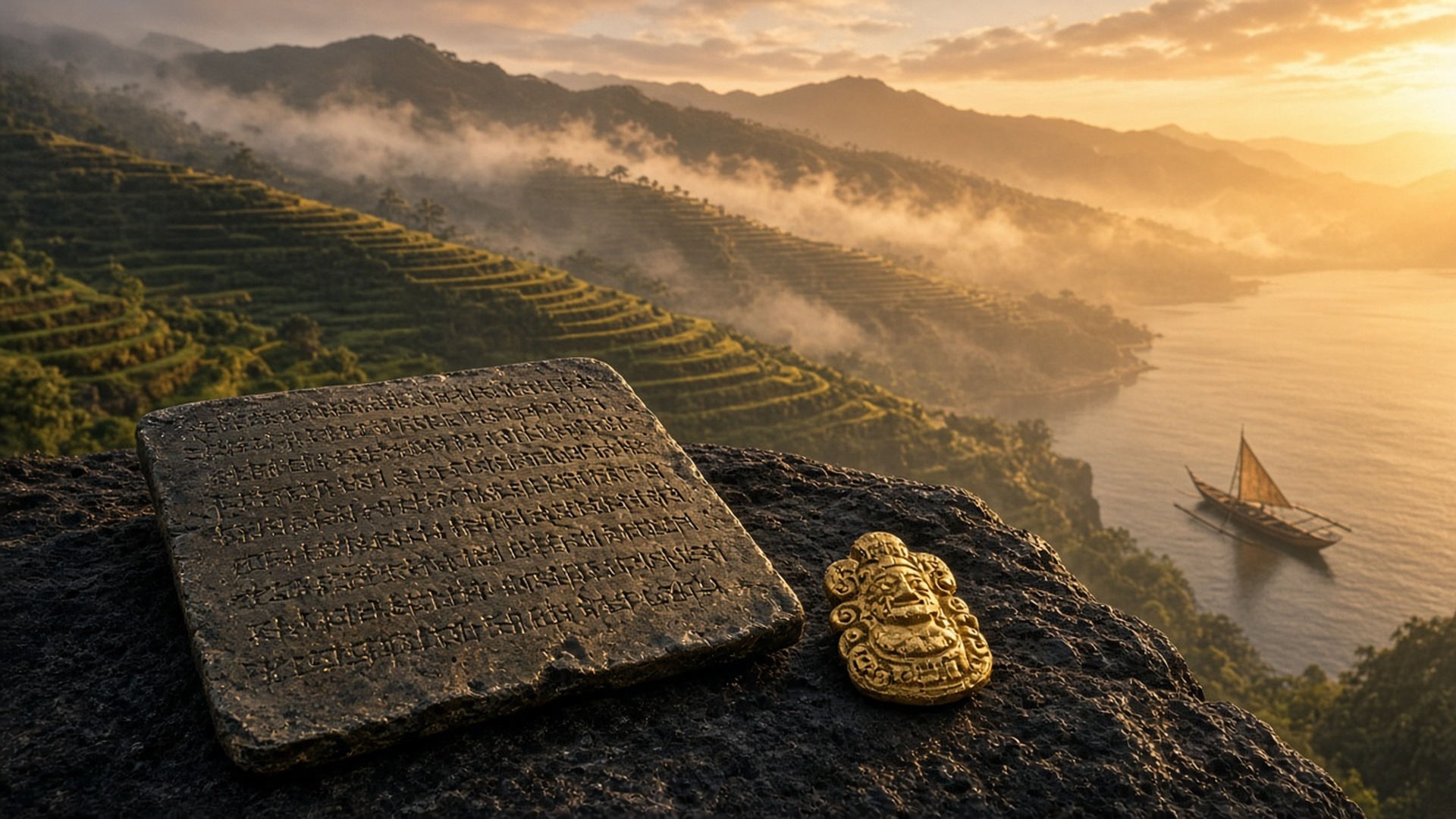
Collaborator photos courtesy of Sofhia Flores (photographer @adamlupix), Bryan Vargas, Lance Raymundo and Nicole Anne Williams. Hero image: illustration. Lillith Magic · Directed by Anthony Perlas.
You might also like
 Culture“Many Rooms”: What John 14:2 Actually Says About Space in Heaven
 ExplainersGo Door to Door: Parking-Lot Conversations Beat Waiting for a Patron
 ExplainersTao Group Hospitality: The Company Behind Marquee, OMNIA, TAO and Hakkasan
 ExplainersAgents Go Shopping Before Black Friday: Shopify’s Quarter, Dots’ Second Brain and a Checklist for Your Wallet
 NightlifeBelief Won’t Save You. Building Will.
 VideoWhy Thursday Is Jupiter’s Day: Dies Iovis and the Spiritual Forecast
Leave a Reply