
Space · Sourced
Two telescopes found a cat in the dark, and a rocket bound for the Moon got its spine.
Darlings, the universe has excellent taste in timing. Two days before Halloween, the world’s two most famous telescopes unveiled a cat made of dust; a day later, India sent a new clock into orbit; and in Florida, the rocket meant to carry astronauts back toward the Moon quietly got its backbone. Here is the week in space, sourced, and what you can see from a rooftop in Los Angeles or New York without any telescope at all.
The Cat’s Head Nebula: Hubble and Webb go trick-or-treating
A ghostly cat sits inside the Carina Nebula. On Oct. 29, ESA/Hubble and ESA/Webb released paired images of a small star-forming region nicknamed the Cat’s Head Nebula, inside the vast Carina Nebula roughly 7,500 light-years from Earth. The nickname comes from its resemblance, in the agencies’ words, to “a cat sitting with its back toward the viewer,” its head turned to the right to reveal a glowing eye.
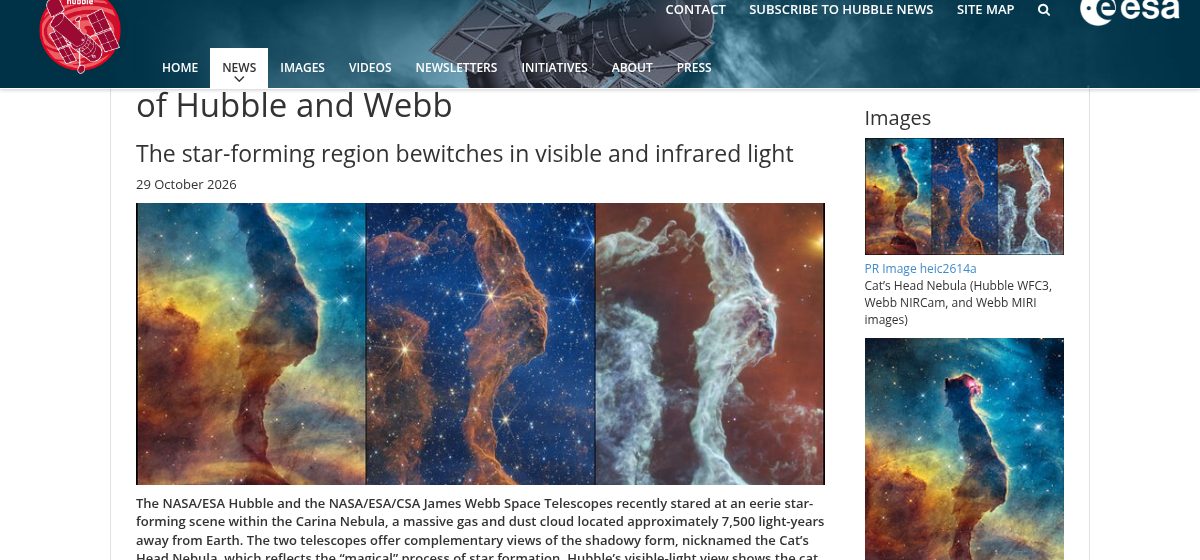
Two telescopes, two moods. Hubble’s visible-light view shows an opaque, dark brown pillar of dust, while Webb’s infrared imagery reveals many stars and hidden details inside it, according to the release. The shape, the astronomers write, was likely sculpted by intense ultraviolet radiation and winds from massive stars nearby; denser material inside the pillar resists that erosion, “at least for now.” The cat’s red eye may be a young star still partly wrapped in dust. The release is careful to say the scene is temporary and will eventually disperse as its stars form and evolve.
The society note: every great portrait has two exposures, the one for the public and the one that shows the bones. Hubble gives you the silhouette; Webb gives you the guest list.
India restores a navigation clock
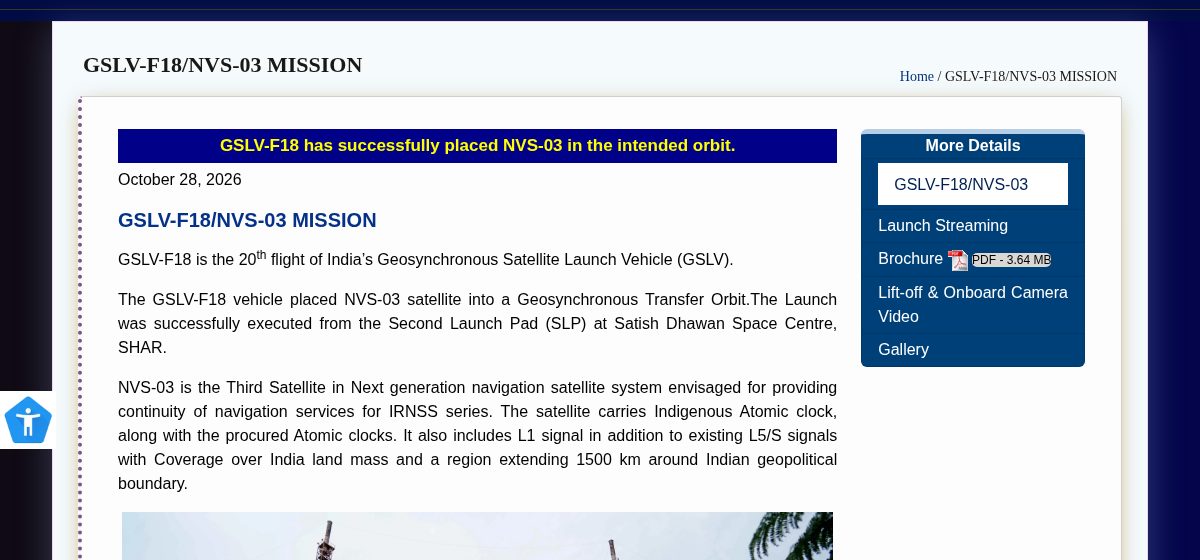
NVS-03 is in orbit. The Indian Space Research Organisation launched its GSLV-F18 rocket on Oct. 30 from the Second Launch Pad at the Satish Dhawan Space Centre, placing the NVS-03 navigation satellite into geosynchronous transfer orbit, according to ISRO and The Hindu. It was the 20th flight of the Geosynchronous Satellite Launch Vehicle. ISRO says NVS-03 is the third satellite in its next-generation series for the NavIC regional navigation system, carrying an indigenous atomic clock alongside procured ones, and adding an L1 signal to the existing L5 and S signals, with coverage over India and a region extending about 1,500 kilometers beyond its borders.
Why it matters past India: every phone map, ride, and delivery depends on a constellation of very precise clocks overhead. More nations running their own is the space-age version of not relying on a single doorman for the whole city.
Artemis III gets its backbone
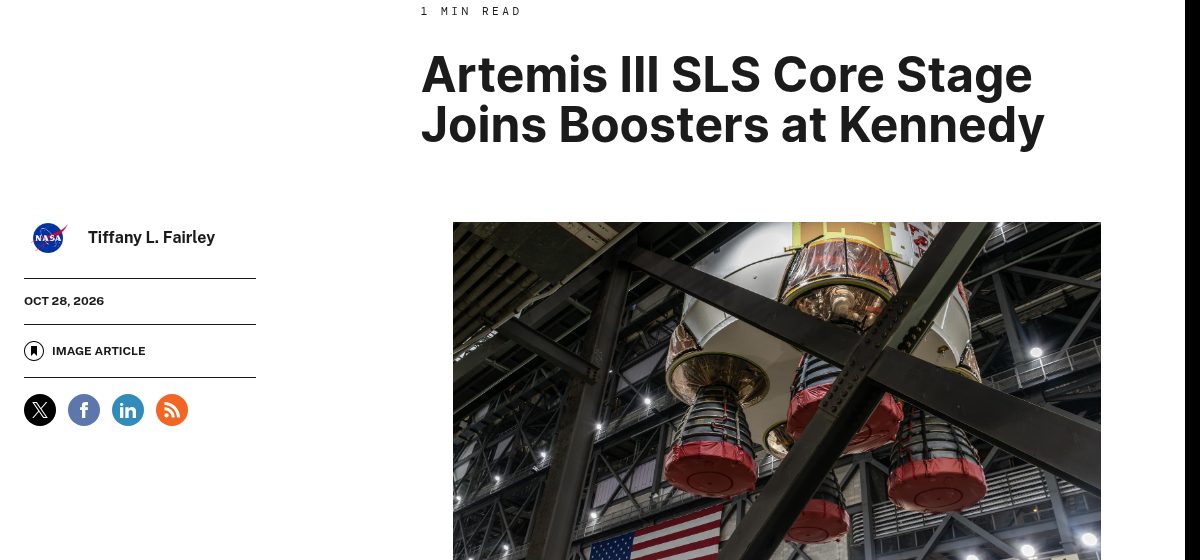
The core stage is stacked. NASA reported that the Artemis III Space Launch System core stage was integrated alongside its twin solid rocket boosters on Oct. 28 inside High Bay 3 of the Vehicle Assembly Building at Kennedy Space Center in Florida. Technicians lifted the 212-foot stage from High Bay 2 using a one-of-a-kind lifting beam designed to place it onto the mobile launcher. According to the agency, once testing and checkouts are complete, teams will roll the core stage and booster stack to Launch Pad 39B for a tanking test, loading liquid hydrogen and liquid oxygen into the core stage.
The society note: a launch is a premiere, and premieres are made in rehearsal. A fueling test with no crew and no countdown to orbit is the dress rehearsal nobody films, and it is the one that decides whether opening night happens.
What you can see yourself: the Taurids
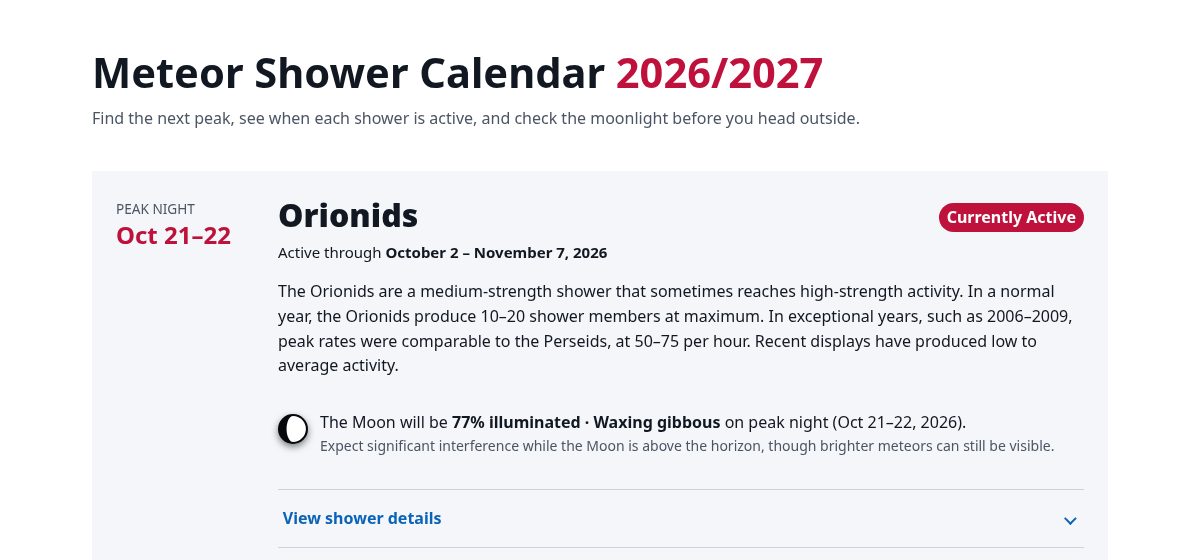
Look up this week and next. Both Taurid showers are active now, according to the American Meteor Society’s calendar. The Southern Taurids’ fireball-swarm component peaks around Nov. 5, with the society listing the night of Nov. 4–5 under a 25 percent waning crescent Moon; the Northern Taurids peak the night of Nov. 11–12, with the Moon just 4 percent lit, which the society calls very favorable. The Taurids are not a high-count shower, but the society notes they are “rich in fireballs,” and when the two streams overlap in late October and early November there is “sometimes a notable increase in fireball activity.” The Leonids follow, peaking Nov. 16–17.
A Halloween footnote: clocks fall back an hour at 2 a.m. Sunday, Nov. 1, which means darker evenings starting this week, and an earlier sky for anyone stargazing after work.
The read
The week’s theme is patience. A pillar of dust resists erosion for a while; a navigation network is rebuilt satellite by satellite; a Moon rocket is assembled bolt by bolt. The glamour is the image release. The work is everything before it.
Sources
- ESA/Hubble: Ghostly Cat’s Head Nebula lurks within sight of Hubble and Webb (heic2614, Oct. 29, 2026)
- ESA/Webb: Cat’s Head Nebula release (weic2622)
- ISRO: GSLV-F18/NVS-03 mission
- The Hindu: NVS-03 launched successfully; satellite placed in intended orbit (Oct. 30, 2026)
- Space.com: India launches next-gen navigation satellite to orbit
- NASA: Artemis III SLS core stage joins boosters at Kennedy (Oct. 28, 2026)
- American Meteor Society: meteor shower calendar
You are invited: Code Red, Halloween night.
Join Nightlife Report at CODE RED’s HALLOWEEN! ft. Don Woezik — Saturday, Oct. 31, 11 p.m., secret Los Angeles location, tickets from $17.49: posh.vip/e/halloween-ft-don-woezik
Nightlife Report is funded by readers. Back the reporting at patreon.com/aperlas.
nightlifereport.app | Tips: editor@nightlifereport.app | 1049 Havenhurst Dr, Unit 67, West Hollywood, CA 90046
You might also like
 ExplainersSwift Falls, Hubble Finds a Cat’s Tail, and NASA Asks Who Can Save the Old Telescope
 NewsPulse: The Morning After on Both Coasts, Through an Eileen Otte Ford Lens
 NewsPulse: Holiday Party Season Opens on Both Coasts, Through an Eileen Otte Ford Lens
 CultureCryonics: The Science Bet on a Second Life, With Every Caveat
 NewsHoliday Campaigns Go After Dark: Claudia Schiffer for Chloé, Irina Shayk for Donna Karan
 VideoWhy Thursday Is Jupiter’s Day: Dies Iovis and the Spiritual Forecast
Leave a Reply