
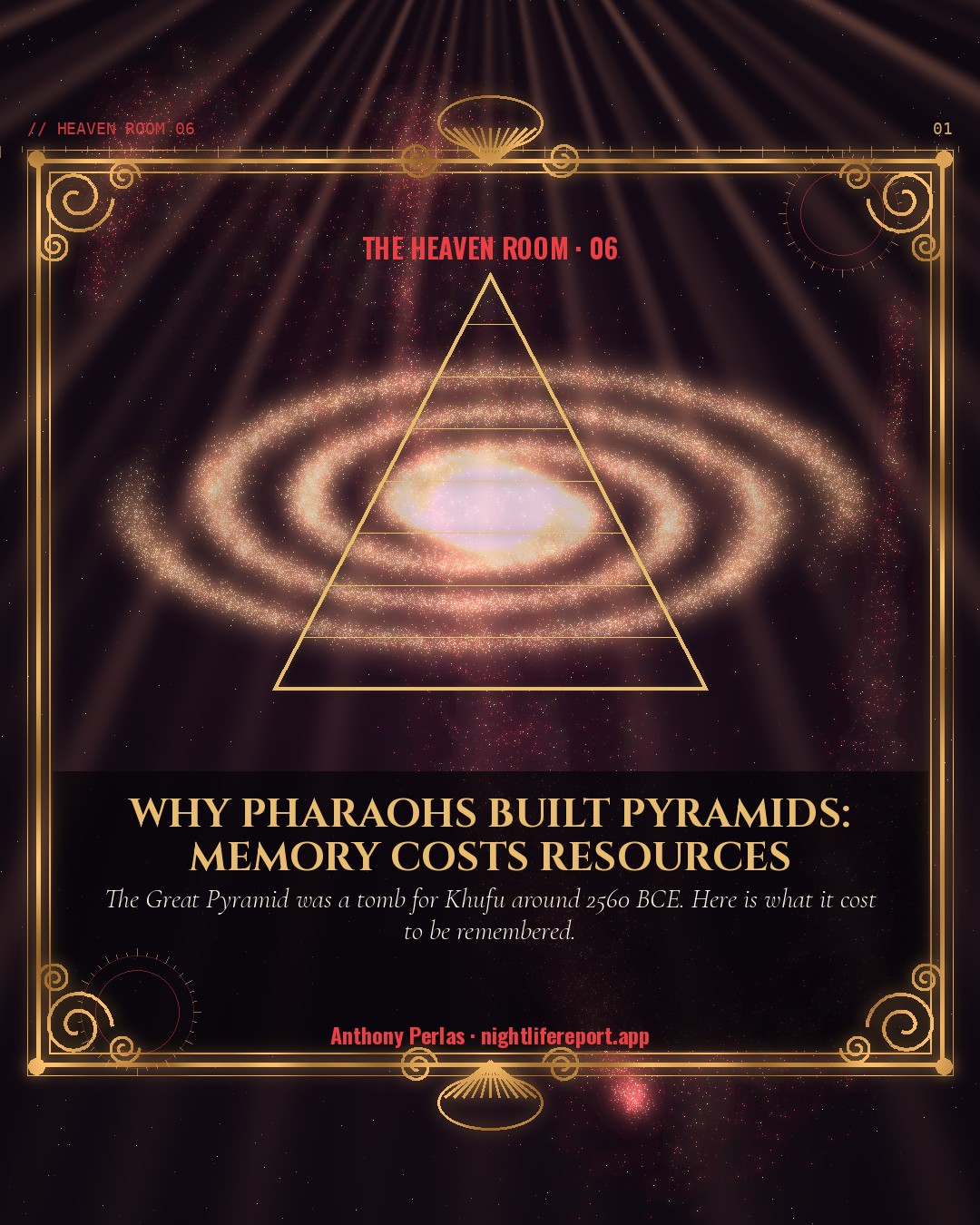
The Great Pyramid was a tomb for Khufu around 2560 BCE. Here is what it cost to be remembered.
The tomb
The Great Pyramid at Giza was built for the pharaoh Khufu of Egypt’s Fourth Dynasty, around 2560 BCE.
Step 1: the belief
Egyptians believed a person had a ka, a life force, and a ba, a personality. Both needed the body and the name to survive.
Step 2: the body
Mummification preserved the body so the ka could return to it. A destroyed body put the afterlife at risk.
Step 3: the name
The ren, or name, was part of the soul. Saying a dead person’s name kept them alive. Erasing it was a second death.
Step 4: the build
The pyramid holds an estimated 2.3 million stone blocks. It was the tallest human-made structure for about 3,800 years.
RelatedEach Planet Rides Its Own Plane
Step 5: the workers
Herodotus wrote of 100,000 workers. Excavations of the workers’ village at Giza suggest a paid, fed crew of perhaps 20,000 to 30,000.
Step 6: the economy
Bakeries, breweries and cattle fed the crew. A tomb required a whole state organized around one name.
Step 7: the offering
Priests were endowed to make offerings and speak the king’s name after death. Memory was a job with a budget.
Step 8: the result
The King’s Chamber held a granite sarcophagus. When explorers reached it, it was empty. Khufu’s body has never been found.
What lasted
The body is gone. The name survived. Khufu is remembered because a structure and a culture kept saying it.
Robbed in antiquity
Most Egyptian royal tombs were looted in ancient times. Treasure attracted thieves. Monuments and stories outlasted the gold.
The pattern
Being remembered takes labor, materials and organization. Pharaohs funded memory on purpose. Most people never do.
Anthony’s point
You will not get a pyramid. But you can build what the pyramid stood for: work so good that others keep your name alive.
Your blocks
Your blocks are finished work, people helped and stories others repeat. Lay one a day.
The takeaway
A name spoken by others outlasts a name kept alone. Build something people will want to keep saying.
First principles
Memory costs resources. Bodies decay; names spoken by others survive. Fund your legacy on purpose.
Sources
- Encyclopaedia Britannica, “Pyramids of Giza.”
- Wikipedia, “Great Pyramid of Giza” (height, blocks, empty sarcophagus).
- Mark Lehner and Zahi Hawass, Giza and the Pyramids (2017), workers’ village.
- Herodotus, Histories, Book 2.124.
- Britannica, “Ka” and “Ba” (Egyptian religion).
Part of Is There Room for You? The Heaven Room series.
Join the Heaven Room
Talk it through with the group on Discord. Support the series and get the full carousels on Patreon.
Anthony Perlas · nightlifereport.app
You might also like
 CultureThe Hand Span of God: Isaiah 40:12 Run as Math
 ExplainersPhotographers and Models Working for Drinks
 ExplainersOppression vs. Suppression: Know Which One Is Holding You Down
 ExplainersHow Tables Work in Los Angeles: Bottle Service at Poppy, Delilah and the h.wood Rooms
 NewsCoperni Shuts Down After Eight Years. What Happened Between the Founders and Their Distributor
 VideoWhy Thursday Is Jupiter’s Day: Dies Iovis and the Spiritual Forecast
Leave a Reply