
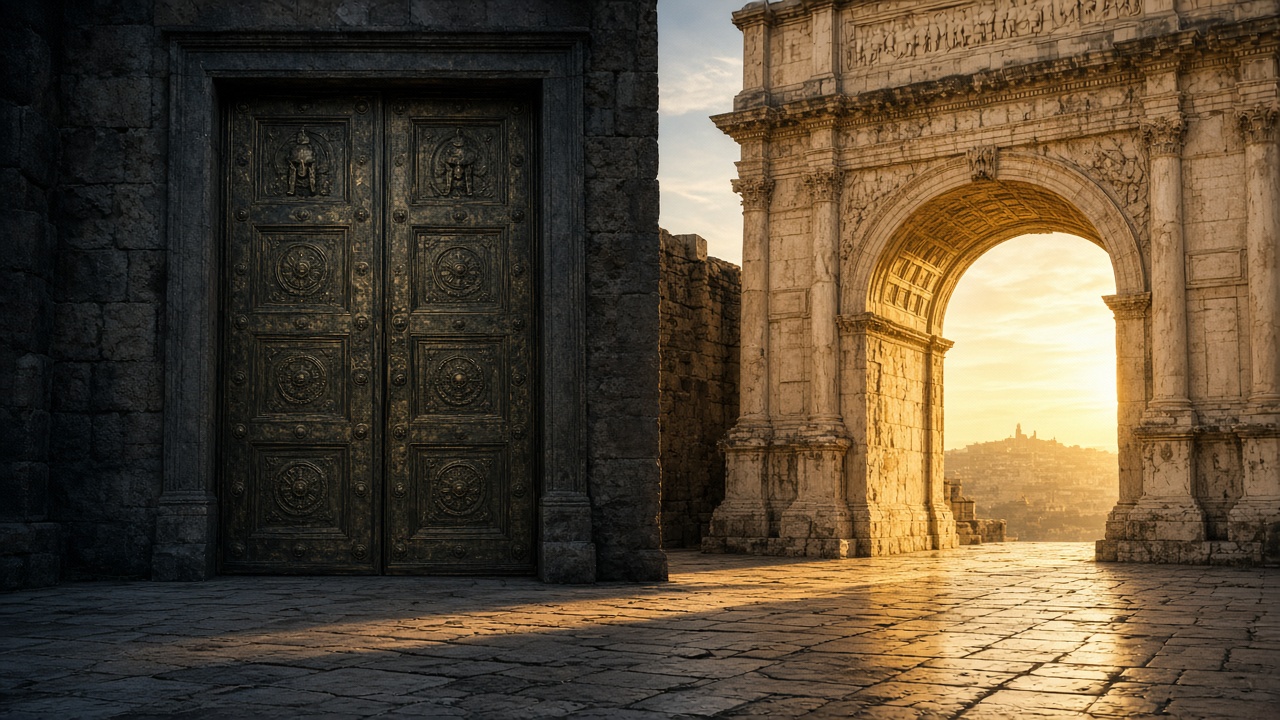
Two ancient cities ran the same experiment with opposite answers. Sparta guarded who could belong. Rome kept widening the circle. One shrank; the other lasted for centuries. The lesson carries over to any creative circle you build today.
What history and research show
- Sparta: Citizenship was hard to get and easy to lose, and land piled up in few hands. Aristotle blamed the resulting shortage of citizens (oliganthropia) for Sparta’s decline: a land that could support many fighting men had fewer than a thousand in his day (Politics 2.1270a; Hodkinson 2000). Sparta also periodically expelled foreigners (Thucydides 1.144; Plutarch, Lycurgus 27).
- Rome: Rome grew its manpower by folding allies and new citizens in. Polybius records a pool of roughly 700,000 infantry and 70,000 cavalry across Rome and its allies in 225 BC (Polybius 2.24). After the Social War of 91 to 88 BC, citizenship went to the Italian allies, and in AD 212 to nearly every free person in the empire (Beard, SPQR).
- A Roman said it himself: Arguing to admit Gallic nobles to the Senate in AD 48, the emperor Claudius said Sparta and Athens fell because they treated the conquered as outsiders, while Rome’s founder made enemies into citizens (Tacitus, Annals 11.24).
- Self-run commons: Groups that manage shared resources for generations tend to have clear membership, rules suited to local conditions, members who help make the rules, monitors accountable to members, graduated sanctions and cheap ways to settle conflict (Ostrom, Governing the Commons, 1990).
How to build one
- Start small: a chapter of 7 to 12 members. (Our suggestion, not a research finding.)
- Write it down: a one-page charter so membership and rules are clear (Ostrom’s first principle).
- Let members make the rules: those affected by a rule should have a say in changing it (Ostrom).
- Choose leaders on competence: elect them, then review after 60 days.
- Keep the door open: set a clear path for new people to join, the way Rome did.
- Hand off what you know: document it whenever a leader changes.
Unpopular opinion: Exclusive “inner circles” feel powerful and die fast. Open doors with clear rules outlast them.
Sources
- Aristotle, Politics 2.1270a. Perseus Digital Library
- Hodkinson, S. (2000). Property and Wealth in Classical Sparta. Duckworth / Classical Press of Wales.
- Thucydides 1.144. Perseus Digital Library
- Plutarch, Life of Lycurgus 27. LacusCurtius
- Polybius, Histories 2.24. LacusCurtius
- Tacitus, Annals 11.24. LacusCurtius
- Beard, M. (2015). SPQR: A History of Ancient Rome. Liveright.
- Ostrom, E. (1990). Governing the Commons. Cambridge University Press. doi:10.1017/CBO9780511807763
Lillith Magic · Directed by Anthony Perlas.
RelatedWhat You Missed: West Hollywood and Koreatown Halloween 2026, in the Rain
You might also like
 Field ReportsThe Nightlife Report Investigation: From the Free Gig to the Private Dinner, Identifying the Debauchery (Part Four)
 NewsSupreme x Vaquera Drops Today. Here’s What Is Actually in the Capsule
 NewsPalace Opened a Soho Flagship With a Burberry Capsule You Can Only Buy There
 GuidesThe 30-Minute Sunday Reset That Makes Monday Easier
 CultureWhy Pharaohs Built Pyramids: Memory Costs Resources
 VideoWhy Thursday Is Jupiter’s Day: Dies Iovis and the Spiritual Forecast
Leave a Reply